|
Page
number |
Transcription |
Thumbnail |
| Cover |
MANUAL
OF GUARD DUTY,
UNITED STATES ARMY. |
 |
| Title page |
MANUAL
OF
GUARD DUTY,
UNITED STATES
ARMY.
___________
APPROVED JUNE 14, 1902.
___________
WASHINGTON:
GOVERNMENT PRINTING OFFICE
1902.
|
 |
| II |
WAR DEPARTMENT,
ADJUTANT GENERAL'S OFFICE
Document No. 167.
|
 |
| III |
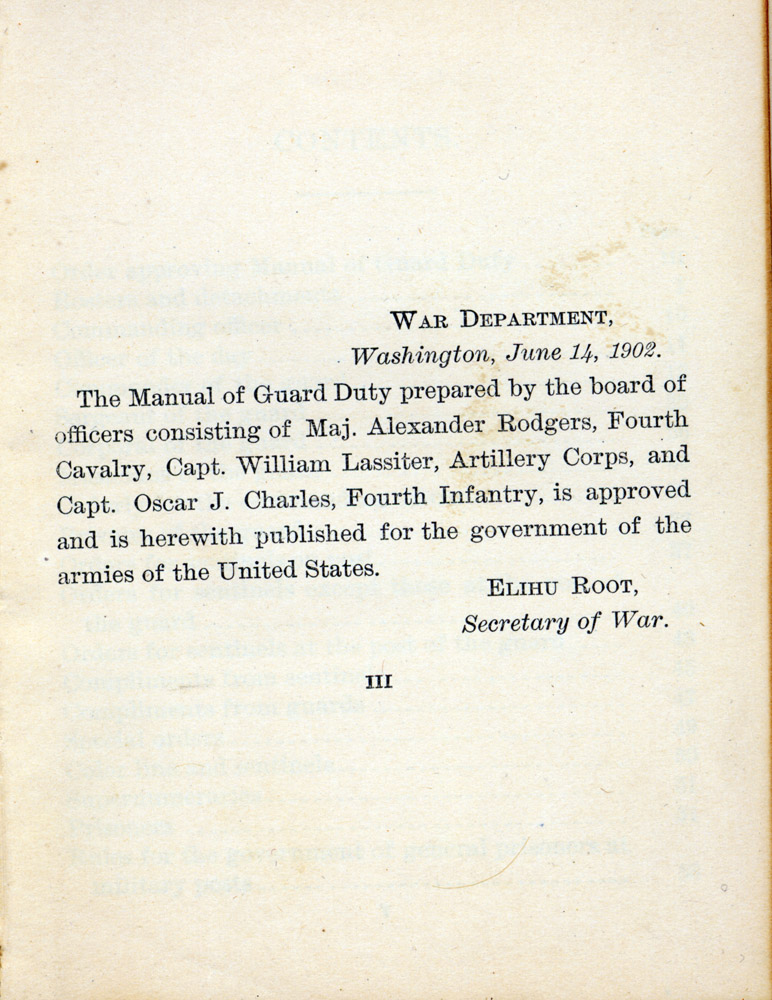
WAR DEPARTMENT,
Washington, June 14, 1902.
The Manual of Guard Duty prepared by the
board of officers consisting of Maj. Alexander Rodgers, Fourth Cavalry,
Capt. William Lassiter, Artillery Corps, and Capt. Oscar J. Charles,
Fourth Infantry, is approved and is herewith published for the government
of the armies of the United States.
ELIHU ROOT,
Secretary of War. |
 |
| IV |
Blank page.
|
Blank. |
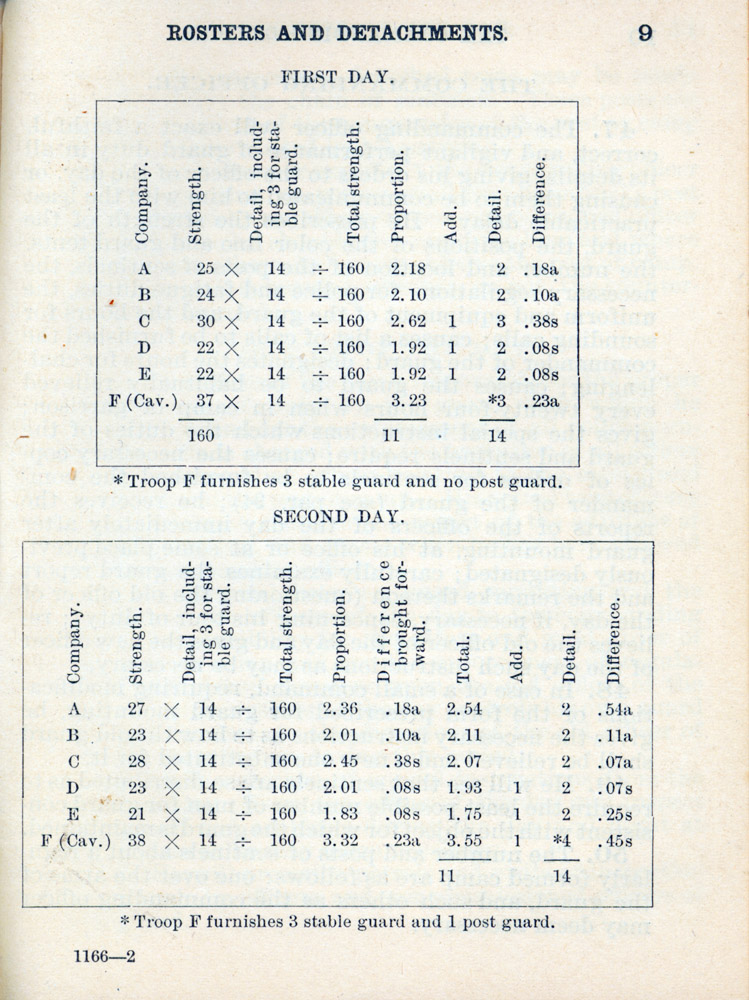
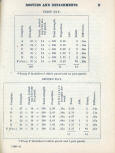
| V |
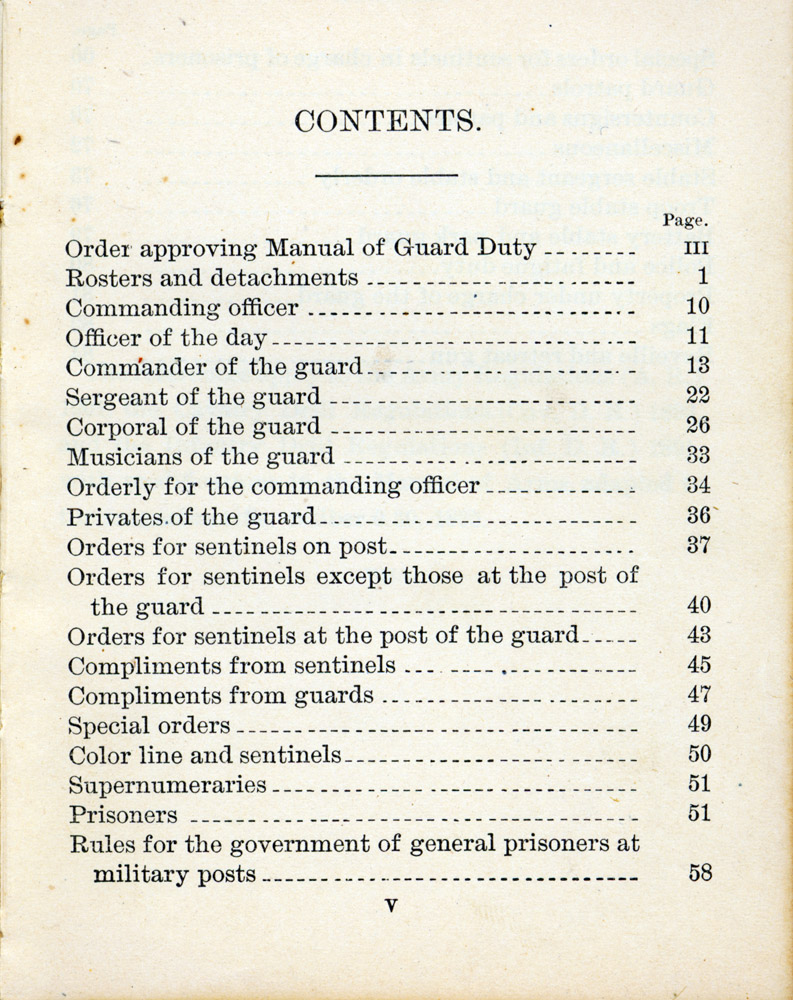
CONTENTS.
______________
Page
Order approving Manual of Guard Duty
___________________________________________ III
Rosters and detachments
______________________________________________________ 1
Commanding officer
__________________________________________________________ 10
Officer of the day
____________________________________________________________ 11
Commander of the guard
_______________________________________________________ 13
Sergeant of the guard
__________________________________________________________ 22
Corporal of the guard
__________________________________________________________ 26
Musicians of the guard
_________________________________________________________ 33
Orderly for the commanding officer
________________________________________________ 34
Privates of the guard
__________________________________________________________ 36
Orders for sentinels on post.
____________________________________________________ 37
Orders for sentinels except those at the post of the guard
_______________________________ 40
Orders for sentinels at the post of the guard
________________________________________ 43
Compliments from sentinels
_____________________________________________________ 45
Compliments from guards
______________________________________________________ 47
Special orders
______________________________________________________________ 49
Color line and sentinels
________________________________________________________ 50
Supernumeraries
____________________________________________________________ 51
Prisoners
__________________________________________________________________
51
Rules for the government of general prisoners at military posts
__________________________ 58 |
 |
| VI |
Page.
Special orders for sentinels in charge of
prisoners ___________________________________ 66
Guard patrols
______________________________________________________________ 70
Countersigns and paroles
______________________________________________________ 70
Miscellaneous
______________________________________________________________ 72
Stable sergeant and stable orderly
________________________________________________ 73
Troop stable guard
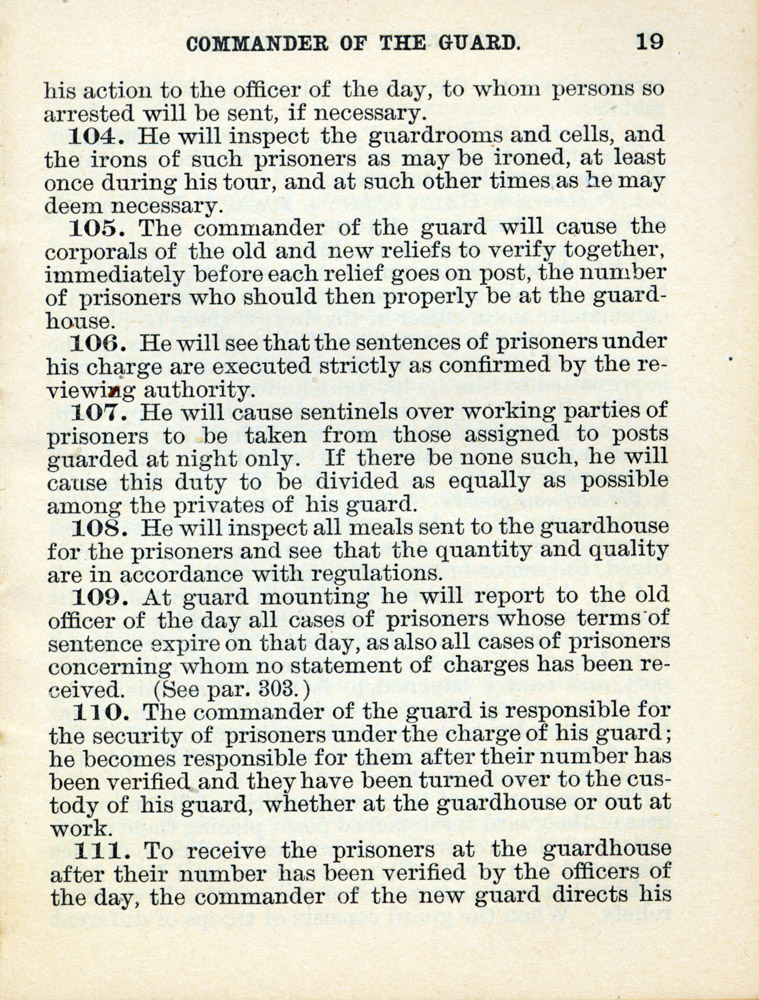
___________________________________________________________ 76
Battery stable and park
guard____________________________________________________ 79
Police and fatigue
duty_________________________________________________________ 80
Property under charge of the guard
_______________________________________________ 81
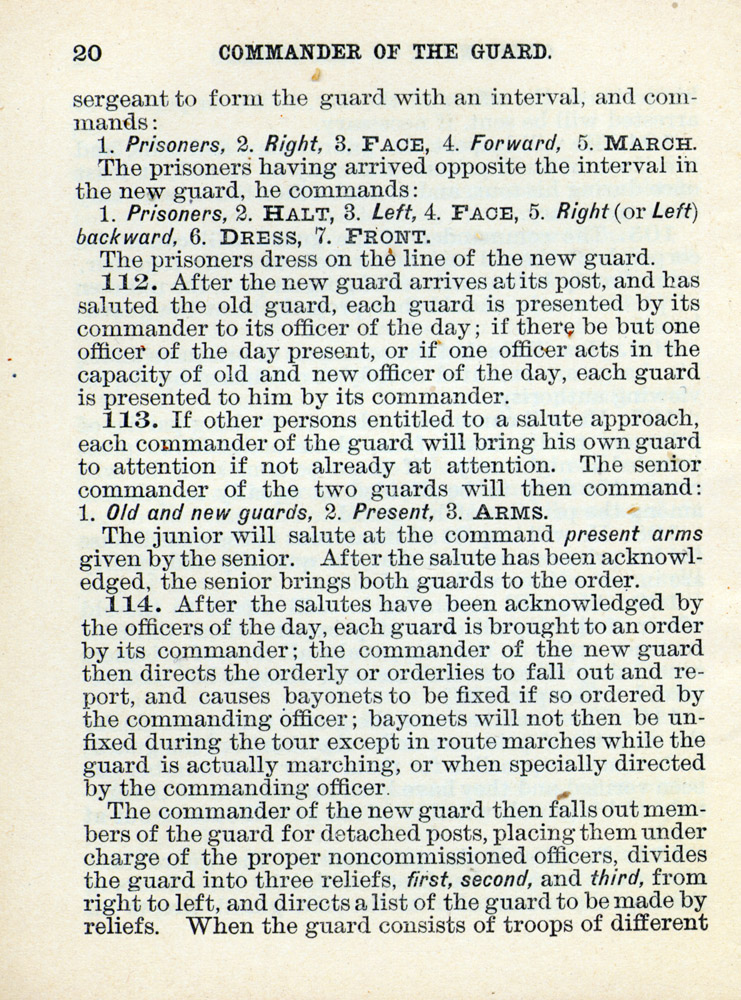
Flags
________________________]____________________________________________
82
Reveille and retreat gun
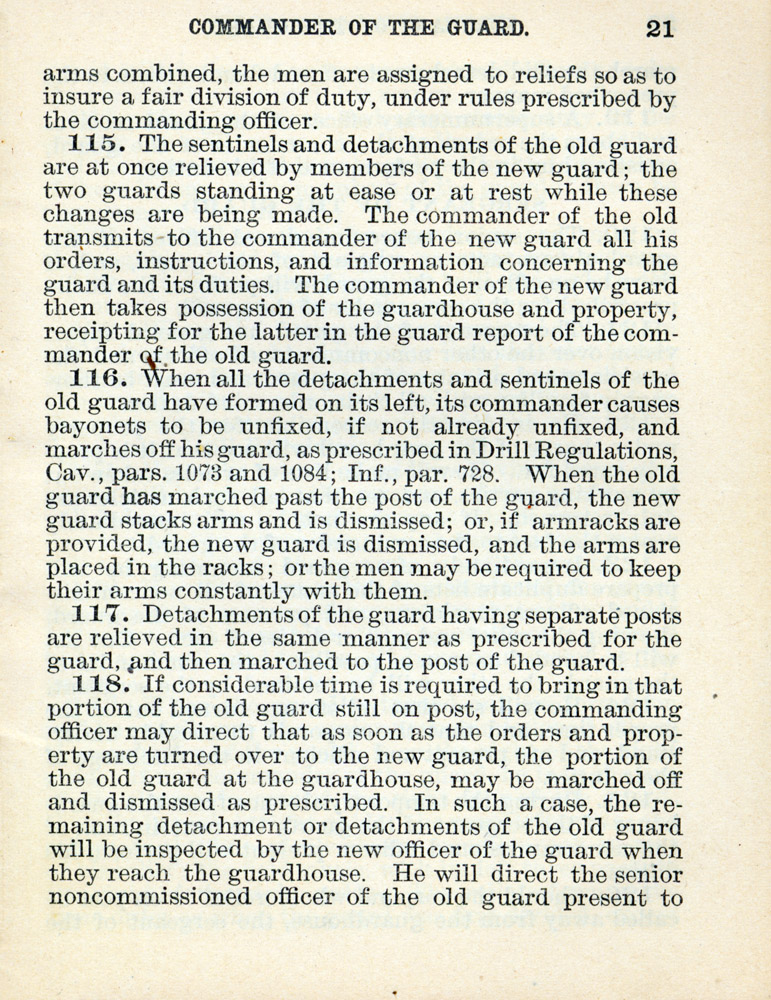
_______________________________________________________ 84 |
 |
| VII |
The references apply to the Army
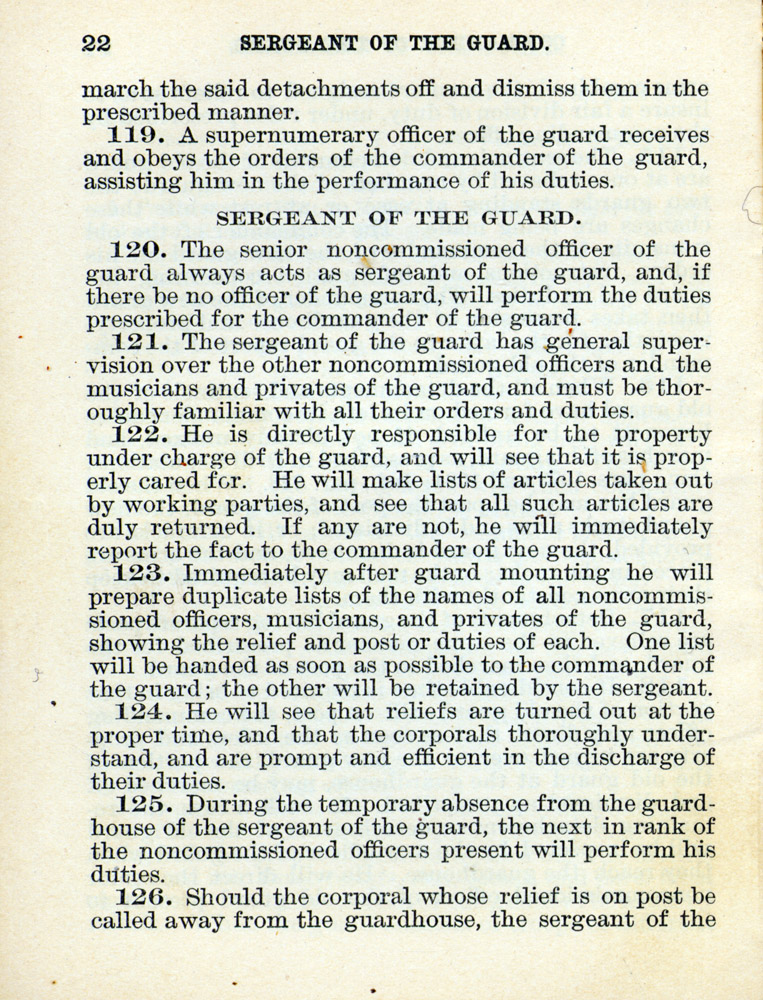
Regulations (A. R.) 1901, the Cavalry Drill Regulations (Cav. D. R.) 1896,
and the Infantry Drill Regulations (Inf. D. R.) 1891, with modifications
in the Manual of Arms, adapted to the magazine rifle, caliber 0.30, 1895. |
 |
| 1 |
MANUAL OF GUARD DUTY.
______________
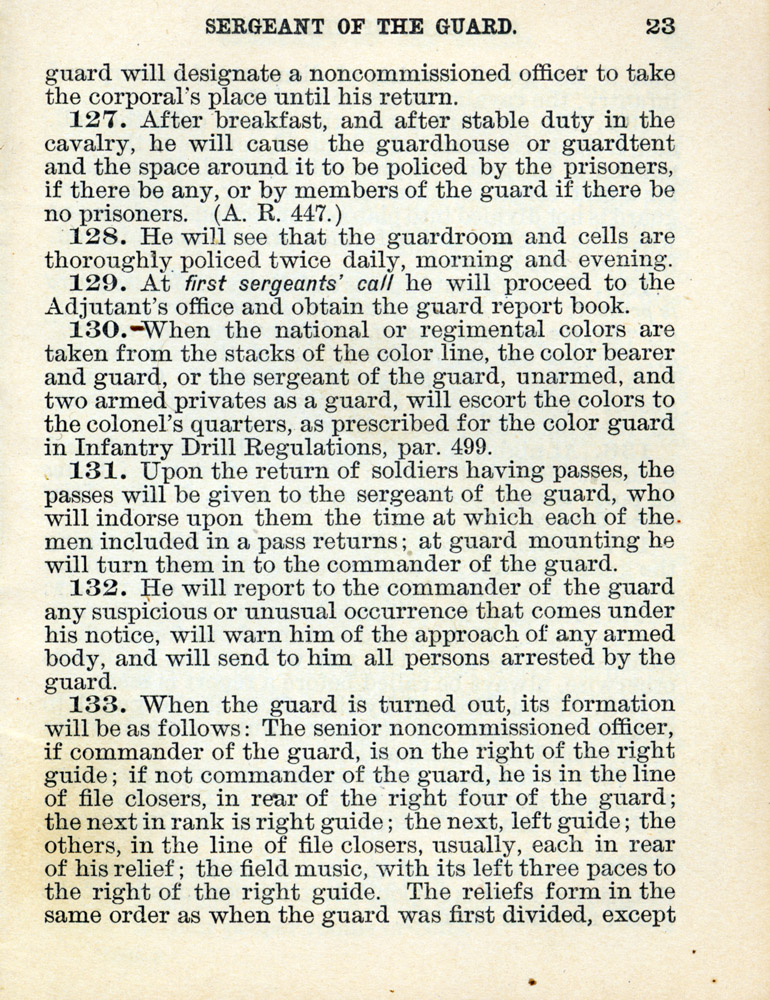
ROSTERS AND DETACHMENTS.
1. A roster is a list of officers
or men for duty, with a record of the duty performed by each. Generally,
details for duty are so made that the one longest off is the first for
detail. Details so made are said to be made by roster. (A. R. 423.)
2. All details for service in garrison and in the field,
except the authorized special and extra-duty details, will be by roster;
but officers or enlisted men, when detailed, must serve whether a roster
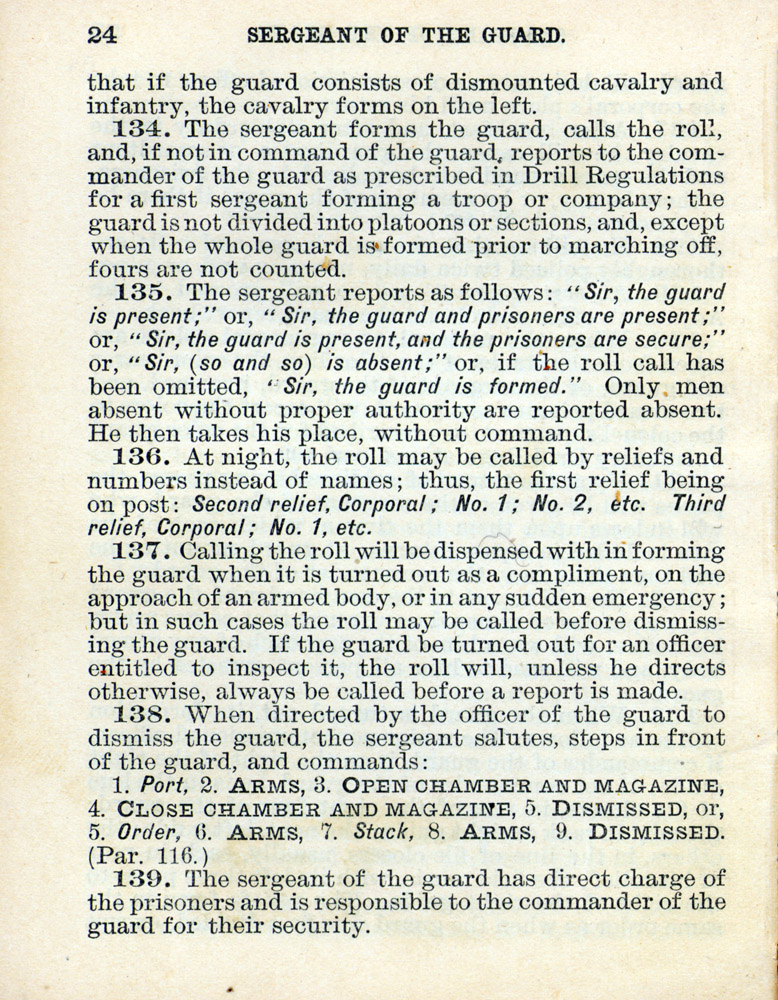
be kept or not. Haying performed the service, they may appeal to superior
authority if they deem themselves aggrieved. (A. R. 424.)
3. The duties performed by roster are of two classes. The
first comprises (1) outposts; (2) interior guards, including stable
guards; (3) detachments to protect laborers on military works; (4) armed
working parties on such works. The second comprises all other duties and
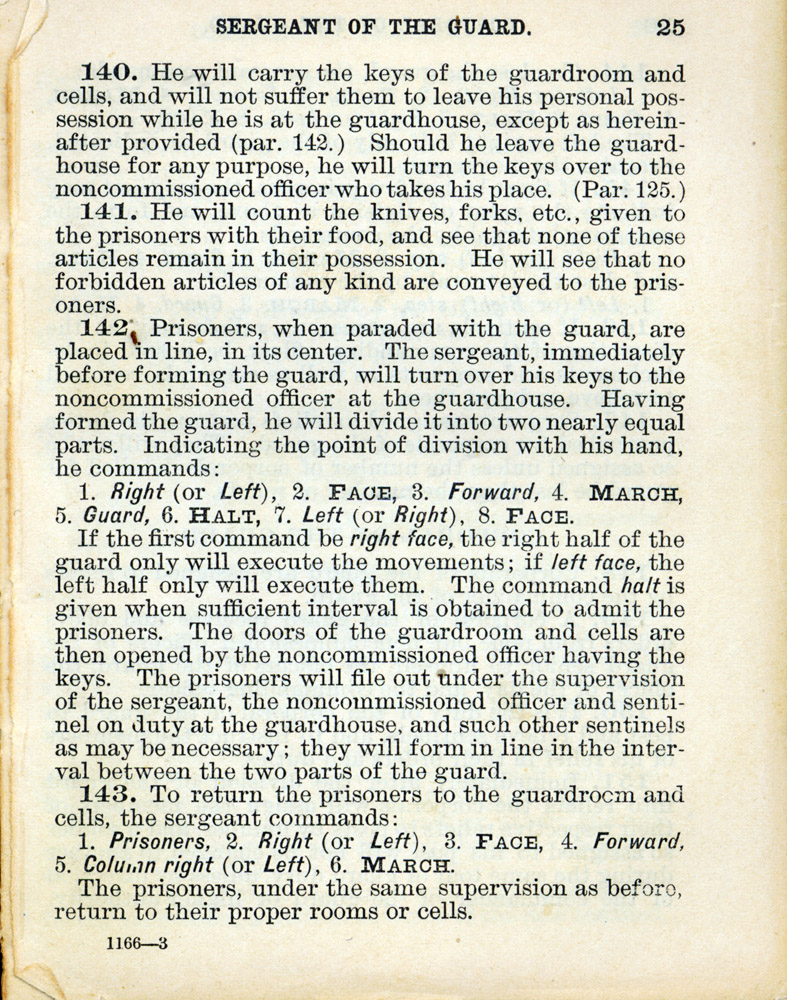
fatigue, in or out of the garrison or camp. (A. R. 425.)
4. The rosters are distinct for each class. Officers are named
on them in the order of rank. Details are made in succession according to
roster, beginning at the head. (A. R. 426.)
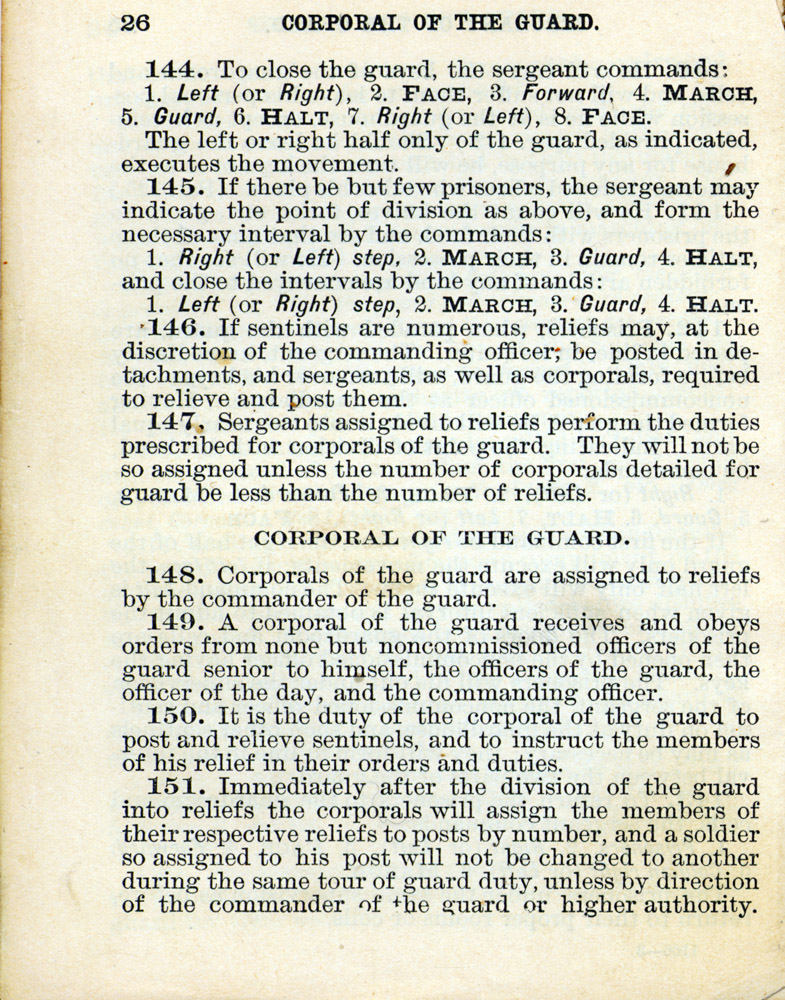
5. Lieutenant colonels and majors are on one roster, and may
be detailed when the importance of the duty requires it. In the field
their roster is kept at division and brigade headquarters. Captains form
one roster and are exempt from ordinary fatigue duties. A captain |
 |
| 2 |
commanding a battalion is exempt from detail,
and duty falling to him passes. Lieutenants form one roster and first and
second lieutenants are entered alternately. Sergeants, corporals,
musicians, and privates form distinct rosters. (A. B. 427.)
6. Officers, noncommissioned officers, and privates take
duties of the first class in the order stated, viz: The first for detail
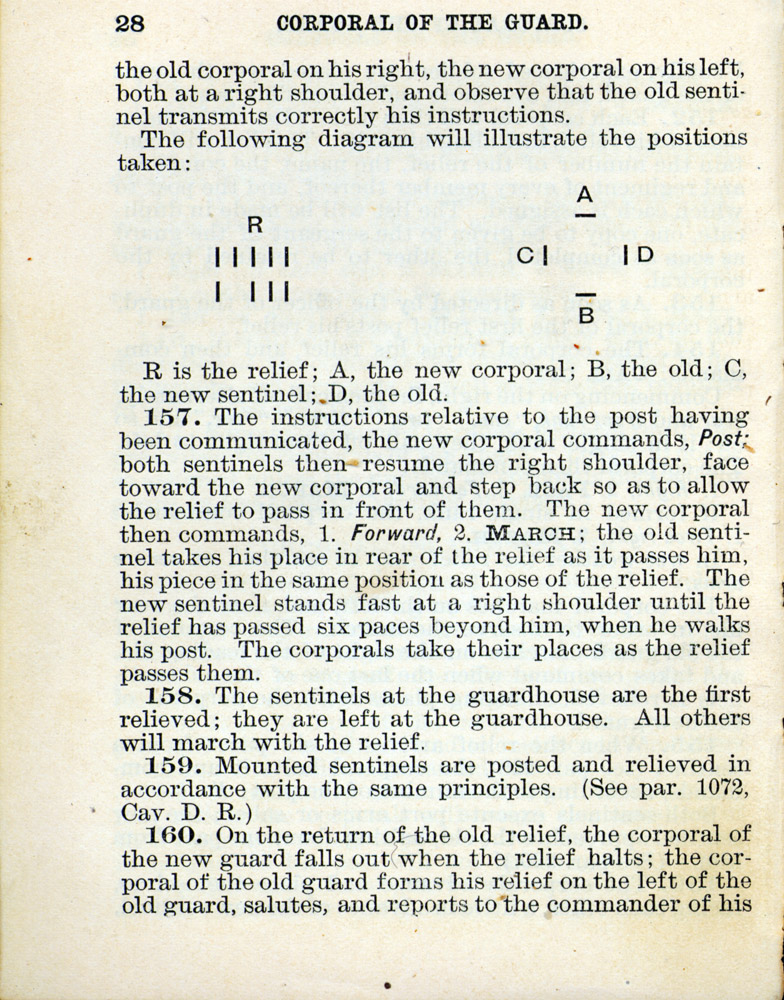
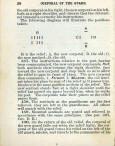
takes the outposts; the next the interior guards, and so on. In those of
the second class the senior officer takes the largest party. The party
first for detail takes the service out of camp. (A. R. 428.)
7. When an officer has been detailed and is not present or
available at the hour of marching, the next after him takes the duty. When
an outpost has passed the chain of sentinels, or an interior guard has
reached its post, the officer whose tour it was can not take it unless so
ordered by the commanding officer, but succeeds to the tour of the officer
who has taken his. (A. R. 430. )
8. Duties of the first class are credited on the roster when
the guards or detachments have passed the chain of sentinels, or an
interior guard has reached its post; other duties, when the parties have
entered upon their performance. (A. R. 431.)
9. In making details by roster, an officer or enlisted man is
each day charged with the number of days that he has remained present and
available since the beginning of his last tour. Departures from this rule
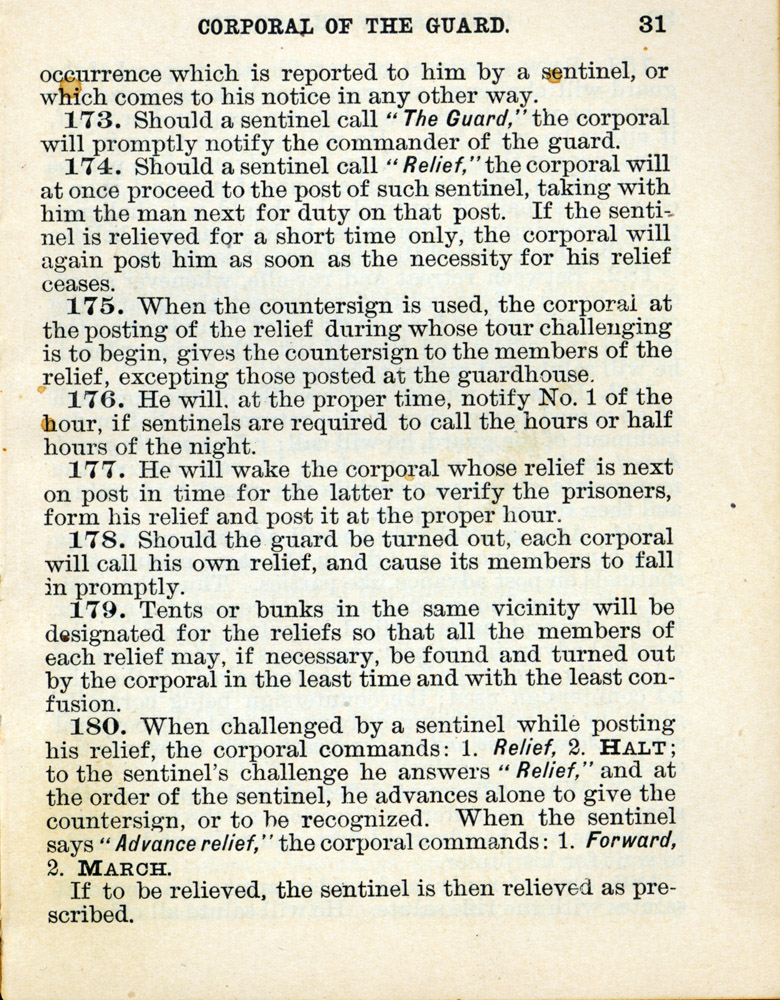
may be authorized by the commanding officer whenever a strict application
would allow improper advantage or work hardship. (A. R. 429.)
10. An officer or enlisted man on duty of the first class, or
who is next for detail for such duty, is available, when relieved, for
duty of the second class that has fallen to him during that time. Except
in emergencies, no duty will be required of the old officer of the day or
the old guard until four hours after they have been relieved. (A. R. 432.) |
 |
| 3 |
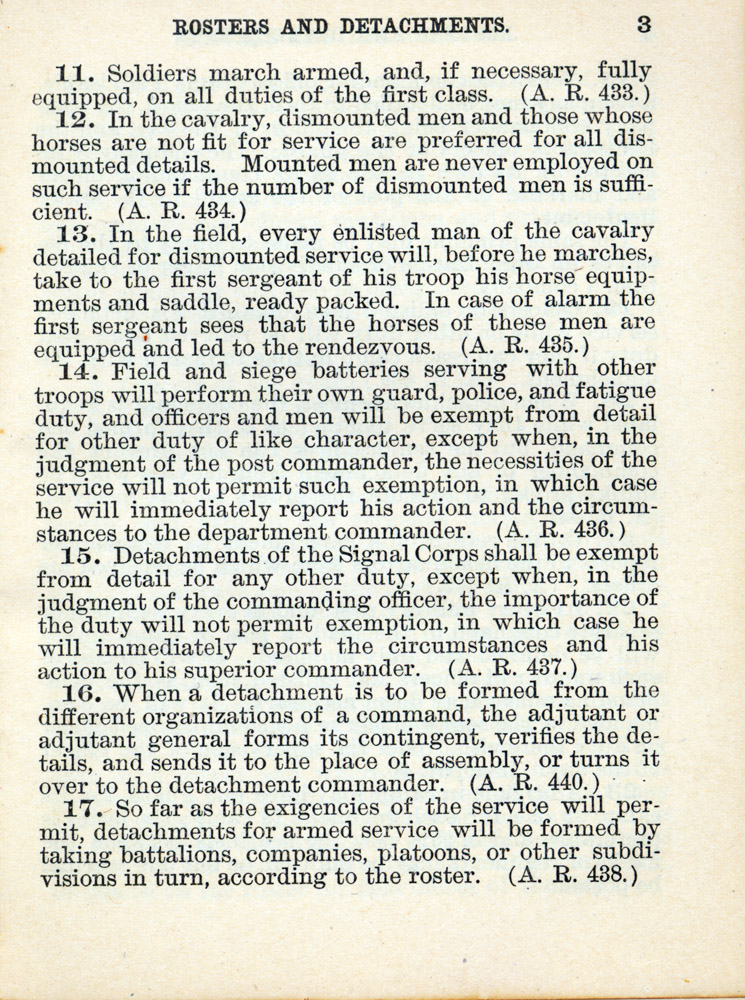
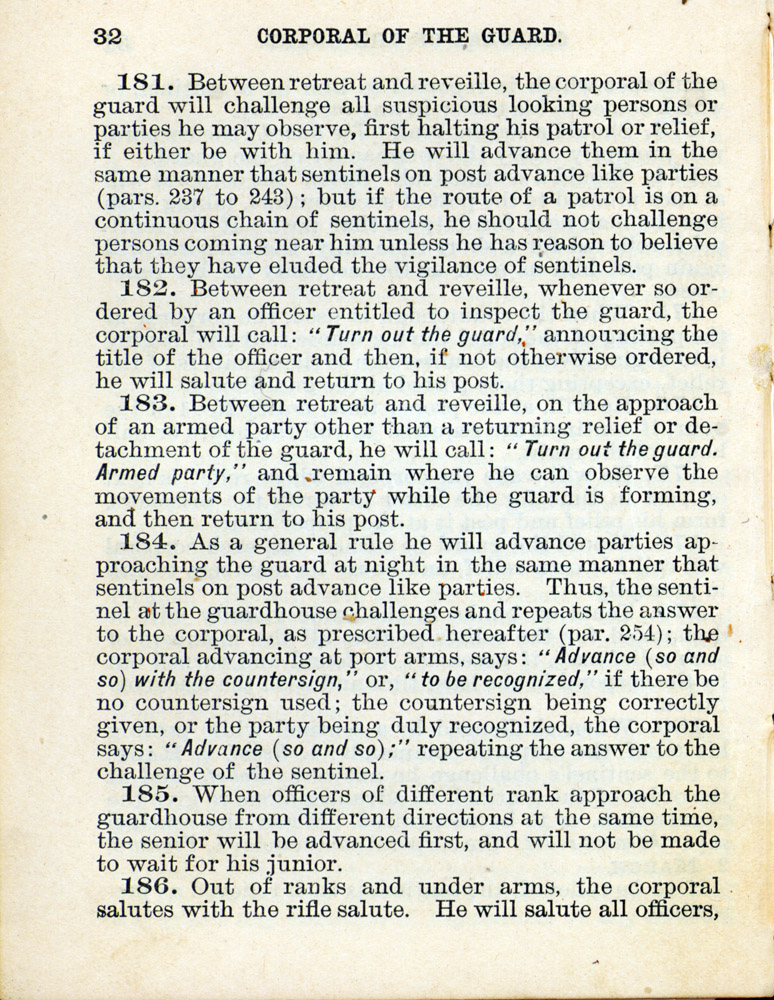
11. Soldiers inarch armed, and,
if necessary, fully equipped, on all duties of the first class. (A. R.
433.)
12. In the cavalry, dismounted men and those whose horses are
not fit for service are preferred for all dismounted details. Mounted men
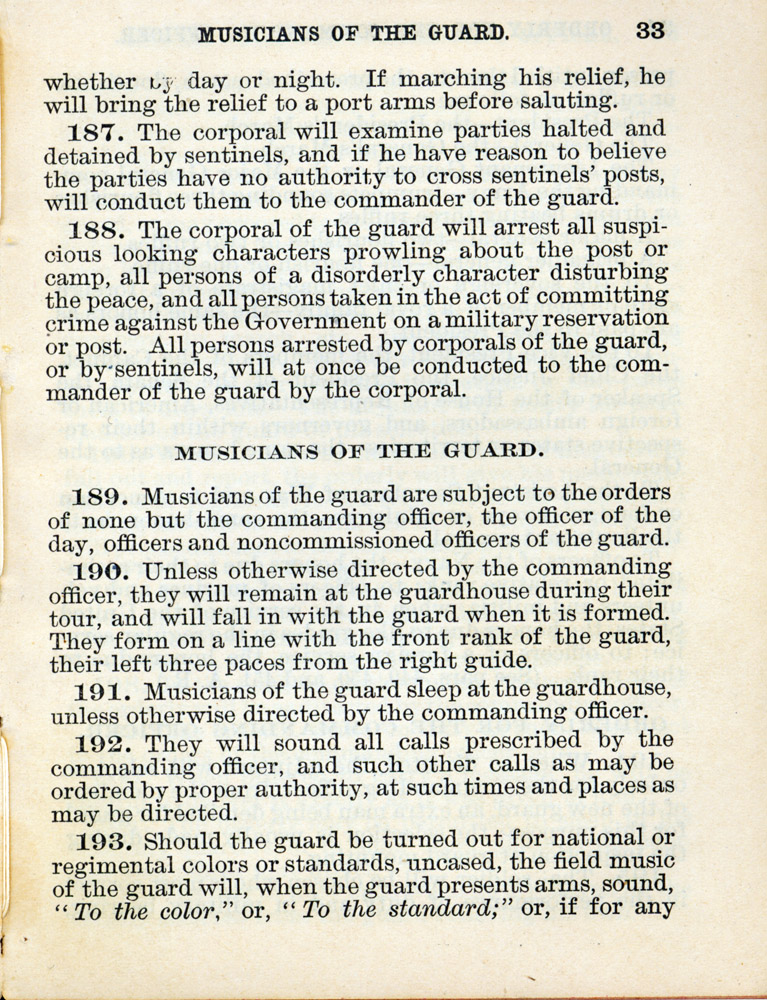
are never employed on such service if the number of dismounted men is
sufficient. (A. R. 434.)
13. In the field, every enlisted man of the cavalry detailed
for dismounted service will, before he marches, take to the first sergeant
of his troop his horse equipments and saddle, ready packed. In case of
alarm the first sergeant sees that the horses of these men are equipped
and led to the rendezvous. (A. R. 435.)
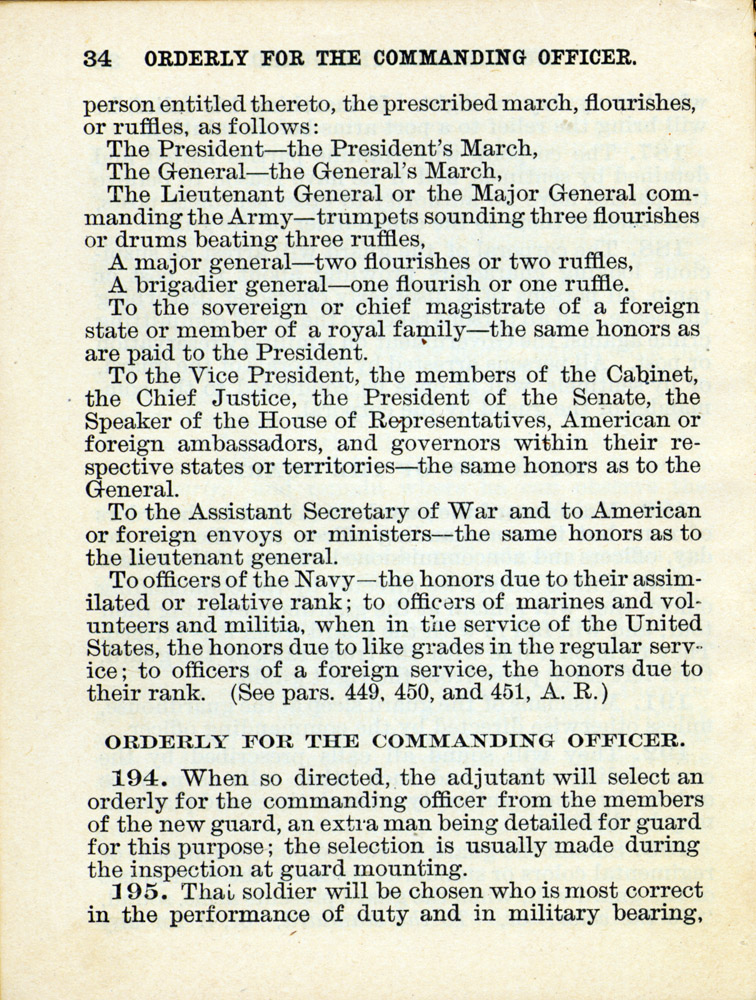
14. Field and siege batteries serving with other troops will
perform their own guard, police, and fatigue duty, and officers and men
will be exempt from detail for other duty of like character, except when,
in the judgment of the post commander, the necessities of the service will
not permit such exemption, in which case he will immediately report his
action and the circumstances to the department commander. (A. R. 436.)
15. Detachments of the Signal Corps shall be exempt from
detail for any other duty, except when, in the judgment of the commanding
officer, the importance of the duty will not permit exemption, in which
case he will immediately report the circumstances and his action to his
superior commander. (A. R. 437.)
16. When a detachment is to be formed from the different
organizations of a command, the adjutant or adjutant general forms its
contingent, verifies the details, and sends it to the place of assembly,
or turns it over to the detachment commander. (A. R. 440.)
17. So far as the exigencies of the service will permit,
detachments for armed service will be formed by taking battalions,
companies, platoons, or other subdivisions in turn, according to the
roster. (A. R. 438.) |
 |
| 4 |
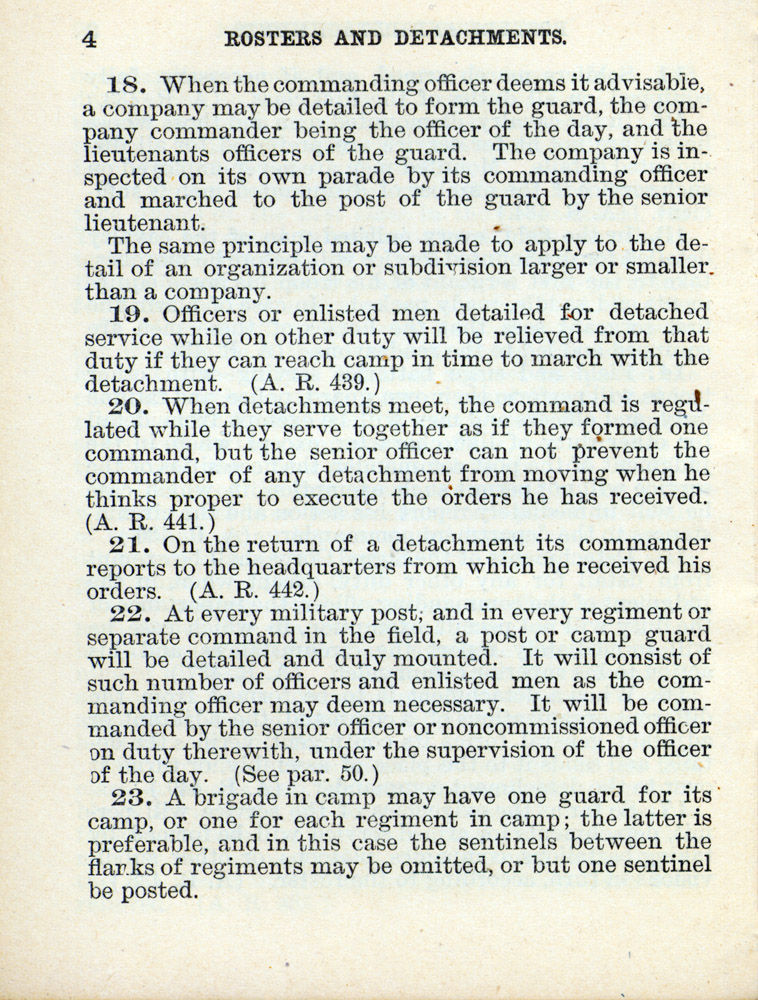
18. When the commanding officer
deems it advisable, a company may be detailed to form the guard, the
company commander being the officer of the day, and the lieutenants
officers of the guard. The company is inspected on its own parade by its
commanding officer and marched to the post of the guard by the senior
lieutenant.
The same principle may be made to apply to the detail of an
organization or subdivision larger or smaller, than a company.
19. Officers or enlisted men detailed for detached service
while on other duty will be relieved from that duty if they can reach camp
in time to inarch with the detachment. (A. R. 439.)
20. When detachments meet, the command is regulated while
they serve together as if they formed one command, but the senior officer
can not prevent the commander of any detachment from moving when he thinks
proper to execute the orders he has received. (A. R. 441.)
21. On the return of a detachment its commander reports to the
headquarters from which he received his orders. (A. R. 442.)
22. At every military post, and in every regiment or separate
command in the field, a post or camp guard will be detailed and duly
mounted. It will consist of such number of officers and enlisted men as
the commanding officer may deem necessary. It will be commanded by the
senior officer or noncommissioned officer on duty therewith, under the
supervision of the officer of the day. (See par. 50.)
23. A brigade in camp may have one guard for its camp, or one
for each regiment in camp; the latter is preferable, and in this case the
sentinels between the flanks of regiments may be omitted, or but one
sentinel be posted. |
 |
| 5 |
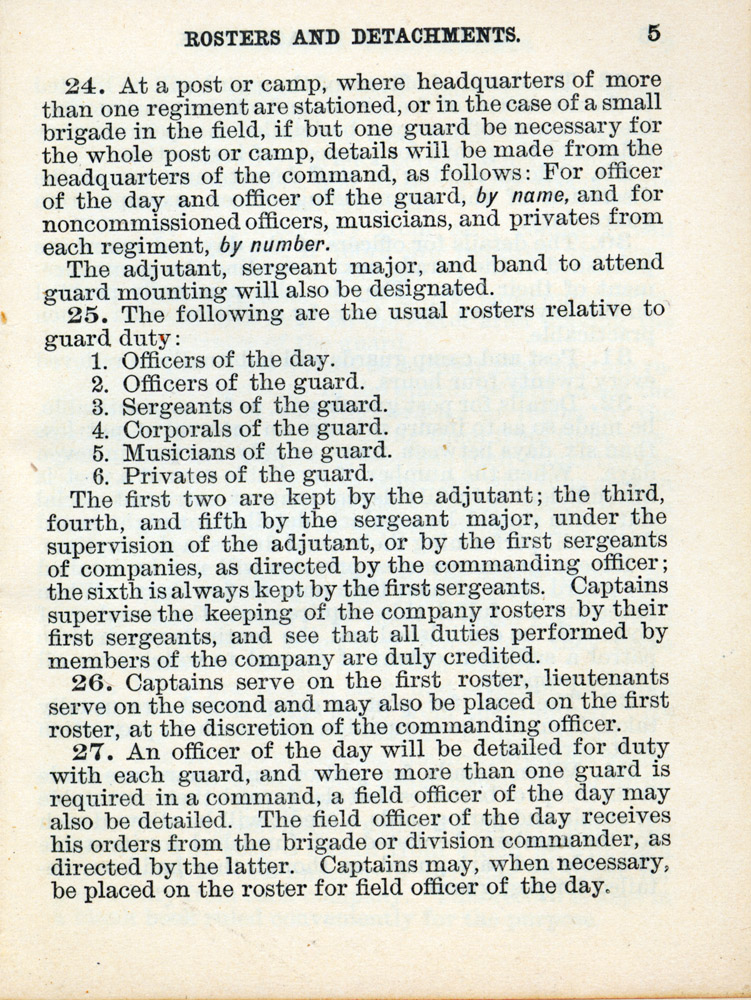
24. At a post or camp, where
headquarters of more than one regiment are stationed, or in the case of a
small brigade in the field, if but one guard be necessary for the whole
post or camp, details will be made from the headquarters of the command,
as follows: For officer of the day and officer of the guard, by name, and
for noncommissioned officers, musicians, and privates from each regiment,
by number.
The adjutant, sergeant major, and band to attend guard mounting will
also be designated.
25. The following are the usual rosters relative to guard
duty:
1. Officers of the day.
2. Officers of the guard.
3. Sergeants of the guard.
4. Corporals of the guard.
5. Musicians of the guard.
6. Privates of the guard.
The first two are kept by the adjutant; the third, fourth, and fifth
by the sergeant major, under the supervision of the adjutant, or by the
first sergeants of companies, as directed by the commanding officer; the
sixth is always kept by the first sergeants. Captains supervise the
keeping of the company rosters by their first sergeants, and see that all
duties performed by members of the company are duly credited.
26. Captains serve on the first roster, lieutenants serve on
the second and may also be placed on the first roster, at the discretion
of the commanding officer.
27. An officer of the day will be detailed for duty with each
guard, and where more than one guard is required in a command, a field
officer of the day may also be detailed. The field officer of the day
receives his orders from the brigade or division commander, as directed by
the latter. Captains may, when necessary, be placed on the roster for
field officer of the day. |
 |
| 6 |
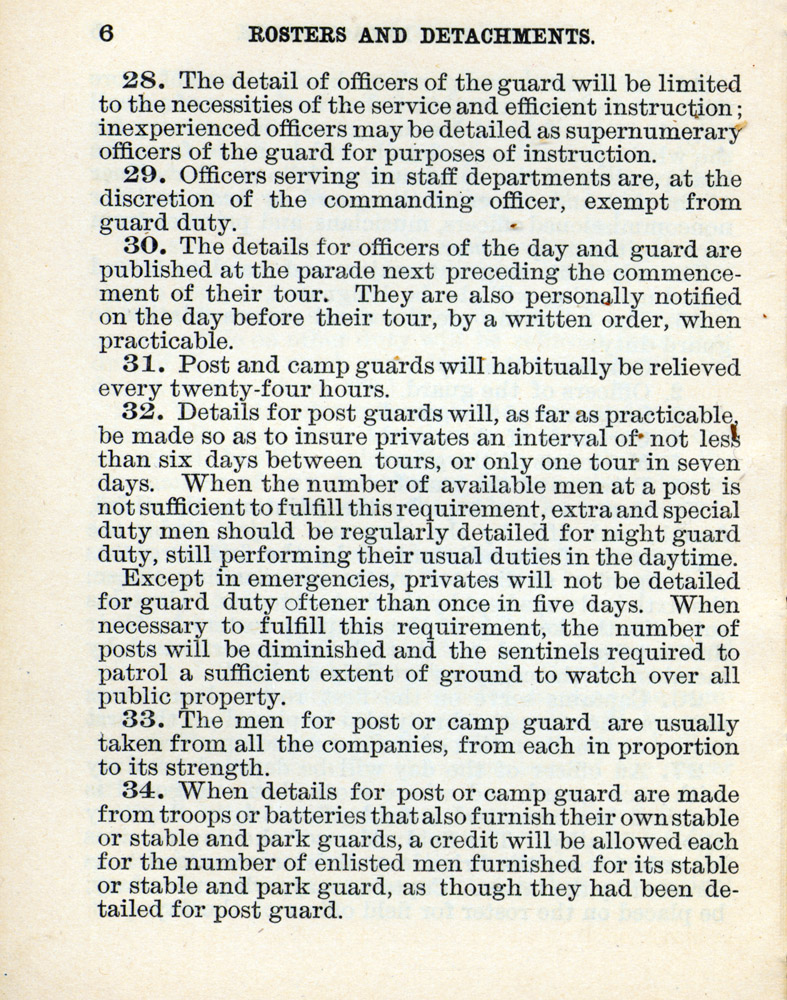
28. The detail of officers of the
guard will be limited to the necessities of the service and efficient
instruction; inexperienced officers may be detailed as supernumerary
officers of the guard for purposes of instruction.
29. Officers serving in staff departments are, at the
discretion of the commanding officer, exempt from guard duty.
30. The details for officers of the day and guard are
published at the parade next preceding the commencement of their tour.
They are also personally notified on the day before their tour, by a
written order, when practicable.
31. Post and camp guards will habitually be relieved every
twenty-four hours.
32. Details for post guards will, as far as practicable, be
made so as to insure privates an interval of not less than six days
between tours, or only one tour in seven days. When the number of
available men at a post is not sufficient to fulfill this requirement,
extra and special duty men should be regularly detailed for night guard
duty, still performing their usual duties in the daytime.
Except in emergencies, privates will not be detailed for guard duty
oftener than once in five days. When necessary to fulfill this
requirement, the number of posts will be diminished and the sentinels
required to patrol a sufficient extent of ground to watch over all public
property.
33. The men for post or camp guard are usually taken from all
the companies, from each in proportion to its strength.
34. When details for post or camp guard are made from troops
or batteries that also furnish their own stable or stable and park guards,
a credit will be allowed each for the number of enlisted men furnished for
its stable or stable and park guard, as though they had been detailed for
post guard. |
 |
| 7 |
35. Special details for herd
guard will be credited on the roster for fatigue duty.
36. The stable sergeant and stable orderly are detailed on
special duty, for such periods as may be directed by troop commanders, and
while on this special duty are not subject to detail for guard.
37. One supernumerary from each company will usually be
detailed; if more are required, the commanding officer fixes the number.
38. First sergeants, in detailing supernumeraries, will take
the men next on the roster after making the detail for privates of the
guard.
39. Should the adjutant be notified that men are required to
fill vacancies in the guard, he will cause the proper number of
supernumeraries to report to the commander of the guard, taking them from
those companies that have furnished less than their proportionate part of
the guard. A supernumerary who thus goes on guard will be credited on the
company roster with a tour of guard duty as if he had been detailed as a
private of the guard.
40. At first sergeants' call, all the first sergeants repair
to headquarters and take from the bulletin board all the data necessary
for them to make the required details from their respective companies;
they make their details accordingly from their rosters.
41. When practicable, each first sergeant publishes at retreat
all the details made from the company. He will also post them on the
company bulletin board.
42. The method of keeping the first sergeants' roster is shown
in the model duty roster issued by the Adjutant General of the Army.
43. The sergeant major, under the supervision of the adjutant,
will keep a record from, which he will each day determine the number of
privates required for guard duty from each company. This record is kept in
a blank book ruled conveniently for the purpose. |
 |
| 8 |
44. If noncommissioned officers
and musicians are not detailed by name from rosters kept by the sergeant
major, lie determines, in a similar manner, the number of each to be
detailed. He will post on a bulletin board in his office all data required
by the first sergeants in making details from their respective companies,
giving the names of those detailed by name.
45. The sergeant major determines the number of privates to be
detailed from each company by the following rules: Take the number of
privates for duty in each company from its morning report for the day next
preceding that on which the tour of duty is to commence, deducting
details for detached service of over twenty-four hours, made after the
morning report has been received; the total of these gives the total
number of privates available. Then: The total strength is to the strength
of a company as the total detail is to the detail from the company.
Multiply the total detail by the strength of the company, and divide the
result by total strength; carry out to two places of decimals,
disregarding all smaller fractions. This rule is applied for each
company.
The whole numbers in the results thus obtained are added together,
and if the total is less than the total detail required, add one to the
whole number in the result that has the largest fraction, and so on for
each company till the required total is obtained.
46. There will thus be a difference between the exact
proportion and the number detailed from each company; this difference is
carried forward to the next day's proportion, to be added if a company has
furnished less, or to be subtracted if a company has furnished more than
its exact proportion, thus: |
 |
| 9 |
[Two charts.] ROSTERS AND DETACHMENTS
First Day
Second Day |
 |
| 10 |
THE COMMANDING OFFICER.
47. The commanding officer will
exact a faithful, correct, and vigilant performance of guard duty in all
its details, giving his orders to the officer of the day, or causing them
to be communicated to him with the least practicable delay. He prescribes
the strength of the guard, the positions of the color link and guard
tents, the number and location of the posts of sentinels, the necessary
regulations for police and fatigue duties, the uniform and equipment of
the guard, and the hours for sounding calls; causes a list of calls to be
furnished the commander of the guard; designates the hours for
challenging; causes the guard to be habitually relieved every twenty-four
hours when' in camp or garrison\ gives the special instructions which the
duties of the guard and sentinels require; causes the necessary copies of
orders for sentinels to be furnished the commander of the guard (see par.
94); he receives the reports of the officers of the day immediately after
guard mounting, at his office or at some place previously designated;
carefully examines the guard report and the remarks thereon (questioning
the old officer of the day, if necessary, concerning his tour of duty);
relieves the old officer of the day and gives the new officer of the day
such instructions as may be necessary.
48. In case of a small command, requiring modifications of
the form prescribed for guard mounting, he gives the necessary
instructions as to how the old guard shall be relieved and a new one
substituted for it.
49. He will see that sentinels are so distributed as to
require the least possible number of men for guard consistent with the
object for which the guard is maintained.
50. The number and posts of sentinels about a regularly
formed camp are as follows: one over the arms of the guard, and such
others as the commanding officer may deem necessary. |
 |
| 11 |
51. When necessary, detached
posts may be established outside the chain of sentinels. These posts are
under the orders of the commander of the post or camp guard, and are
visited by his patrols.
52. If necessary or expedient, the commanding officer may
require that no person shall pass a sentinel's post unless passed by an
officer or noncommissioned officer of the guard; he should also prescribe
how and where soldiers and others shall enter or leave the post or camp.
53. He will determine whether, or not, the countersign shall
be used.
OFFICER OF THE DAY.
54. The officer of the day is
responsible for the proper performance of duty by the guard with which he
marches on and for the enforcement of all police regulations. He is
charged with the execution of all orders of the commanding officer
relating to the safety and good order of the post or camp. His actual tour
of duty begins when he receives the report of the adjutant at guard
mounting, and ceases when he has been relieved by the commanding officer.
In the interval between guard mounting and the reports of the
officers of the day to the commanding officer, responsibility for the
safety and good order of the post or camp and for the enforcement of
regulations and orders, devolves upon the old officer of the day. The new
officer of the day controls his own guard but will conform to the
directions of the old officer of the day as to its use during this period.
55. In the absence of special instructions from the commanding
officer, the officer of the day will inspect the guard and sentinels
during the day and night at such times as he may deem necessary.
56. He will prescribe patrols and visits of inspection to be
made by officers and noncommissioned officers of the guard. |
 |
| 12 |
57. He will see that the
commander of the guard is furnished with the parole and countersign before
retreat, and will inform him of the presence in the post or camp of any
person entitled to compliment.
58. In case of an alarm of any kind, the officer of the day
will at once take such steps as may be necessary to insure the safety of
public property and preserve order in the command, disposing his guard so
as best to accomplish this result.
59. The officer of the day, in the performance of his duties
as such, is subject to the orders of the commanding officer only, except
that in case of an alarm of any kind, and at a time of great danger, the
senior line officer present is competent to give necessary orders to the
officer of the day for the employment of the portion of his guard not
already occupied with duties prescribed in this manual and the standing
orders of the post or camp.
60. At the inspections and musters prescribed in Army
Regulations, the officer of the day will be present at the post of the
guard, but all commands to the guard will be given by the commander of the
guard.
61. The new officer of the day must be present at guard
mounting; the old officer of the day also, if so directed by the
commanding officer; after the guard has passed in review, or marched to
its post, they proceed to the guardhouse, and the old officer of the day
gives the new officer of the day the old or standing orders, and each,
placing himself at a convenient distance from and facing his guard,
receives the prescribed salute.
62. Both officers of the day together verify the number of
prisoners and inspect the guardhouse and premises.
To verify the number of prisoners at the guardhouse, the officers of
the day take post in front of and facing the old guard. The new officer of
the day, from the |
 |
| 13 |
list of prisoners on the report of the
commander of the guard, calls the names of the prisoners. Each prisoner,
as his name is called, answers" Here, "steps two paces to the front and
halts. If any prisoners are out at work, the officers of the day verify
their number as is most convenient.
63. If there are any prisoners with no record of charges
against them, the old officer of the day will report that fact to the
commanding officer, who will give the necessary instructions. (A. R.
1009.)
64. The old officer of the day will, at guard mounting,
release all prisoners whose sentences expire that day.
65. If there be no officer of the guard, the new officer of
the day will receipt to the old officer of the day for the articles under
charge of the guard. (See par. 436.)
66. The old officer of the day enters on the report of the
commander of the guard such remarks concerning his tour of duty as may be
necessary, and signs his name thereto as officer of the day; if he enters
no remarks, he signs his name as officer of the day on the face of the
report.
67. The officers of the day then report to the commanding
officer. On presenting themselves, both salute with the right hand,
remaining covered. The old officer of the day, standing on the right of
the new, then says: "Sir, I report as old officer of the day, "and
presents the guard report. As soon as the commanding officer notifies the
old officer of the day that he is relieved, the old officer of the day
salutes the commanding officer and retires. The new officer of the day
again salutes and says: " Sir, I report as new officer of the day," and
then receives his instructions.
COMMANDER OF THE GUARD.
68. The senior officer or
noncommissioned officer of the guard is commander of the guard. |
 |
| 14 |
69. The commander of the guard is
responsible for the instruction and discipline of the guard. He will see
that all its members are correctly instructed in their orders and duties,
and that they understand and properly perform them.
70. He receives and obeys the orders of the commanding
officer and the officer of the day, and reports to the latter without
delay all orders relating to the guard not given or transmitted by him; he
transmits to his successor all material instructions and information
relating to his duties.
71. He is responsible under the officer of the day for the
general safety of the post or camp as soon as the old guard marches away
from the guardhouse. In case of any emergency occurring while both guards
are at the guardhouse, the senior commander of the two guards will be
responsible that proper action is taken.
72. Officers of the guard will remain constantly with their
guards, except while visiting sentinels or necessarily engaged elsewhere
in the performance of their duty. The commanding officer will allow a
reasonable time for meals.
73. A commander of a guard leaving his post for any purpose
will mention his destination and the probable duration of his absence to
the next in command.
74. Except in emergencies, the commander of the guard may
divide the night with the next in command, but retains his responsibility;
the one on watch must be constantly on the alert.
75. When any alarm is raised in a camp or garrison, the guard
will be formed immediately. If the case be serious, the proper call will
be sounded, and the commander of the guard will cause the commanding
officer and the officer of the day to be at once notified.
76. If a sentinel calls: " The Guard," the commander of the
guard will at once send a patrol to such sentinel's post. If the danger be
great, in which case the sentinel |
 |
| 15 |
will discharge his piece, the patrol will be
as strong as possible.
77. When practicable, there should always be an officer or
noncommissioned officer and at least two privates of the guard at the
guardhouse, in addition to the sentinels there on post.
78. The commander of the guard will see that the guard is
formed promptly, and under arms, when turned out for any purpose whatever.
79. Between reveille and retreat, when the guard has been
turned out for any person entitled thereto (see par. 270), the commander
of the guard, if an officer, will receive the report of the sergeant of
the guard, returning the salute of the latter with the right hand. He
will then draw his sword, and place himself two paces in front of the
center. When the person for whom the guard has been turned out approaches,
the commander of the guard faces his guard, commands: 1. Present, 2. arms
; faces to the front and salutes. When his salute is acknowledged, he
resumes the carry, faces about, commands: 1. Order, 2. ARMS; and faces to
the front.
If it be an officer entitled to inspect the guard, after saluting and
before bringing his guard to the order, the officer of the guard reports:
"Sir, the guard is present;" or, "Sir, the guard and prisoners are
present;" or, "Sir, the guard is present and the prisoners are secure;"
or, " Sir, (so and so] is absent;" except that at guard mounting the
commanders of the guards present their guards and salute without making
any report.
Between retreat and reveille, the commander of the guard salutes and
reports, but does not bring the guard to a present.
80. To those entitled to have the guard turned out but not
entitled to inspect it, no report will be made; nor will a report be made
to any officer, unless he halts in front of the guard. |
 |
| 16 |
81. When a guard commanded by a
noncommissioned officer is turned out as a compliment or for inspection,
the noncommissioned officer, standing at a right shoulder on the right of
the right guide, commands: 1. Present, 2. arms. He then himself executes
the rifle salute.
If a report be also required, he will, after saluting and before
bringing his guard to the order, report as prescribed for the officer of
the guard. (See par. 79.)
82. If a guard be commanded by a commissioned officer, no
compliments will be paid to persons except those entitled to have the
guard turned out. (See par. 270.)
83. An officer commanding a guard, marching his guard to or
from the guardhouse, will salute all persons entitled to compliment from
the guard. (See par. 270.)
A noncommissioned officer inarching a guard or relief will salute all
officers.
In both cases the pieces are brought to the port arms before the
commander of the guard salutes.
84. A guard being in line, and not under inspection, when
commanded by a noncommissioned officer, is brought to "attention" when an
officer not entitled to have the guard turned out passes, and the
noncommissioned officer salutes with the rifle salute.
85. If the person entitled to compliment pass in rear of the
guard, it does not salute, but stands at attention at an "order," facing
to the front.
86. After any person entitled to the compliment has been
saluted by the guard or guards, official recognition of his presence
thereafter, while he remains in the same vicinity, will be taken by
bringing the guard or guards to attention.
87. The commander of the guard will inspect his guard at
reveille and retreat to assure himself that the men are in proper
condition to perform their duties and that their arms and equipments are
in proper order; |
 |
| 17 |
for inspection by other officers, he prepares
the guard -as directed in each case by the inspecting officer.
88. Any person having authority to inspect a guard, and who
wishes to do so, will, after its commander has reported, direct him to
prepare it for inspection, stating in what manner.
89. The guard will not be paraded during ceremonies unless so
ordered by the commanding officer.
90. At all formations of the guard or reliefs, he will see
that the chambers and magazines of rifles or carbines are opened as soon
as the men have fallen in.
91. After receiving the report of its corporal, he will
inspect each relief before it goes on post to assure himself
that every sentinel is properly armed and equipped and is in proper
condition to perform his duties. The same rule applies to all patrols and
sentinels over prisoners. The relief first posted after guard mounting
need not be thus inspected.
92. He will see that sentinels are habitually relieved every
two hours, unless the weather or other cause make it necessary or proper
that it be done at shorter or longer intervals, as directed by the
commanding officer.
93. He will question his noncommissioned officers and
sentinels relative to the instructions they may have received from the old
guard; he will see that patrols and visits of inspection are made as
directed by the officer of the day.
94. He will see that the orders for each sentinel are posted,
either written or printed, in the guardhouse, and, if practicable, in the
sentry box or other sheltered place to which the sentinel has constant
access. (See par. 47.)
95. He will see that the proper calls are sounded at the hours
appointed by the commanding officer.
96. Should a member of the guard be taken sick, or be
arrested, or desert, or leave his guard, the commander |
 |
| 18 |
of the guard will at once notify the
adjutant. (See par. 39.)
97. He will, when the countersign is used, communicate it to
the noncommissioned officers of the guard and see that it is duly
communicated to sentinels "before the hour for challenging; the
countersign will not be given to sentinels posted at the guardhouse.
98. He will have the details for hoisting the flag at
reveille, and lowering it at retreat, made in time for the proper
performance of these duties (see pars. 447-448); he will see that the
flags are kept in the best condition possible, and that they are never
handled except in the proper performance of duty.
99. The commander of the guard may permit members of the guard
-while at the guardhouse to remove their head dress, overcoats, and
gloves; if they leave the guardhouse for any purpose whatever, he will
require that they shall be properly equipped and armed according to the
character of the service in which engaged, or as directed by the
commanding officer.
100. He will enter in the guard report a report of his tour of
duty, and, on the completion of his tour, will present it to the officer
of the day. He will transmit with his report all passes turned in at the
post of the guard.
101. Whenever a prisoner is sent to the guardhouse or
guardtent for confinement, the commander of the guard will cause him to be
searched, and will, without unnecessary delay, report the case to the
officer of the day.
102. If anyone is to be passed out of camp at night, he is
sent to the commander of the guard who will have him passed beyond the
sentinels.
103. The commander of the guard will detain at the guardhouse
all suspicious characters, or parties attempting to pass a sentinel's post
without authority, reporting |
 |
| 19 |
his action to the officer of the day, to whom
persons so arrested will be sent, if necessary.
104. He will inspect the guardrooms and cells, and the irons
of such prisoners as may be ironed, at least once during his tour, and at
such other times as he may deem necessary.
105. The commander of the guard will cause the corporals of
the old and new reliefs to verify together, immediately before each relief
goes on post, the number of prisoners who should then properly be at the
guardhouse.
106. He will see that the sentences of prisoners under his
charge are executed strictly as confirmed by the reviewing authority.
107. He will cause sentinels over working parties of prisoners
to be taken from those assigned to posts guarded at night only. If there
be none such, he will cause this duty to be divided as equally as possible
among the privates of his guard.
108. He will inspect all meals sent to the guardhouse for the
prisoners and see that the quantity and quality are in accordance with
regulations.
109. At guard mounting he will report to the old officer of
the day all cases of prisoners whose terms of sentence expire on that day,
as also all cases of prisoners concerning whom no statement of charges has
been received. (See par. 303.)
110. The commander of the guard is responsible for the
security of prisoners under the charge of his guard; he becomes
responsible for them after their number has been verified and they have
been turned over to the custody of his guard, whether at the guardhouse or
out at work.
111. To receive the prisoners at the guardhouse after their
number has been verified by the officers of the day, the commander of the
new guard directs his |
 |
| 20 |
sergeant to form the guard with an interval,
and commands :
1. Prisoners, 2. Right, 3. FACE,
4. Forward, 5. MARCH.
The prisoners having arrived opposite the interval in the new
guard, he commands:
1. Prisoners, 2. HALT, 3. Left, 4.
FACE, 5. Right (or Left) backward,
6. DRESS, 7. FRONT.
The prisoners dress on the line of the new guard.
112. After the new guard arrives at its post, and has saluted
the old guard, each guard is presented by its commander to its officer of
the day; if there be but one officer of the day present, or if one officer
acts in the capacity of old and new officer of the day, each guard is
presented to him by its commander.
113. If other persons entitled to a salute approach, each
commander of the guard will bring his own guard to attention if not
already at attention. The senior commander of the two guards will then
command:
1. Old and new guards, 2. Present, 3. ARMS.
The junior will salute at the command present arms
given by the senior. After the salute has been acknowledged, the senior
brings both guards to the order.
114. After the salutes have been acknowledged by the officers
of the day, each guard is brought to an order by its commander; the
commander of the new guard then directs the orderly or orderlies to fall
out and report, and causes bayonets to be fixed if so ordered by the
commanding officer; bayonets will not then be unfixed during the tour
except in route marches while the guard is actually marching, or when
specially directed by the commanding officer.
The commander of the new guard then falls out members of the guard
for detached posts, placing them under charge of the proper
noncommissioned officers, divides the guard into three reliefs,
first, second, and third, from right
to left, and directs a list of the guard to be made by reliefs. When the
guard consists of troops of different |
 |
| 21 |
arms combined, the men are assigned to
reliefs so as to insure a fair division of duty, under rules prescribed by
the commanding officer.
115. The sentinels and detachments of the old guard are at
once relieved by members of the new guard; the two guards standing at ease
or at rest while these changes are being made. The commander of the old
transmits to the commander of the new guard all his orders, instructions,
and information concerning the guard and its duties. The commander of the
new guard then takes possession of the guardhouse and property, receipting
for the latter in the guard report of the commander of the old guard.
116. When all the detachments and sentinels of the old guard
have formed on its left, its commander causes bayonets to be unfixed, if
not already unfixed, and marches off his guard, as prescribed in Drill
Regulations, Cav., pars. 1073 and 1084; Inf., par. 728. When the old guard
has marched past the post of the guard, the new guard stacks arms and is
dismissed; or, if armracks are provided, the new guard is dismissed, and
the arms are placed in the racks; or the men may be required to keep their
arms constantly with them.
117. Detachments of the guard having separate posts are
relieved in the same manner as prescribed for the guard, and then marched
to the post of the guard.
118. If considerable time is required to bring in that portion
of the old guard still on post, the commanding officer may direct that as
soon as the orders and property are turned over to the new guard, the
portion of the old guard at the guardhouse, may be marched off and.
dismissed as prescribed. In such a case, the remaining detachment or
detachments of the old guard will be inspected by the new officer of the
guard when they reach the guardhouse. He will direct the senior
noncommissioned officer of the old guard present to |
 |
| 22 |
march the said detachments off and dismiss
them in the prescribed manner.
119. A supernumerary officer of the guard receives and obeys
the orders of the commander of the guard, assisting him in the performance
of his duties.
SERGEANT OF THE GUARD.
120. The senior noncommissioned
officer of the guard always acts as sergeant of the guard, and, if there
be no officer of the guard, will perform the duties prescribed for the
commander of the guard.
121. The sergeant of the guard has general supervision over
the other noncommissioned officers and the musicians and privates of the
guard, and must be thoroughly familiar with all their orders and duties.
122. He is directly responsible for the property under charge
of the guard, and will see that it is properly cared for. He will make
lists of articles taken out by working parties, and see that all such
articles are duly returned. If any are not, he will immediately report the
fact to the commander of the guard.
123. Immediately after guard mounting he will prepare
duplicate lists of the names of all noncommissioned officers, musicians,
and privates of the guard, showing the relief and post or duties of each.
One list will be handed as soon as possible to the commander of the guard;
the other will be retained by the sergeant.
124. He will see that reliefs are turned out at the proper
time, and that the corporals thoroughly understand, and are prompt and
efficient in the discharge of their duties.
125. During the temporary absence from the guardhouse of the
sergeant of the guard, the next in rank of the noncommissioned officers
present will perform his duties.
126. Should the corporal whose relief is on post be called
away from the guardhouse, the sergeant of the |
 |
| 23 |
guard will designate a noncommissioned
officer to take the corporal's place until his return.
127. After breakfast, and after stable duty in the cavalry, he
will cause the guardhouse or guardtent and the space around it to be
policed by the prisoners, if there be any, or by members of the guard if
there be no prisoners. (A. R. 447.)
128. He will see that the guardroom and cells are thoroughly
policed twice daily, morning and evening.
129. At first sergeants' call he will proceed to the
Adjutant's office and obtain the guard report book.
130.
When the national or regimental colors are taken from the stacks of
the color line, the color bearer and guard, or the sergeant of the guard,
unarmed, and two armed privates as a guard, will escort the colors to the
colonel's quarters, as prescribed for the color guard in Infantry Drill
Regulations, par. 499.
131. Upon the return of soldiers having passes, the passes
will be given to the sergeant of the guard, who will indorse upon them the
time at which each of the men included in a pass returns; at guard
mounting he will turn them in to the commander of the guard.
132. He will report to the commander of the guard any
suspicious or unusual occurrence that comes under his notice, will warn
him of the approach of any armed body, and will send to him all persons
arrested by the guard.
133. When the guard is turned out, its formation will be as
follows: The senior noncommissioned officer, if commander of the guard, is
on the right of the right guide; if not commander of the guard, he is in
the line of file closers, in rear of the right four of the guard; the next
in rank is right guide; the next, left guide; the others, in the line of
file closers, usually, each in rear of his relief; the field music, with
its left three paces to the right of the right guide. The reliefs form in
the same order as when the guard was first divided, except |
 |
| 24 |
that if the guard consists of dismounted
cavalry and infantry, the cavalry forms on the left.
134. The sergeant forms the guard, calls the roll, and, if not
in command of the guard, reports to the commander of the guard as
prescribed in Drill Regulations for a first sergeant forming a troop or
company; the guard is not divided into platoons or sections, and, except
when the whole guard is formed prior to marching off, fours are not
counted.
135. The sergeant reports as follows: " Sir, the guard
is present;" or, " Sir, the guard and prisoners are present;"
or, " Sir, the guard is present, and the prisoners are secure;"
or, "Sir, (so and so) is absent;" or, if the roll call has
been omitted, " Sir, the guard is formed." Only men absent
without proper authority are reported absent. He then takes his place,
without command.
136. At night, the roll may be called by reliefs and numbers
instead of names; thus, the first relief being on post: Second
relief, Corporal; No. 1; No. 2, etc. Third relief, Corporal; No. 1, etc.
137. Calling the roll will be dispensed with in
forming the guard when it is turned out as a compliment, on the approach
of an armed body, or in any sudden emergency; "but in such cases the roll
may be called before dismissing the guard. If the guard be turned out for
an officer entitled to inspect it, the roll will, unless he directs
otherwise, always be called before a report is made.
138. When directed by the officer of the guard to dismiss the
guard, the sergeant salutes, steps in front of the guard, and commands:
1. Port, 2. ARMS,
3. OPEN CHAMBER AND MAGAZINE, 4. CLOSE CHAMBER AND MAGAZINE,
5. DISMISSED,
or, 5. Order, 6. ARMS, 7. Stack,
8. ARMS, 9. DISMISSED. (Par. 116.)
139. The sergeant of the guard has direct charge of the
prisoners and is responsible to the commander of the guard for their
security. |
 |
| 25 |
140. He will carry the keys of
the guardroom and cells, and will not suffer them to leave his personal
possession while he is at the guardhouse, except as herein after provided
(par. 142.) Should he leave the guardhouse for any purpose, he will turn
the keys over to the noncommissioned officer who takes his place. (Par.
125.)
141. He will count the knives, forks, etc., given to the
prisoners with their food, and see that none of these articles remain in
their possession. He will see that no forbidden articles of any kind are
conveyed to the prisoners.
142. Prisoners, when paraded with the guard, are placed in
line, in its center. The sergeant, immediately before forming the guard,
will turn over his keys to the noncommissioned officer at the guardhouse.
Having formed the guard, he will divide it into two nearly equal parts.
Indicating the point of division with his hand, he commands:
1. Right (or Left), 2. FACE, 3.
Forward, 4. MARCH, 5. Guard, 6. HALT,
7. Left (or Right), 8. FACE.
If the first command be right face, the right half of
the guard only will execute the movements; if left face, the
left half only will execute them. The command halt is given
when sufficient interval is obtained to admit the prisoners. The doors of
the guardroom and cells are then opened by the noncommissioned officer
having the keys. The prisoners will file out under the supervision of the
sergeant, the noncommissioned officer and sentinel on duty at the
guardhouse, and such other sentinels as may be necessary; they will form
in line in the interval between the two parts of the guard.
143. To return the prisoners to the guardroom and cells, the
sergeant commands:
1. Prisoners, 2. Right (or Left),
3. FACE, 4. Forward, 5. Column right
(or Left), 6. MARCH.
The prisoners, under the same supervision as before, return to their
proper rooms or cells. |
 |
| 26 |
144. To close the guard, the
sergeant commands:
1. Left (or Right), 2. FACE,
3. Forward, 4. MARCH, 5. Guard, 6.
HALT, 7. Right (or Left), 8. FACE.
The left or right half only of the guard, as indicated, executes the
movement.
145. If there be but few prisoners, the sergeant may indicate
the point of division as above, and form the necessary interval by the
commands:
1. Right (or Left) step, 2.
MARCH, 3. Guard, 4. HALT, and close the
intervals by the commands:
1. Left (or Right) step, 2.
MARCH,
3. Guard, 4. HALT.
146. If sentinels are numerous, reliefs may, at the discretion
of the commanding officer; be posted in detachments, and sergeants, as
well as corporals, required to relieve and post them.
147. Sergeants assigned to reliefs perform the duties
prescribed for corporals of the guard. They will not be so assigned unless
the number of corporals detailed for guard be less than the number of
reliefs.
CORPORAL OF THE GUARD.
148. Corporals of the guard are
assigned to reliefs by the commander of the guard.
149. A corporal of the guard receives and obeys orders from
none but noncommissioned officers of the guard senior to himself, the
officers of the guard, the officer of the day, and the commanding officer.
150. It is the duty of the corporal of the guard to post and
relieve sentinels, and to instruct the members of his relief in their
orders and duties.
151. Immediately after the division of the guard into reliefs
the corporals will assign the members of their respective reliefs to posts
by number, and a soldier so assigned to his post will not be changed to
another during the same tour of guard duty, unless by direction of the
commander of the guard or higher authority. |
 |
| 27 |
Usually, experienced soldiers are placed over
the arms of the guard, and at remote and responsible posts.
152. Each corporal will then make a list of the members of
his relief, including himself. This list will contain the number of the
relief, the name, the company, and regiment of every member thereof, and
the post to which each is assigned. The list will be made in duplicate,
one copy to be given to the sergeant of the guard as soon as completed,
the other to be retained by the corporal.
153. As soon as directed by the officer of the guard, the
corporal of the first relief posts his relief.
154. The corporal forms his relief, and then commands:
CALL OFF.
Commencing on the right, the men call off alternately, rear
and front rank, "one," "two," "three," "four" and so on;
if in single rank, they call off from right to left. The corporal then
commands:
1. Right, 2. PACE, 3, Forward, 4.
MARCH.
If formed in single rank, the corporal commands: 1. Twos right,
2. MARCH.
In wet weather the relief may be marched at secure arms.
The corporal marches on the left, and near the rear file, in
order to observe the march. The corporal of the old guard marches on the
right of the leading file, and takes command when the last one of the old
sentinels is relieved, changing places with the corporal of the new
guard.
155. When the relief arrives at six paces from a sentinel (see
par. 228), the corporal halts it and commands, according to the number of
the post: No. (——).
Both sentinels execute port arms or saber; the new sentinel
approaches the old, halting about one pace from him. (See par. 220.)
156. The corporals advance and place themselves, facing each
other, a little in advance of the new sentinel, |
 |
| 28 |
the old corporal on his right, the new
corporal on his left, both at a right shoulder, and observe that the old
sentinel transmits correctly his instructions.
The following diagram will illustrate the positions taken:
R A
| | | | | C| |D
| | | |
__
B
R is the relief; A, the new corporal; B,
the old; C, the new sentinel ; D, the old.
157. The instructions relative to the post having been
communicated, the new corporal commands, Post; both
sentinels then resume the right shoulder, face toward, the new corporal
and step back so as to allow the relief to pass in front of them. The new
corporal then commands, 1. Forward, 2. MARCH; the old
sentinel takes his place in rear of the relief as it passes him, his
piece in the same position as those of the relief. The new sentinel stands
fast at a right shoulder until the relief has passed six paces beyond him,
when he walks his post. The corporals take their places as the relief
passes them.
158. The sentinels at the guardhouse are the first relieved;
they are left at the guardhouse. All others will march with the relief.
159. Mounted sentinels are posted and relieved in accordance
with the same principles. (See par. 1072, Cav. D. R.)
160. On the return of the old relief, the corporal of the new
guard falls out when the relief halts; the corporal of the old guard forms
his relief on the left of the old guard, salutes, and reports to the
commander of his |
 |
| 29 |
guard: "Sir, the relief is present;"
or, "Sir, (so and so) is absent," and takes his place in the
guard.
161. To post a relief after the sentinels of the old guard
have been relieved, its corporal forms it by the commands:
1. (Such) relief, 2. FALL IN; and if arms are
stacked, 3. Take, 4. ARMS.
The relief is formed in double or single rank (according as the
guard is formed) facing to the front, with arms at an order
(see par. 114); the men place themselves according to the numbers of their
respective posts, viz: two, four, six, and so on, in the front
rank, one, three, five, and so on, in the rear rank, or in
the order of their respective posts from right to left, according as the
relief is in double or single rank. The corporal, standing about two
paces in front of the center of his relief, then commands: CALL OFF.
The men call off as prescribed (par. 154). The corporal then
commands:
1. Port, 2. ARMS, 3. OPEN CHAMBER AND
MAGAZINE, 4. CLOSE CHAMBER AND MAGAZINE, 5. Order,
6. ARMS; faces the commander of the guard, executes the rifle
salute, reports, "Sir, the relief is present;" or,
"Sir, (so and so) is absent," and then takes his place on the
right at order arms.
162. Having inspected the relief (see par. 91), the commander
of the guard directs the corporal, Post your relief. The corporal salutes
and posts his relief as prescribed (pars. 154 to 158); the corporal of the
relief on post does not go with the new relief, except when necessary to
show the way.
163. If so directed by the commander of the guard, the
corporal, before posting his relief will command: 1. With ball
cartridges, 2. LOAD, 3. Lock, 4. PIECES,
5. Order, 6. ARMS.
164. To dismiss the old relief, it is halted and faced to the
front at the guardhouse by the corporal of the |
 |
| 30 |
new relief, who then falls out; the corporal
of the old relief then steps in front of the relief, and commands: 1.
Port, 2. ARMS, 3. OPEN CHAMBER AND MAGAZINE, 4. CLOSE CHAMBER
AND MAGAZINE, 5. DISMISSED, or, 5. Order, 6. ARMS,
7. Stack, 8. ARMS, 9. DISMISSED.
165. Should the pieces have been loaded before the relief was
posted, the corporal will, before dismissing his relief, see that no
cartridges are left in the chambers or magazines. The same rule applies to
sentinels over prisoners.
166. Each corporal will thoroughly acquaint himself with all
the special orders of every sentinel on, his relief, and see that each
sentinel correctly transmits such orders in detail to his
successor.
167. He will see that each sentinel, on being posted, clearly
understands the limits and extent of his post.
168. There should be at least one noncommissioned officer
constantly on the alert at the guardhouse, usually the corporal whose
relief is on post. This noncommissioned officer takes post near the
entrance of the guardhouse, and does not fall in with the guard when it is
formed. He will have his rifle constantly with him.
169. Whenever it becomes necessary for the corporal to leave
his post near the entrance of the guardhouse, he will notify the sergeant
of the guard who will at once take his place, or designate another
noncommissioned officer to do so.
170. He will see that no person enters the guardhouse, or
guardtent, or crosses the posts of the sentinels there posted, without
proper authority.
171. Should any sentinel call for the corporal of the guard,
the corporal will, in every case, at once and quickly proceed to such
sentinel. He will notify the sergeant of the guard before leaving the
guardhouse.
172. He will at once report to the commander of the guard any
violation of regulations or any unusual |
 |
| 31 |
occurrence which is reported to him by a
sentinel, or which comes to his notice in any other way.
173. Should a sentinel call " The Guard," the
corporal will promptly notify the commander of the guard.
174. Should a sentinel call " Relief," the
corporal will at once proceed to the post of such sentinel, taking with
him the man next for duty on that post. If the sentinel is relieved for a
short time only, the corporal will again post him as soon as the necessity
for his relief ceases.
175. When the countersign is used, the corporal at the posting
of the relief during whose tour challenging is to begin, gives the
countersign to the members of the relief, excepting those posted at the
guardhouse.
176. He will, at the proper time, notify No. 1 of the hour, if
sentinels are required to call the hours or half hours of the night.
177. He will wake the corporal whose relief is next on post in
time for the latter to verify the prisoners, form his relief and post it
at the proper hour.
178. Should the guard be turned out, each corporal will call
his own relief, and cause its members to fall in promptly.
179. Tents or bunks in the same vicinity will be designated
for the reliefs so that all the members of each relief may, if necessary,
be found and turned out by the corporal in the least time and with the
least confusion.
180. When challenged by a sentinel while posting his relief,
the corporal commands: 1. Relief, 2. HALT; to the
sentinel's challenge he answers " Relief," and at the order
of the sentinel, he advances alone to give the countersign, or to be
recognized. When the sentinel says " Advance relief,'' the
corporal commands: 1. Forward, 2. MARCH.
If to be relieved, the sentinel is then relieved as prescribed. |
 |
| 32 |
181. Between retreat and
reveille, the corporal of the guard will challenge all suspicious looking
persons or parties he may observe, first halting his patrol or relief, if
either be with him. He will advance them in the same manner that sentinels
on post advance like parties (pars. 237 to 243); but if the route of a
patrol is on a continuous chain of sentinels, he should not challenge
persons coming near him unless he has reason to believe that they have
eluded the vigilance of sentinels.
182. Between retreat and reveille, whenever so ordered by an
officer entitled to inspect the guard, the corporal will call: "
Turn out the guard," announcing the title of the officer and then,
if not otherwise ordered, he will salute and return to his post.
183. Between retreat and reveille, on the approach of an armed
party other than a returning relief or detachment of the guard, he will
call: " Turn out the guard. Armed party,'' and .remain where he can
observe the movements of the party while the guard is forming, and then
return to his post.
184. As a general rule he will advance parties approaching the
guard at night in the same manner that sentinels on post advance like
parties. Thus, the sentinel at the guardhouse challenges and repeats the
answer to the corporal, as prescribed hereafter (par. 254); the corporal
advancing at port arms, says: "Advance (so and so) with the
countersign," or, " to be recognized," if there be
no countersign used; the countersign being correctly given, or the party
being duly recognized, the corporal says: "Advance (so and so);"
repeating the answer to the challenge of the sentinel.
185. When officers of different rank approach the guardhouse
from different directions at the same time, the senior will be advanced
first, and will not be made to wait for his junior.
186. Out of ranks and under arms, the corporal salutes with
the rifle salute. He will salute all officers, |
 |
| 33 |
whether by day or night. If marching his
relief, he will bring the relief to a port arms before saluting.
187. The corporal will examine parties halted and detained by
sentinels, and if he have reason to believe the parties have no authority
to cross sentinels' posts, will conduct them to the commander of the
guard.
188. The corporal of the guard will arrest all suspicious
looking characters prowling about the post or camp, all persons of a
disorderly character disturbing the peace, and all persons taken in the
act of committing crime against the Government on a military reservation
or post. All persons arrested by corporals of the guard, or by sentinels,
will at once be conducted to the commander of the guard by the corporal.
MUSICIANS OF THE GUARD.
189. Musicians of the guard are
subject to the orders of none but the commanding officer, the officer of
the day, officers and noncommissioned officers of the guard.
190. Unless otherwise directed by the commanding officer, they
will remain at the guardhouse during their tour, and will fall in with the
guard when it is formed. They form on a line with the front rank of the
guard, their left three paces from the right guide.
191. Musicians of the guard sleep at the guardhouse, unless
otherwise directed by the commanding officer.
192. They will sound all calls prescribed by the commanding
officer, and such other calls as may be ordered by proper authority, at
such times and places as may be directed.
193. Should the guard be turned out for national or regimental
colors or standards, uncased, the field music of the guard will, when the
guard presents arms, sound, " To the color," or, " To the
standard;" or, if for any |
 |
| 34 |
person entitled thereto, the prescribed
march, flourishes, or ruffles, as follows:
The President—the President's March,
The General—the General's March,
The Lieutenant General or the Major General commanding the
Army—trumpets sounding three flourishes or drums beating three ruffles,
A major general—two flourishes or two ruffles,
A brigadier general—one flourish or one ruffle.
To the sovereign or chief magistrate of a foreign state or member of
a royal family—the same honors as are paid to the President.
To the Vice President, the members of the Cabinet, the Chief Justice,
the President of the Senate, the Speaker of the House of Representatives,
American or foreign ambassadors, and governors within their respective
states or territories—the same honors as to the General.
To the Assistant Secretary of War and to American or foreign envoys
or ministers—the same honors as to the lieutenant general.
To officers of the Navy—the honors due to their assimilated or
relative rank; to officers of marines and volunteers and militia, when in
the service of the United States, the honors due to like grades in the
regular service ; to officers of a foreign service, the honors due to
their rank. (See pars. 449, 450, and 451, A. R.)
ORDERLY FOR THE
COMMANDING OFFICER.
194. When so directed, the
adjutant will select an orderly for the commanding officer from the
members of the new guard, an extra man being detailed for guard for this
purpose; the selection is usually made during the inspection at guard
mounting.
195. That soldier will be chosen who is most correct in the
performance of duty and in military bearing, |
 |
| 35 |
neatest in person and clothing, and whose
arms and accouterments are in the best condition. Clothing, arms, and
equipments must conform to the regulations prescribing the uniform. If
there be doubt as to the relative merits of two or more soldiers, the
adjutant may cause them to form in line a few paces in front of the guard,
or may proceed to the guardhouse and cause them to form in line a few
paces from the guard, after it has been brought to an order. They fall in
facing to the front at order arms. The adjutant will cause them to execute
the manual of arms, both with and without the numbers, to march, etc., the
most proficient being selected as orderly. If doubt still exists, he will
subject them to a more minute inspection, or may cause them to draw lots.
The adjutant will notify the commander of the guard of his selection.
196. When directed by the commander of the guard to fall out
and report, the orderly will give his name, company, and regiment to the
sergeant of the guard, and leaving his rifle in the armrack in his company
quarters, will proceed at once to the commanding officer, reporting: "
Sir, Private ——— , Company ————, reports
as orderly."
197. If the orderly selected be a cavalryman, he will report
equipped with saber belt and saber, unless otherwise directed by the
commanding officer, first leaving his carbine in the armrack of his troop
quarters.
198. In the field, or on the march, the equipment of the
orderly will be as directed by the commanding officer.
199. The orderly, while on duty as such, is subject to the
orders of the commanding officer only.
200. When ordered to carry a message, he will be careful to
deliver it exactly as it was given to him.
201. The orderly may be permitted to sleep in his company
quarters, or in such other place as the commanding officer may direct.
202. His tour of duty ends when he is relieved by the orderly
selected from the guard relieving his own. |
 |
| 36 |
203. The orderly is a member of
the guard, and his name, company, and regiment are entered on the guard
report and lists of the guard.
204. If the necessities of the service require the habitual
detail of other orderlies, they are selected and detailed as prescribed
for the orderly for the commanding officer. They are subject to the orders
of none but the commanding officer, and the officer for whom detailed.
PRIVATES OF THE GUARD.
205. Without permission from the
commander of the guard, members of the guard, except orderlies, will not
leave the immediate vicinity of the guardhouse. Permission to leave will
not be given except in cases of necessity.
206. Members of the guard, except orderlies, will not remove
their accouterments or clothing without permission from the commander of
the guard. (See par. 99.)
207. During his tour of guard duty a soldier is subject to the
orders of the commanding officer, the officer of the day, the officers and
noncommissioned officers of the guard only.
208. When not engaged in the performance of a specific duty,
the proper execution of which would prevent it, a member of the guard will
salute all officers who pass him. This rule applies at all hours of the
day or night.
209. Whenever the guard or a relief is dismissed, each member
not at once required for duty will place his rifle in the armracks, if
they be provided, and will not remove it there from unless he requires it
in the performance of some duty.
210. Privates are assigned to reliefs by the commander of the
guard, and to posts, usually, by the corporal of their relief. They will
not change from one |
 |
| 37 |
relief or post to another, during the same
tour of guard duty, unless by proper authority.
211. Should the guard be formed, soldiers will fall in ranks
under arms. At a roll call, each man, as his name or number and relief are
called, answers "Here," and comes to order arms.
212. No soldier shall hire another to do his duty for him.
(36th Art. of War.)
213. Any soldier who is found drunk on his guard, party, or
other duty, shall suffer such punishment as a court-martial may direct.
(38th Art. of War.)
ORDERS FOR SENTINELS ON
POST.
214. Orders for sentinels on post
are divided into two classes, general orders and special orders.
215. Sentinels will be required to memorize the following :
My general orders are :
To take charge of this post and all Government property in view;
To walk my post in a military manner, keeping constantly on the
alert, observing everything that takes place within sight or hearing;
To report every breach of orders or regulations that I am instructed
to enforce;
To repeat all calls from posts more distant from the guardhouse than
my own;
To quit my post only when properly relieved;
To receive, transmit, and obey all orders from, and allow myself to
be relieved by the commanding officer, officer of the day, an officer or
noncommissioned officer of the guard only;
To hold conversation with no one except in the proper discharge of my
duty;
In case of fire or disorder to give the alarm;
To allow no one to commit nuisance in the vicinity of my post; |
 |
| 38 |
In any case not covered by
instructions, to call the corporal of the guard;
To salute all officers, and colors or standards not cased;
At night to exercise the greatest vigilance. Between retreat
(or——o'clock, naming the hour designated by the commanding
officer) and broad daylight, (or —— o'clock,
naming the hour designated by the commanding officer), challenge all
persons seen on or near my post, and allow no person to pass without
proper authority.
216. In addition to the foregoing, sentinels posted at
the guardhouse or guardtent, will be required to memorize the following:
Between reveille and retreat, to turn out the guard for all
persons entitled to the compliment, for all colors or standards not cased,
and for all armed parties approaching my post, except troops at drill and
reliefs or detachments of the guard.
At night, after challenging any person or party, to advance no one,
but call the corporal of the guard, repeating the answer to the challenge.
217. A sentinel on post is not required to halt and
change the position of his rifle on arriving at the end of his post, nor
to execute to the rear, march, precisely as prescribed in
the drill regulations, but faces about while marching in the
way most convenient to him, and either to the right-about or left-about,
and at any part of his post, as may be best suited to the proper
performance of his duties. He carries his rifle on either shoulder, and in
wet or severe weather, when not in the sentry box, may carry it at a
secure.
218. Sentinels, when in sentry boxes, stand at ease. Sentry
boxes will be used in wet weather only, or at other times when specially
authorized by the commanding officer.
219. In very hot weather, sentinels may be allowed to stand at
ease on their posts, provided they can in this position effectively
discharge their duties. Sentinels will be allowed to take advantage of
this privilege only |
 |
| 39 |
on the express authority of the commander of
the guard or the officer of the day.
220. When calling for any purpose, challenging, or holding
communication with any person, a dismounted sentinel, armed with the
rifle, carbine, or saber, will take the position of port arms or saber. At
night a dismounted sentinel, armed with the pistol, takes the position of
raise pistol in challenging or holding communication. A mounted sentinel
in the daytime does not ordinarily draw his weapon in calling or in
holding communication; but, if drawn, he holds it at advance carbine,
raise pistol, or port saber, according as he is armed with the carbine,
pistol, or saber. At night, in challenging and in holding communication,
he has his weapon at advance carbine, raise pistol, or port saber,
according as he is armed with the carbine, pistol, or saber.
221. A mounted sentinel will not dismount, without authority,
while on duty as a sentinel.
222. A sentinel will quit his piece on an explicit order from
any person from whom he lawfully receives orders while on post; under no
circumstances will he yield it to any other person. Unless necessity
therefore exists, no person will require a sentinel to quit his piece,
even to allow it to be inspected.
223. A sentinel will arrest suspicious persons prowling about
the post or camp at any time, all parties to a disorder occurring on or
near his post, or any, except authorized persons, who attempt to enter the
camp at night, and will turn over all persons arrested to the corporal of
the guard.
224. He will at once report to the corporal of the guard every
unusual or suspicious occurrence noticed.
225. If relief becomes necessary, by reason of sickness or
other cause, the sentinel will call, "Corporal of the guard, No.
(—); Relief," giving the number of his post. |
 |
| 40 |
226. To call the corporal of the
guard for any other purpose than for relief, the sentinel will call, "Corporal
of the guard, No. (—)," adding the number of his post. In no case
will the sentinel call, "Never mind the corporal;" nor will
the corporal heed such call if given.
227. Whenever relieved, a sentinel will repeat, in detail, to
his successor, all special orders relating to his post.
228. If a sentinel is to be relieved, he will halt and face
toward the relief with arms at a right shoulder, when the relief is thirty
paces from him. He will come to port arms with the new sentinel. The old
sentinel, under the supervision of both corporals, gives in a low tone his
instructions to the one taking post. (See pars. 155 and 220.)
ORDERS FOR SENTINELS,
EXCEPT THOSE AT THE POST OF THE GUARD.
229. In case of fire, the
sentinel will call, "Fire, No. (—)," adding the number of
his post; if possible, he will extinguish the fire by his own efforts. In
case of disorder he will call, "The guard, No. (—)," adding
the number of his post. If the danger be great, he will in either case
discharge his piece before calling.
NIGHT ORDERS.
230. A sentinel will not permit
any person to approach so close as to prevent the proper use of his own
weapon before recognizing the person or receiving the countersign.
231. Between retreat (or the hour designated by the commanding
officer) and broad daylight (or the hour designated by the commanding
officer), if a sentinel sees any person or party on or near his post, he
will advance rapidly along his post toward such person or party and when
within about thirty paces will chal-[lenge] |
 |
| 41 |
[chal-]lenge sharply, "Halt. Who is
there?" He will place himself in the best position to receive or,
if necessary, arrest the person or party.
232. In case a mounted party be challenged, the sentinel will
call, " Halt. Dismount. Who is there ? "
233. A sentinel will not divulge the countersign to anyone
except the sentinel who relieves him, or to a person from whom he properly
receives orders, on such person's verbal order given personally. Privates
of the guard will not use the countersign except in the performance of
their duties while posted as sentinels.
234. Forty-fourth Article of War.—Any person belonging
to the armies of the United States, who makes known the watchword to any
person not entitled to receive it, according to the rules and discipline
of war, or presumes to give a parole or watchword different from that
which he received, shall suffer death, or such other punishment as a
court-martial may direct.
235. The sentinel will suffer one only of any party to
approach him for the purpose of giving the countersign, or, if no
countersign be used, of being duly recognized. When this has been done,
the whole party is advanced, i.e., allowed to pass.
236. In all cases the sentinel must satisfy himself beyond a
reasonable doubt that the parties are what they represent themselves to
be, and have a right to pass. If he be not satisfied, he must cause them
to stand, and call the corporal of the guard. So, likewise, if he have no
authority to pass persons with the countersign, or when the party
challenged has not the countersign, or gives an incorrect one.
237. When two or more persons approach in one party, the
sentinel, on receiving an answer that indicates that some one in the party
has the countersign, will say " Advance one with the countersign,"
and, if the countersign is given correctly, will then say "Advance
(so and so)," repeating the answer to his challenge. Thus if the |
 |
| 42 |
answer be "Relief (Friends with the
countersign, patrol, efc.),"the sentinel will say, ''Advance
one with the countersign; " then, " Advance relief
(Friends, patrol, etc.)."
238. If a person having the countersign approach alone, he is
advanced to give the countersign. Thus: If the answer be " Friend
with the countersign (or officer of the day, or etc.)," the
sentinel will say, "Advance, friend (or officer of the day, or
etc.), with the countersign;" then, "Advance, friend (or
officer of the day, or etc.)."
239. If two or more parties approach a sentinel's post from
different directions at the same time, all such parties are challenged in
turn. The senior is first advanced, in accordance with the foregoing
rules.
240. If a party be already advanced, and in communication with
a sentinel, the latter will challenge any other party that may approach;
if the party challenged be senior to the one already on his post, the
sentinel will advance such party at once. The senior may allow him to
advance any or all of the other parties; otherwise, the sentinel will not
advance any of them until the senior leaves him. He will then advance the
senior only of the remaining parties, and so on.
241. The following order of rank will govern a sentinel in
advancing different persons or parties approaching his post at night:
Commanding officer, officer of the day, officer of the guard, officers,
patrols, reliefs, noncommissioned officers of the guard in the order of
rank, friends.
242. The sentinel will never allow himself to be surprised,
nor permit two parties to advance upon him at the same time.
243. If no countersign be used, the rules for challenging are
the same. The rules for advancing parties are modified only as follows:
Instead of saying "Advance (so and so) with the countersign,"
the sentinel will say "Advance (so and so) to be recognized."
Upon recognition the sentinel will say, "Advance (so and so)." |
 |
| 43 |
244. When not in the presence of
the enemy, sentinels may be required to call the hours and half hours
between the time when challenging begins and reveille.
When this is required, they will call successively in the numerical
order of their posts, beginning at the guardhouse (see par. 256), each one
giving the number of his post, repeating the hour of the night, then
adding: "All's well." Thus: "No. 2, Half past eleven
o'clock. All's well." This call should be made, and the number of
the post and the hour announced in a clear and distinct manner, without
unduly prolonging the words.
245. In case any sentinel fails to call off, the one next
preceding him will repeat the call; if the call is not taken up within a
reasonable time, he will call the corporal of the guard, and report the
facts.
ORDERS FOR SENTINELS AT THE
POST OF THE GUARD.
246. Between reveille and
retreat, the sentinel at the post of the guard will turn out the guard on
the approach of any of the persons or parties entitled to the compliment.
(See pars. 270, 272 to 275.)
247. The following examples illustrate the manner in which a
sentinel at the post of the guard turns out the guard: "Turn out the
guard, commanding officer;" " Turn out the guard, Governor of Territory;"
" Turn out the guard, national colors;" " Turn out the guard, armed
party," etc.
At the approach of the new guard at guard mounting, the sentinel
will call, as in the last example: "Turn out the guard, armed
party."
248. Should the person named by the sentinel not
desire the guard formed, he will salute, whereupon the sentinel calls, "Never
mind the guard."
249. After having called, "Turn out the guard,"
the sentinel will not, in any case, call, " Never mind the guard,"
on the approach of an armed party. |
 |
| 44 |
250. Though the guard be already
formed, he will not fail to call, " Turn out the guard," as
required in his general orders, except as provided in paragraph 251.
251. If two or more persons entitled to the compliment
approach at the same time, the sentinel will call for the senior only; if
the senior does not desire the guard formed, the sentinel then calls, "Never
mind the guard." The guard will not be turned out for an officer
while a senior entitled to the compliment is at or coming to the post of
the guard.
252. The sentinels at the post of the guard will warn the
commander of the approach of any armed body and of the presence in the
vicinity of all suspicious or disorderly persons. They will not permit
enlisted men to pass without reporting, unless orders to the contrary have
been given by the commanding officer.
253. In case of fire or disorder in sight or hearing, the
sentinel at the guardhouse will call the corporal of the guard and report
the facts to him.
NIGHT ORDERS.
254. After receiving an answer to
his challenge, the sentinel calls, " Corporal of the guard (so and
so)," repeating the answer to his challenge. He does not in such
cases repeat the number of his post.
255. He remains in the position assumed in challenging until
the corporal has recognized and advanced the person or party challenged,
when he resumes walking his post; if the person or party be entitled
thereto, he salutes and, as soon as the salute is acknowledged, resumes
walking his post.
256. In calling the hours of the night, No. 1 will, at the
direction of a noncommissioned officer of the guard, call, "No. 1,
(such) o'clock." After the call has passed around the chain of
sentinels he will call "All's well." |
 |
| 45 |
In the event of such a disposition of
posts that the call of the sentinel whose post is last in numerical order
can not be heard by No. 1, the call "All's well" may be
returned along the line to the sentinel whose voice can be heard at the
post of the guard.
COMPLIMENTS FROM SENTINELS.
257. Sentinels will salute as
follows: A dismounted sentinel, armed with the rifle, carbine, or saber,
salutes by presenting arms; if otherwise armed he salutes with the right
hand.
A mounted sentinel, if armed with the saber and the saber be drawn,
salutes by presenting saber; otherwise, he in all cases salutes with the
right hand.
258. To salute, a dismounted sentinel halts and faces outward,
his piece at a right shoulder or his saber at a carry, as the person or
party entitled to salute arrives within about thirty paces.
If the officer approaches along the post, the salute will be given
when the officer arrives at the distance of about six paces.
If he passes in front of the sentinel, but not along the post, he is
saluted just before he passes the sentinel's front.
If he crosses the post, he is saluted just before he crosses.
The sentinel will remain at the present until his salute is returned,
or until the person saluted has passed.
He resumes walking his post when the person saluted has passed about
six paces beyond him.
259. A sentinel in a sentry box, armed with the rifle or
carbine, stands at attention at an order, on the approach of a person or
party entitled to salute, and salutes by presenting arms in accordance
with the foregoing rules. |
 |
| 46 |
If armed with, the saber, he stands at
the carry and salutes as before.
260. A mounted sentinel on a regular post halts, faces outward
and salutes in accordance with the foregoing rules; if doing patrol duty,
he salutes but does not halt unless spoken to.
261. Sentinels salute in accordance with the foregoing rules,
all persons and parties entitled to compliments from the guard (pars.
270, 272, 273, 275); officers of the Army, Navy, and Marine Corps;
military and naval officers of foreign powers; officers of volunteers and
militia when in the service of the United States.
262. A sentinel salutes as above prescribed when an officer
comes on his post; if the officer holds communication with the sentinel,
the sentinel salutes again when the officer leaves him.
During the hours when challenging is prescribed, the first salute is
given as soon as the officer has been duly recognized and advanced. A
mounted sentinel armed with the carbine or pistol, or a dismounted
sentinel armed with the pistol, does not salute after challenging. He
stands at advance carbine or raise pistol until the officer passes.
263. In case of the approach of an armed party of the guard,
the sentinel will halt when it is about thirty paces from him, facing
toward the party, with his piece at the right shoulder. If not himself
relieved, he will, as the party passes, place himself so that it will pass
in front of him; he resumes walking his post when the party has passed six
paces beyond him.
264. Except as provided in pars. 261 and 263, sentinels do not
halt or salute on the approach of any armed or unarmed body of troops,
unless the same are commanded by a commissioned officer.
265. The rules for saluting applicable to sentinels over
prisoners are prescribed in par. 365. |
 |
| 47 |
266. Saluting distance is the
limit within which individuals and insignia of rank can be readily
recognized ; it is assumed to be about thirty paces.
267. An officer is entitled to the compliments prescribed,
whether in uniform or not.
268. If an officer or group of officers remain on or near a
sentinel's post, the sentinel salutes but once; after that he walks his
post.
269. A sentinel in communication with an officer will not
interrupt the communication to salute a junior, unless directed by the
senior to do so.
COMPLIMENTS FROM GUARDS.
270. Between reveille and
retreat, the guard of a post or camp turns out and presents arms to the
following : The President; sovereign or chief magistrate of a foreign
country and members of a royal family; Vice President; President of the
Senate; American and foreign ambassadors; members of the Cabinet; Chief
Justice; Speaker of the House of Representatives; committees of Congress
officially visiting a military post; governors within their respective
states or territories; governors general;* Assistant Secretary of War
officially visiting a military post; all general officers of the Army;
general officers of a foreign service visiting a post; naval, marine,
volunteer, and militia officers in the service of the United States and
holding the relative rank of general officer; American and foreign envoys
or ministers; ministers resident accredited to the United States; charges
d'affaires; consuls general accredited to the United States; commanding
officer of the post or camp; officer of the day.
271. The relative rank between officers of the Army and Navy
is as follows: General with admiral, lieutenant general with vice admiral,
major general with rear
_______________________________________________________________________________
* The term '' governors general'' shall be taken to mean
administrative officers under whom officers with the title of governor are
acting. |
 |
| 48 |
admiral, brigadier general with commodore, *
colonel with captain, lieutenant colonel with commander, major with
lieutenant commander, captain with lieutenant, first lieutenant with
lieutenant (junior grade), second lieutenant with ensign. (A. B. 12.)
272. Guards will turn out and present arms when the national
or regimental colors or standards, not cased, are carried past by a color
guard or any armed party. This rule applies also when the party carrying
the colors is at drill. If the drill is conducted in the vicinity of the
guardhouse, the guard will be turned out when the colors first pass and
not thereafter.
Colors and standards when cased will not be saluted, nor will the
guard turn out for them.
273. All guards will turn out under arms when armed parties,
except troops at drill and reliefs or detachments of the guard, approach
their posts. To parties commanded by commissioned officers they will
present arms, officers saluting.
274. The old guard will turn out and present arms on the
approach of the new guard, and the new guard will present arms as the old
guard marches past, commanders of both guards saluting in both cases,
whatever be the grade of either commander.
275. In case the remains of a deceased officer or soldier are
carried past, the guard will turn out and present arms.
276. The commander of an armed party should have his command
at attention and at a port arms before returning the salute of a guard or
sentinel and until he has passed six paces beyond the guard or sentinel.
277. Guards will, subject to the provisions of par. 86, turn
out and present arms to persons entitled to the
* The grade of commodore ceased to exist as a grade of
rank on the active list in the Navy of the United States on March 3,
1899. By sec. 7 of the Act of March 3, 1899, the nine junior rear
admirals are authorized to receive the pay and allowances of a brigadier
general of the Army.
|
 |
| 49 |
compliment as often as they pass. The
personal guard of a general officer will turn out to him and to his
superiors in rank only.
278. Guards do not turn out as a matter of compliment after
sunset, nor will any compliments be paid by the guard as a formed body
between retreat and reveille, except as provided in par. 274.
279. From reveille until retreat is the interval between the
firing of the morning and the evening gun; or if no gun be fired it is the
interval between the sounding of the first note of the reveille, or the
first march, if marches be played, and the last note of the retreat.
280. A guard may be turned out between retreat and reveille by
direction of any person entitled to inspect it.
281. All guards and sentinels will pay the same compliments to
civil officers of the Government, to officers in the military or civil
service of foreign powers, to officers of the Navy and Marine Corps, and
to officers of volunteers and militia when in the service of the United
States, that are directed to be paid to officers of the Army of
corresponding rank. (See pars. 270 and 271.)
SPECIAL ORDERS.
282. Special orders define the
duties to be performed by a sentinel on a particular post, and are
prescribed by the commanding officer.
283. The number, limits, and extent of his post will
invariably constitute part of the special orders of every sentinel on
post. The limits of his post should be so defined as to include every
place to which he is required to go in the performance of his duties.
284. The sentinel at the commanding officer's tent will warn
him, day or night, of any unusual movement in or about the camp.
285. Special orders for sentinels over the colors and over
prisoners will be found in pars. 294 and 364 to 368, inclusive. |
 |
| 50 |
COLOR LINE AND SENTINELS.
286. A sufficient number of
sentinels is placed on the color line to guard the colors and stacks.
287. In camps of instruction, the proper number of sentinels
for the color line will be selected from the guard by the adjutant at
guard mounting, the required number of extra men being detailed for guard
for this purpose. They are designated color sentinels, and
are selected in the manner prescribed for the selection of the orderly for
the commanding officer. (See par. 195.)
288. Color sentinels so selected are on post only so long as
the stacks are formed. If necessary, their places are taken at night by
the other sentinels posted on the color front or on the flanks.
289. When stacks are broken, the color sentinels may be
permitted to return to their respective companies. They are required to
report in person to the commander of the guard at, reveille and retreat.
They will fall in with the guard, under arms, at guard mounting.
290. Color sentinels are not placed on the regular reliefs,
nor are their posts numbered. In calling for the corporal of the guard,
they call, "Corporal of the guard. Color line."
291. The time of walking post on the color line is equally
divided among the color sentinels by the commander of the guard.
292. A color sentinel on post is subject to, and will observe
all the general orders prescribed for sentinels on other posts.
293. Officers or enlisted men passing the uncased colors will
render the prescribed salute; with no arms in hand, the salute will be
made by uncovering. If the colors are on the stacks, the salute will be
made on crossing the color line, or on passing the colors. (A. B. 451.) |
 |
| 51 |
SPECIAL ORDERS FOR COLOR
SENTINELS.
294. A sentinel placed over the
colors will not permit them to be moved, except in the presence of an
armed escort. Unless otherwise ordered by the commanding officer he will
allow no one to touch them but the color bearer, or a noncommissioned
officer of the guard.
He will not permit any soldier to take arms from the stacks, or to
touch them, except by order of an officer, or a noncommissioned officer of
the guard.
If any person passing the colors or crossing the color line fails to
salute the colors, the sentinel will caution him to do so, and if the
caution be not heeded, he will call the corporal of the guard and report
the facts.
SUPERNUMERARIES.
295. Supernumeraries will not be
allowed to leave the camp or garrison; they will hold themselves
constantly in readiness for detail as members of the guard. They will not,
however, be excused from ordinary camp or garrison duties, but will not be
detailed for anything that may interfere with their duties as
supernumeraries. (See pars. 87 to 39.)
PRISONERS.
296. The following articles of
war bear directly upon the subject of the confinement of prisoners by a
military guard, and their provisions must be carefully observed:
ARTICLE 66. Soldiers charged with crimes shall be confined until
tried by court-martial, or released by proper authority.
ART. 67. No provost marshal, or officer commanding a guard, shall
refuse to receive or keep any prisoner committed to his charge by an
officer belonging to the |
 |
| 52 |
forces of the United States; provided the
officer committing shall, at the same time, deliver an account in writing,
signed by himself, of the crime charged against the prisoner.
ART. 68. Every officer to whose charge a prisoner is committed shall,
within twenty-four hours after such commitment, or as soon as he is
relieved from his guard, report in writing to the commanding officer the
name of such prisoner, the crime charged against him, and the name of the
officer committing him ; and if he fails to make such report, he shall be
punished as a court-martial may direct.
ART. 69. Any officer who presumes, without proper authority, to
release any prisoner committed to his charge, or suffers any prisoner so
committed to escape, shall be punished as a court-martial may direct.
ART. 70. No officer or soldier put in arrest shall be continued in
confinement more than eight days, or until such time as a court-martial
can be assembled.
297. The Revised Statutes of the United States contain the
following section:
SECTION 2151. No person apprehended by military force under the
preceding section shall be detained longer than five days
after arrest and before removal. All officers and soldiers who may have
any such person in custody shall treat him with all the humanity which the
circumstances may permit. The preceding section referred to, section 2150,
R. S. (quoted in par. 564 A. R.), provides for the employment, by
direction of the President, of the military forces of the United States in
the execution of certain laws relative to Indians and to the Indian
country.
298. The commander of a guard will place a civilian in
confinement on an order from higher authority only, unless such civilian
be arrested while in the act of committing some crime within the limits of
the military |
 |
| 53 |
jurisdiction; in which case the commanding
officer will be immediately notified.
299. Civilian prisoners and soldiers in confinement belonging
to other commands are temporarily attached to companies for rations.
300. Noncommissioned officers will not be confined at the
guardhouse in company with privates, except in aggravated cases or where
escape is feared, but will be placed in arrest in their barracks or
quarters.
Their names will be entered on the guard report, and at formations of
their companies, troops, or batteries, they will report to the1 commander
of the guard unless required to attend with their companies, etc.; if the
guard is paraded at the same time, they take their places in the line of
file closers of the guard. (A. R. 1005.)
301. The arrest of a noncommissioned officer or the
confinement of a soldier will, as soon as practicable, be reported to his
company or detachment commander by the officer authorizing the arrest. (A.
R. 1007.)
302. Except as provided in the twenty-fourth article of war,
or when restraint is necessary, no soldier will be confined without the
order of an officer, who shall previously inquire into his offense. (A. R.
1006.)
303. An officer ordering a soldier into confinement will send,
as soon as practicable, a written statement, signed by himself, to the
commander of the guard, setting forth the name, company, and regiment of
such soldier, and a brief statement of his alleged offense. It is
sufficient statement of the offense to give the number of the article of
war under which the soldier is charged.
304. A prisoner, after his first day of confinement, and until
his sentence has been duly promulgated, is considered as held in
confinement under the authority of the commanding officer. After the due
promulgation of his sentence, the prisoner is held in confinement by
authority of the officer who reviews the proceedings of |
 |
| 54 |
the court awarding sentence. The commander of
the guard will state in his report, in the proper place, the name of the
officer by whom the prisoner was originally confined.
305. Enlisted men against whom charges have been preferred
will be designated as "Awaiting trial;" enlisted men who have been tried
will, prior to the promulgation of the result, be designated as "Awaiting
result of trial;" enlisted men serving sentences of confinement not
involving dishonorable discharge will be designated as "Garrison
prisoners;" those sentenced to dishonorable discharge and to terms of
confinement in penitentiaries or at military posts will be designated as "
General prisoners." (A. R. 1004.)
306. When court-martial orders are to be published at parade,
the prisoners whose sentences are to be published will be marched to the
place of parade by a detachment of the guard of suitable strength,
commanded by a sergeant, and with at least one noncommissioned officer or
private as file closer. The prisoners will be placed in the center of the
detachment. As soon as the command is formed, the sergeant will march his
party to a position behind the most convenient flank of the command and
halt it there, the outer flank of the detachment opposite the outer flank
of the command and the front rank of the detachment three paces behind the
line of file closers. If at regimental parade, the detachment will be
halted in rear of the most convenient flank of the center or right center
battalion. The sergeant causes the detachment to stand at parade rest
while the command is at that position.
During the exercises in the manual the detachment stands fast at an
order. At the adjutant's directions to bring forward the prisoners, the
sergeant will march his party, at a right shoulder, by the most convenient
means around the flank and along the front of the command, three paces in
front of the line of company |
 |
| 55 |
officers, until opposite the center of the
command, where he will halt it and face it to the front. Each prisoner, as
his name is called, will step three paces to the front, halt, uncover, and
remain uncovered during the publication of the orders in his case. He will
then cover, face about, and take his place in the detachment When all the
court-martial orders have been published, the adjutant will direct the
sergeant to remove the prisoners. The sergeant then marches his party,
arms at a right shoulder, by the most convenient means along the front
until past the flank of the command, and if at battalion parade, by the
most direct route back to the guard; if at regimental parade, he marches
his party around the same flank as before, and thence in rear of the file
closers by the most direct route back to the guard.
A soldier who has been acquitted will not be paraded in front of the
command to hear the orders in his case published; nor will a
noncommissioned officer be so paraded unless his offense has been an
aggravated one, or his sentence imposes reduction to the ranks; in this
case his chevrons will be removed before he is paraded with the
detachment.
307. When the orders are not to be read at parade, the officer
of the guard, or officer of the day if there be no officer of the guard,
will read the sentences of prisoners to them when the order promulgating
the same is received.
308. When the date for the commencement of a term of
confinement imposed by sentence of a court-martial is not expressly fixed
by the sentence, the term of confinement begins on the date of the order
promulgating it. The sentence is continuous until the term expires, except
when the person sentenced is absent without authority. (A. R. 1045.)
309. When soldiers awaiting result of trial or undergoing
sentence, commit offenses for which they are tried, |
 |
| 56 |
the second sentence will be executed upon the
expiration of the first. (A. R. 1049.)
310. Prisoners awaiting trial by, or undergoing sentence of,
general court-martial, and those confined for serious offenses will, if
practicable, be kept apart from those confined by sentence of an inferior
court, or for minor offenses. Enlisted men awaiting trial or awaiting
result of trial will not be sent to work with garrison or general
prisoners if it can be avoided, and may, in the discretion of the
commanding officer, be required to attend drills, or sent to work, under
charge of a sentinel during the usual working hours. General prisoners
will not be confined with other prisoners except in cases of necessity.
(A. R,. 1008.)
311. Prisoners will not be placed in irons except under
sentence of a court-martial, or in the extraordinary case of a prisoner
who, in the judgment of the commanding officer, is a desperate or
dangerous character, in which case report of action and the circumstances
will be immediately made to the department commander. A prisoner may be
shackled or handcuffed while being transported from one post to another,
or from a post to a penitentiary when, in the judgment of the officer in
charge, the escape of the prisoner can not otherwise be prevented. (A. R.
1010.)
312. Prisoners, other than general prisoners, will be
furnished with food from the general mess, their respective companies, or
from the organizations to which they may be temporarily attached.
The food of the prisoners will, when practicable, be sent to their
places of confinement, but post commanders may arrange to send the
prisoners, under proper guard, to their messes for meals.
When there is no special mess for general prisoners, they will be
attached for rations to companies or to the general mess, |
 |
| 57 |
313. Enlisted men bringing meals
for the prisoners will not be allowed to enter the prison room. (See par.
357.)
314. The working hours of prisoners, except when otherwise
directed by the commanding officer, are from reveille to retreat, with
proper intermissions for meals.
315. No prisoners will be allowed to leave the guardhouse
unless under the special charge of a sentinel and passed by a
noncommissioned officer of the guard.
316. Prisoners reporting themselves sick at sick call, or at
the time designated by the commanding officer, will be sent to the
hospital under charge of proper guard, with a sick report kept for the
purpose. The recommendation of the surgeon will be entered in the guard
report.
317. The security of sick prisoners in the hospital devolves
upon the post surgeon who will, if necessary, apply to the post commander
for a guard.
318. Prisoners will be paraded with the guard at reveille and
retreat roll calls and, except those out at work, at guard mounting, but
at no other times unless by direction of the commanding officer.
319. A prisoner under charge of a sentinel will not salute an
officer.
320. A general prisoner, when released from confinement at a
post, will be carefully examined and a record of all marks, scars, and
physical peculiarities made by a medical officer on the outline figure
card used in the examination of recruits, which the medical officer will
forward direct to the Surgeon General. (A. R. .1015.)
321. All serviceable clothing which belongs to a prisoner, and
his blankets, will accompany him to the post designated for his
confinement, and will be fully itemized on the clothing list sent to that
post. The guard in charge of the prisoner during transfer, will be
furnished with a duplicate of this list and will be held responsible |
 |
| 58 |
for the delivery of all articles, itemized
therein, with the prisoner. At least one serviceable woolen blanket will
be sent with every such prisoner so transferred. (A. B. 1013.)
322. When mattresses are not supplied, each prisoner in the
guardhouse will be allowed a bed sack and 30 pounds of straw per month for
bedding. So far as practicable, iron bunks will be furnished to all
prisoners in post guardhouses and prison rooms. (A. R. 1161.)
RULES FOR THE GOVERNMENT OF
GENERAL PRISONERS AT MILITARY POSTS.
(G. 0. No. 55, Oct. 21, 1895.)
323. The commanding officer will
detail a commissioned officer as "officer in charge of prisoners," and a
noncommissioned officer as "overseer of prisoners," to assist the officer
in charge. A second noncommissioned officer may be detailed if necessary.
324. The officer in charge will make a daily inspection of the
cells, prison, and mess rooms, looking to their security and proper
police, the quality, cooking, and service of the meals, and will receive,
investigate; and submit to the commanding officer all complaints
concerning the same. Under the direction of the commanding officer he will
supervise all working parties of prisoners, and will make frequent
inspections with a view to enforcing attention to and the proper execution
of such labor as may be directed. He will see that the prisoners are kept
constantly employed at least eight hours a day. (See par. 314.)
325. He will have charge of the property, money, and valuables
belonging to prisoners which they are not permitted to keep in their
possession, and will disburse said money, when desired by the owner, for
such purposes as may be approved by the commanding officer. |
 |
| 59 |
326. He will prepare and forward
all reports and returns required, and at the end of each month will
prepare "Statement of prisoners in confinement," on blanks to be
furnished by the Adjutant General of the Army, and forward a copy thereof
to that officer and a copy to the department commander through the post
commander.
327. The following books and accounts will be kept:
Descriptive Book, recording names of prisoners, company, regiment, date of
entry into prison, offense for which convicted, order promulgating
sentence, date and place of discharge from service, health and result of
physical examination, description of person, nativity, name and address of
nearest relative, age, special marks, and such other data as may be
necessary to identify the prisoner. Morning Report Book. Daily Merit Book,
showing at what work prisoners are employed and figure of merit earned,
also good time credit. Personal Property Book. Mess Fund Account Book.
Clothing Book.
328. Pars. 829 to 362 will be read to, or by, every prisoner
as soon as practicable after his confinement, and a copy of the same,
which will be furnished from the Adjutant General's Office, will be kept
posted in each cell and room.
329. Prisoners will be divided into first, second, and third
classes. On admission, they will be placed in the second class, and may be
reduced to the third class for misconduct, or promoted to the first class
for good conduct. The first class will be composed of those whose quiet,
orderly habits, and general good conduct in the second class shall prove
them worthy of promotion. A limited number of the first class, who have
not more than four months to serve, may be paroled for work in the
Quartermaster's Department as mechanics, teamsters, or laborers. No
paroled prisoner will be employed about the post exchange or the quarters
of any officer |
 |
| 60 |
except as a mechanic or laborer under the
direction of the quartermaster. Promotions and reductions of prisoners
will be made by the commanding officer.
330. Every general prisoner on admission will be minutely
searched and allowed to retain in his possession only proper clothing and
necessary toilet articles. He will then be required to bathe. His hair
will be cut close and his beard, whiskers, and mustache trimmed.
331. Prisoners will bathe at least once a week; they will wear
their hair short. The beard, whiskers, and mustache of every third-class
prisoner will be shaved off and the hair cut close once a fortnight. The
hair and beard of a prisoner may be permitted to grow during the last
month of his confinement.
332. A list of all articles taken from a prisoner will be
entered in the Personal Property Book. These articles will be suitably
marked with the prisoner's name and stored until his discharge, when they
will be returned to him.
333. The prison rooms will be properly policed, good order and
quiet demeanor maintained, and necessary measures taken for security. The
names of occupants of cells will be posted on the doors. Each cell and
prison room will be inspected at least once a day, for the purpose of
detecting contraband articles and of seeing whether any alterations have
been made or attempted which might facilitate escape.
334. A record will be kept of all violations of these rules,
or infractions of discipline, and a report of the same by the overseer
will be handed to the officer in charge to accompany the morning report.
335. As one of the means of classifying prisoners as provided
in paragraph 329, a daily record will be kept in the Daily Merit Book of
the work of all prisoners employed inside the prison or guardhouse, as
follows:
(a) If a prisoner does his work as well as any good man
working for wages, is at all times attentive, diligent, |
 |
| 61 |
quiet, and orderly, obeys his instructions
strictly, and shows entire willingness to learn, his conduct is excellent,
and he should be marked three.
(b) If a prisoner does His work well, is attentive, quiet,
orderly, and obeys instructions, but fails to do the best he can, his
conduct is good, and he should be marked two.
(c) If a prisoner is not perfectly diligent and attentive,
does his work imperfectly, or does not fully attend to instructions, his
conduct is fair, and he should be marked one.
(d) If a prisoner is disorderly, idle, or inattentive, spoils
his work, does not attend to instructions, or is generally negligent and
inefficient, his conduct is bad, and he should be marked zero.
336. The diet of prisoners shall be determined by the
commanding officer. A prisoner confined on bread and water diet will be
allowed 18 ounces of bread each day, and as much water as he may desire.
337. Prisoners will be formed in squads and marched to and
from their mess rooms. Meals will be served in prison rooms or cells when
no separate mess is provided. Ordinary conversation will be permitted at
the tables. Ample time and a sufficient quantity of food will be allowed
for each meal Should an officer enter the room during the meal hour, the
prisoners will preserve silence, keeping their seats and remain at
attention until the visit is ended.
338. Prisoners will be furnished and will have at all times
one complete suit of outer clothing, two complete suits of underclothing,
one pair of shoes, one hat, and one or two blankets, depending upon the
temperature. The outer clothing of prisoners will be conspicuously marked
"P" and divested of all ornament. The class to which the prisoner belongs
will be indicated by the color of the letter, and this for the first class
will be white; for the second class, red; for the third class, |
 |
| 62 |
yellow. When released each prisoner will have
in his possession a serviceable suit of clothing, the outer garments
bearing no prison mark.
339. At the weekly inspection each prisoner will stand by his
bed or bank, and the officer in charge will see that the rules for
cleanliness have been observed. The bedding and clothing will be folded,
the clothing on top of the bedding. Prisoners will be held to a strict
accountability for clothing in their possession, and they are forbidden to
alter it without authority.
340. Prisoners will be kept at hard labor
daily except Sunday, January First, February Twenty-second, May
Thirtieth, July Fourth, Labor Day, Thanksgiving Day, and Christmas Day,
but in case of pressing necessity they may be employed on these days. So
far as practicable, they will perform all scavenger duties at the posts.
They will not be employed in cultivating company or private gardens, or
upon ordinary police about company stables or barracks.
341. Prisoners who desire an interview with the commanding
officer will make application to the officer in charge, stating the
purpose. The officer in charge will receive complaints that prisoners may
make and will notify them of his action. Complaints may be made orally or
in writing. If in writing, they will be addressed to the officer in
charge, who will lay them before the commanding officer with such
information as he may possess bearing on the case.
342. Wrongs will be righted if possible, but those who make
frivolous and untruthful complaints will be punished. Prisoners will be
permitted to submit explanations for offenses for which reported. No
prisoner will sign any protest or petition in conjunction with other
prisoners; each will make his own complaints or requests.
343. A record will be kept of all reports against prisoners,
together with the punishment awarded in each case. |
 |
| 63 |
344. No punishment of any kind
will be inflicted upon prisoners unless by direction of the commanding
officer, and then only after his full investigation of each case.
345. General prisoners will be constantly under charge of the
post guard, and in the event of mutiny, attempted outbreak or escape, or
any disorder, immediate action will be taken by the guard and enough force
used to restore order. The force used in any case will be limited to that
necessary to the enforcement of these rules, the preservation of order,
and the proper control over the prisoners.
346. A prisoner who violates any of these rules, is insolent,
insubordinate, disrespectful, impertinent, disorderly, uses indecent or
profane language, who escapes or attempts to escape, will be punished at
the discretion of the commanding officer as the gravity of the case may
demand, by—
(a) Being deprived of a meal;
(b) Being locked in his cell when not at work;
(c) Forfeiture of good-conduct time previously earned;
(d) Performing extra hard or disagreeable labor;
(e) Performing extra hours of such labor;
(f) Solitary confinement on bread-and-water diet.
Such solitary confinement on bread and water will not exceed fourteen
consecutive days at any one period, and will not be repeated until an
interval of fourteen days shall have elapsed.
347. No good-conduct time can be forfeited in advance. When it is
necessary to punish a prisoner who has none to his credit, the punishment
must take some other form. Reduction to the third class carries with it
the forfeiture of not exceeding thirty days of good-conduct time
previously earned. This rule does not apply to a greater forfeiture
authorized or required by other rules. Third-class prisoners, when not at
work |
 |
| 64 |
or at their meals or sick in hospital, will
be locked in their cells or prison rooms.
348. Any prisoner who attempts to escape will be reduced to
the third class, and will suffer forfeiture of all good-conduct time
previously earned. A recaptured prisoner will receive the same punishment.
349. A prisoner refusing to work may for the first offense, be
closely confined and deprived of his next meal, but allowed food as soon
as he consents to resume work, and may be punished for his offense by loss
of not less than twenty days" good-conduct time, or by being locked in his
cell for thirty days or more, except when at work.
350. Letters will not be sent out by prisoners except through
the officer in charge. Except in urgent cases, they will be permitted to
write to their friends but once in each month, all letters to be
submitted, unsealed, to the officer in charge, with the name of the writer
signed in full. Prisoners who write to their friends or others will use
paper furnished them for this purpose by the officer in charge. The
letters will be sent to that officer without stamp or envelope. These
directions also apply to all official communications.
351. Prison authorities have no right to open and inspect
letters addressed to or sent by their prisoners without the consent of the
latter. They can, however, retain such letters unopened which may come
into their possession until such time as the parties may be tried or
released, or the letters otherwise disposed of under judicial process.
352. Prisoners will be permitted to make application for
clemency as soon after their arrival at the place of confinement as they
may desire, but thereafter not oftener than once a year, unless, in the
opinion of the commanding officer, there should be special reasons
therefore. Those who ask for clemency will address |
 |
| 65 |
their letters to the officer in charge, but
may state in the letter the authority to which they wish to appeal.
353. Application for clemency should be based on reasonable
grounds. Good conduct is rewarded by an allowance of good-conduct time,
but does not, of itself, furnish any claim to clemency or further
mitigation of sentence. It will aid, however, in obtaining favorable
consideration for applications based upon other grounds.
354. Prisoners will be allowed an abatement of their terms of
confinement five days for each period of twenty-five days during the whole
of which their conduct has been good; but abatements thus earned may be
forfeited, either in whole or in part, by subsequent misconduct. Such
forfeitures are determined by the Commanding officer of the post where a
prisoner is confined.
355. Talking, gazing about, or laughing in ranks is
prohibited. Prisoners who are not at work will stand at attention when
addressed by an officer or noncommissioned officer. Those at work will,
under no circumstances, leave their places of employment without the
permission of the noncommissioned officer or sentinel in charge of the
party.
356. A prisoner will not address an officer except in case of
urgent necessity, and then only after having obtained permission; when
desiring to speak to a sentinel, he will hold up his hand as a signal for
the desired permission.
357. No person will be permitted to enter the prison rooms
without authority from the commanding officer, officer of the day, or the
officer in charge.
358. The beds will be neatly made up as soon as the cells are
unlocked. The night buckets will be emptied, cleaned, and put in the place
provided for them during the day. A small quantity of disinfecting fluid
will be |
 |
| 66 |
placed in each bucket, and they will be taken
to the cells immediately after supper.
359. Spitting on the walls or floors of cells and prison
rooms, or defacing them, is forbidden. Any prisoner who makes unnecessary
litter or dirt in the prison will be reported to the prison overseer.
360. Trafficking with prisoners is prohibited.
361. Prisoners will be in bed at taps. Loud-talking or loud
noises of any kind will not be permitted at any time; strict silence is
required after tattoo.
362. Prisoners will be respectful in their treatment of each
other; they are forbidden to hold any conversation with soldiers or
citizens, except on a matter of duty, without authority of the commanding
officer, officer of the day, or officer in charge.
363. The foregoing rules will be enforced with reference to
garrison prisoners so far as applicable.
SPECIAL ORDERS FOR SENTINELS IN CHARGE OF PRISONERS.
364. The sentinel at the post of
the guard has charge of the prisoners. He will allow none to escape or to
cross his post leaving the guardhouse, except under proper guard and
passed by a noncommissioned officer of the guard.
He will allow no one to communicate in any way with prisoners without
permission from proper authority.
He will at once report to the corporal of the guard any suspicious
noise made by prisoners.
He must be prepared to tell, whenever asked, how many prisoners are
in the guardhouse, and how many are at work, or elsewhere.
Whenever prisoners pass his post, returning from work, he will halt
them and call the corporal of the guard, notifying him of the number of
prisoners so returning. Thus: " Corporal of the guard, (so many)
prisoners." |
 |
| 67 |
He will not allow any prisoners to pass
into the guardhouse until the corporal of the guard has responded to the
call and ordered him to do so.
365. A sentinel in charge of prisoners at work will not suffer
them to escape nor allow them to converse with each other, nor with any
person without permission from proper authority. He will not himself speak
to them, except in the execution of his duty. He will see that they do not
straggle and are orderly in deportment, and that they keep constantly at
work.
He will keep his prisoners constantly in front of him, and never
allow them to walk at his side or in his rear. He will not at any time
lose sight of them. When an officer approaches, or when he approaches an
officer within six paces, he will salute with the rifle salute, taking
care to keep his prisoners constantly in front of him.
It is proper, however, in the discretion of the commanding officer,
to direct that sentinels in charge of prisoners render no compliment, when
such orders are necessary in order that the sentinel may not have his
attention diverted from the prisoners under his charge, and that he may be
held to strict accountability for their safekeeping in situations
favorable for escape.
366. If a prisoner attempts to escape, the sentinel will call
" Halt" If he fails to halt when the sentinel has once
repeated his call, and if there be no other possible means of preventing
his escape, the sentinel will fire upon him.
The following will more fully explain the important duties of the
sentinel in this connection:
WAR DEPARTMENT,
ADJUTANT GENERAL'S OFFICE,
WASHINGTON, November 1, 1887.
(CIRCULAR.)
By direction of the Secretary of War the
following is published for the information of the Army: |
 |
| 68 |
U. S. CIRCUIT COURT, E. D. OF
MICH., AUG. 1, 1887.
The United
States v. James Clark.
The Circuit Court has
jurisdiction of a homicide committed by one soldier upon another within a
military reservation of the United States.
If a homicide be committed by a military guard without malice, and in
the performance of his supposed duty as a soldier, such homicide is
excusable, unless it was manifestly beyond the scope of his authority, or
was such that a man of ordinary sense and understanding would know that it
was illegal.
It seems that the sergeant of the guard has a right to shoot a
military convict if there be no other possible means of preventing his
escape.
The common law distinction between felonies and misdemeanors has no
application to military offenses.
While the finding of a Court of Inquiry acquitting the prisoner of
all blame is not a legal bar to a prosecution, it is entitled to weight as
an expression of the views of the military court of the necessity of using
a musket to prevent the escape of the deceased.
*
* *
* *
By order of the Secretary of War:
R. C. DRUM,
Adjutant General.
The following is taken from Circular No.
3 of 1883, from Headquarters Department of the Columbia:
VANCOUVER
BARRACKS, W. T.,
April 20, 1883.
To the assistant
adjutant general,
DEPARTMENT OF THE COLUMBIA.
SIR:
*
* *
* *
A sentinel is placed as guard over prisoners to prevent their escape,
and, for this purpose, he is furnished a musket1 with ammunition. To
prevent escape is his first and most important duty.
*
* *
* *
I suppose the law to be this :
That a sentinel shall not use more force or violence to prevent the escape
of a prisoner than is necessary to effect that object, but, if the
prisoner, after being ordered to halt, continues his flight, the sentinel
may maim or even kill him, and it is his duty to do so. |
 |
| 69 |
A sentinel who allows a
prisoner to escape without firing upon him, and firing to hit him, is, in
my judgment, guilty of a most serious military offense, for which he
should and would be severely punished by a general court-martial.
*
* *
* *
(Signed)
HENRY A. MORROW,
Colonel 21st Infantry, Commanding Post.
[Third
indorsement.]
OFFICE JUDGE
ADVOCATE,
MILITARY DIVISION OF THE PACIFIC,
May 11, 1883.
Respectfully returned to
the Assistant Adjutant General, Military Division of the Pacific,
concurring fully in the views expressed by Colonel Morrow. I was not aware
that such a view had ever been questioned. That the period .is a time of
peace does not affect the authority and duty of the sentinel or guard to
fire upon the escaping prisoner, if this escape can not otherwise be
prevented. He should, of course, attempt to stop the prisoner before
firing, by ordering him to halt, and will properly warn him by the words,
" Halt or I fire," or words to such effect.
W. WlNTHROP,
Judge Advocate.
[Fourth
indorsement.]
HEADQUARTERS
MILITARY DIVISION OF THE PACIFIC
May 11, 1883.
Respectfully returned to
the Commanding General, Department of the Columbia, approving the opinion
of the commanding officer 21st Infantry, and of the Judge Advocate of the
Division, in respect to the duty of and method to be adopted by sentinels
in preventing prisoners from escaping.
*
* *
* *
By command of Major General
Schofield:
J. C. KELTON,
Assistant Adjutant General.
See also Circular No. 53, A. G. O.,
December 22, 1900.
367. On approaching the post of the sentinel at the
guardhouse, a sentinel in charge of prisoners will halt them and call, "
No. 1, (so many) prisoners." He will not allow them to cross
the post of the sentinel until so directed by the corporal of the guard.
368. Sentinels placed over prisoners for work will receive
specific and explicit instructions covering the |
 |
| 70 |
required work; they will be held strictly
responsible that the prisoners under their charge properly and
satisfactorily perform the designated work.
GUARD PATROLS.
369. A guard patrol is a small
detachment of two or more men detailed to observe and procure information
of the enemy, or for the performance of some special service connected
with guard duty. Patrols are usually detailed from the guard and receive
instructions from its commander.
370. If the patrol be required to go beyond the chain of
sentinels, the officer or noncommissioned officer in command will be
furnished with the countersign, and the outposts and sentinels warned.
371. If challenged by a sentinel, the patrol is halted by its
commander, and the noncommissioned officer accompanying it advances alone
and gives the countersign.
COUNTERSIGNS AND PAROLES.
372. A countersign
is a word given daily from the principal headquarters of a command to aid
guards and sentinels in identifying persons who may be authorized to pass
at night.
373. It is given to such persons as are entitled to pass and
repass sentinels' posts during the night, and to officers, noncommissioned
officers, and sentinels of the guard.
374. The parole is a word used as a check on the
countersign in order to obtain more accurate identification of persons.
It is imparted only to those who are entitled to inspect guards and to
commanders of guards.
The parole, or countersign, or both, are sent sealed in the form of
an order to each person entitled thereto. |
 |
| 71 |
When the commander of the guard demands
the parole, he will advance and receive it as the corporal receives the
countersign (par. 184).
375. As the communications containing the parole and the
countersign must at times be distributed by many orderlies, the parole
intrusted to many officers, and the countersign besides to numerous
sentinels, and both must for large commands be prepared several days in
advance, there is always danger of their being lost or otherwise disclosed
to persons who would make improper use of them; moreover, a sentinel is
too apt to take it for granted that any person who gives the right
countersign is what he represents himself to be; hence, for outpost duty
there is greater security in omitting the use of the countersign and
parole, or using them with great caution. The chief reliance should be
upon personal recognition or identification of all persons claiming
authority to pass.
Persons whose sole means of identification is the countersign, or
concerning whose authority to pass there is a reasonable doubt, should not
be allowed to pass without the authority of the corporal of the guard
after proper investigation; the corporal will take to his next superior
any case that he himself is not competent to decide.
376. The countersign is usually the name of a
battle; the parole that of a general or other distinguished
person.
377. When they can not be communicated daily, a series of
words for some days in advance may be sent to the posts or detachments
that are to use the same parole and countersign as the main body.
378. If the countersign be lost, or if a member of the guard
desert with it, the commander on the spot will substitute another for it,
and report the case at once to the proper superior, that immediate notice
may be given to headquarters. |
 |
| 72 |
379. No person shall make known
the countersign or parole to any person not entitled to receive them. (See
forty-fourth article of war and par. 233).
380. In addition to the countersign, use may be made of
preconcerted signals, such as striking the rifle with the hand, or
striking the hands together a certain number of times as agreed upon. Such
signals may be used by the guards throughout the same general command or
by those guards only that occupy exposed points.
They are made before the countersign is given, and must not be
communicated to any person not authorized to know the countersign. Their
use is intended to prevent the surprise of a sentinel.
381. In the daytime, signals, such as raising a cap or a
handkerchief in a prearranged manner, may be used by sentinels to
communicate with the guard or with each other.
MISCELLANEOUS.
382. All persons, of whatever
rank in the service, are required to observe respect toward sentinels.
383. All material instructions given to a sentinel by an
officer having authority will be promptly communicated to the commander of
the guard by the officer giving them.
384. The adjutant, sergeant major, first sergeants,
supernumeraries, and the band are held to be a portion of the guard until
the guard has passed the officer of the day in review, or been marched to
its post. Thereafter, the above-mentioned persons cease to belong to the
guard.
385. Answers to a sentinel's challenge intended to confuse or
mislead him are prohibited, but the use of such an answer as "
Friends with the countersign" is not to be understood as
misleading, but is the usual answer made by officers, patrols, etc., when
the purpose of their visit |
 |
| 73 |
makes it desirable that their official
capacity should not be announced.
386. When inspecting sentinels, questions asked of them should
be of such a character as to ascertain their knowledge of their duties and
surroundings, without seeking to confuse them.
387. On the march, the camp guard with the prisoners marches
in rear of the command, or in advance with the camping party.
388. When the camp guard marches with the camping party, it
forms, on reaching the camp, on the ground marked for the command. The
commander of the guard furnishes the sentinels required by the commander
of the camping party. Sentinels will be placed over the provisions, fuel,
and forage in the vicinity, and water when it is necessary to prevent
waste or fouling.
STABLE SERGEANT AND STABLE
ORDERLY.
389. The stables of cavalry will
be guarded by sentinels posted from the main guard, the subdivisions of
which will be so arranged as to give cavalry soldiers this duty, under the
control of the officer of the day. The post commander will limit the
number of sentinels to the least compatible with the protection of horses
arid property. Habitually one sentinel at each end of a row of eight or
less troop stables will be ample for this duty. If less than three troops
of cavalry are stationed at a post, one sentinel will be posted to the
best advantage to secure safety of horses and property. A stable orderly,
in addition to the stable sergeant, should always remain in the stable at
night within easy call of the guard. These special details, as also that
for herd guard when necessary, will be made and credited to the cavalry on
proper rosters. (See pars. 35-36.) |
 |
| 74 |
The stable sergeant and stable orderly
are detailed for the protection of all public and private property in and
about the troop stables, and for the enforcement of special regulations
relating to the stables and horses.
390. The stable sergeant will receive his orders from his
troop commander. He will—
1. Instruct the stable orderly in his duties.
2. Exact order and cleanliness about the stables.
3. Prevent the introduction of intoxicants into the stables, shops,
and tents about the stables.
4. Allow no smoking in the stable, or in its immediate vicinity.
5. Allow no fire nor light (other than the stable lanterns) in the
stable.
6. Take charge of the animals, horse equipments, forage, and all
property, both public and private, in and about the stable.
7. Examine all locks, windows, doors, and gates, and see that
everything is secure at night.
8. See that the lanterns are prepared during the day for lighting at
night; he will not allow them to be filled, trimmed, or lighted in the
stable.
9. Answer the call of the sentinel promptly.
10. Call the farrier in case a horse is sick, and see that the case
is properly attended to.
11. Report any unusual occurrence to the troop commander.
12. Not allow horses or other property to leave the stables without
the written order of the post or troop commander, with the following
exceptions:
(a) Officers' private property is subject to the owners'
order.
(b) Horses authorized for mounted duty or pass may be taken
out on a written order of the first sergeant.
(c) No formal order will be required for horses and equipments
to leave the stable at established hours for |
 |
| 75 |
ceremonies, mounted drill, herding and
watering horses. The stable sergeant must be present to satisfy himself
that the horses, etc., are taken out solely for these purposes.
(d) The troop team will be allowed to leave the stables in
the daytime (between reveille and retreat) when the wagoner reports it to
be necessary.
(e) The horses and equipments of the first sergeants and the
noncommissioned officers in charge of the stables may be taken out by
their riders between reveille and retreat.
391. All horses returning to the stables, except from a
formation, will be reported to the stable sergeant, and he will see that
they are properly cared for; in case of abuse at any time, he will
promptly report the fact to the troop commander if the horse be public
property; to the owner, if private property.
392. In case of fire at the stable, the stable sergeant will
take the necessary precautions in opening or closing the doors so as to
prevent as far as possible the spreading of the fire and make it possible
to remove the horses. He will then, assisted by all the available men,
commence to lead out the horses, and, if practicable, secure them at the
picket line or other designated place.
393. The stable sergeant will, when it is necessary for him to
leave the stable or its vicinity, notify the stable orderly, who is his
assistant in the performance of the duties herein prescribed, and in his
absence takes his duties.
394. Men employed about the stables will receive orders from
the stable sergeant or, in his absence, from the stable orderly.
395. The stable orderly, in addition to the stable sergeant,
will remain in or near the stable at night, within easy call of the
sentinel, and in the daytime the stables will never be without at least
one man in charge of them. |
 |
| 76 |
TROOP STABLE GUARD
396. Troop stable guards will not be used
except in the field, or when it is impracticable to guard the stables by
sentinels from the main guard.
397. Stable guards will be under the immediate control
of their respective troop commanders; they will be posted in each cavalry
stable, or a convenient place near the picket line, and will consist of
not less than one noncommissioned officer and three privates.
Stable guards are for the protection of the horses, stables, forage,
equipments, and public property generally. They will in addition enforce
the special regulations in regard to stables and horses.
398. The sentinels of stable guards will be posted at the
stable, or at the picket lines when the horses are kept outside. The
stable guard may be used as a herd guard during the daytime or when
grazing is practicable.
399. The stable guard will generally be mounted with the post
or camp guard, and when mounted will be armed with the carbine.
After guard mounting the stable guard may, at the discretion of the
troop commander, be armed with either the carbine or pistol.
400. The commanding officer may authorize the stable guard to
be mounted under the supervision of the troop commander.
401. The tour continues for twenty-four hours, or until
properly relieved by the new guard.
402. The employment of stable guards for police and
fatigue duties at the stables is forbidden; but this will not prohibit the
stable guard from being required to assist in feeding grain before
reveille.
403. The stable guard will attend stables with the
rest of the troop and groom their own horses, the sentinels being taken
off post for the purpose.
404. Neither the noncommissioned officer nor the members of
the stable guard will absent themselves from |
 |
| 77 |
the immediate vicinity of the stables, except
in case of urgent necessity, and then for no longer time than is
absolutely necessary. No member of the guard will leave for any purpose
without the authority of the noncommissioned officer of the guard.
405. The noncommissioned officer and one member of the stable
guard will go for meals at the proper hour; upon their return the other
members of the guard will be directed to go by the noncommissioned
officer.
406. When the horses are herded each troop will furnish its
own herd guard. (Par. 35.)
407. Smoking in stables or their immediate vicinity is
prohibited. No fire nor light, other than the stable lanterns, will be
permitted in the stables.
NONCOMMISSIONED OFFICER OF THE
STABLE GUARD.
408. The noncommissioned officer
receives his orders from his troop commander, to whom he will report,
immediately after posting his first relief, and when relieved will turn
over all his orders to his successor. He instructs his sentinels in their
general and special duties; exercises general supervision over his entire
guard; exacts order and cleanliness about the guardroom; prevents the
introduction of intoxicants into the guardhouse or stables; receives, by
count, from his predecessor, the animals, horse equipments, and all,
property (both private and public) pertaining thereto; examines, before
relieving his predecessors, all locks, windows and doors, and should any
be found insecure he will report the fact to his troop commander when he
reports for orders. He will personally post and relieve each sentinel,
taking care to verify the property responsibility of the sentinel who
comes off post, and see that the sentinel who goes on post is aware of the
property responsibility that he assumes.
409. That the noncommissioned officer may be more thoroughly
informed of his responsibility, all horses |
 |
| 78 |
returning, except those from a regular
formation, will be reported to him. He will then notify the sentinel on
post, and, in the absence of the stable sergeant, will see that the horses
are promptly cared for.
In case of abuse, he will promptly report to troop commander. Should
the horse be the private property of an officer, he will report such abuse
to the owner.
410. The noncommissioned officer will report any
unusual occurrence during his tour direct to his troop commander.
411. Horses and other property for which the noncommissioned
officer is responsible, will not be taken from the stables without the
order of the post or troop commander, with the exceptions noted in
paragraph 390.
412. The lanterns will not be lighted, filled, or trimmed in
the stables, but must be taken to the guardroom, or to such other place as
may be designated by the troop commander for the purpose.
413. The noncommissioned officer must answer the sentinel's
calls promptly.
414. In case of fire, the noncommissioned officer will see
that the requirements of paragraph 421 are promptly carried out.
415. Whenever it becomes necessary for the noncommissioned
officer to leave his guard, he will designate a member of it to take
charge, and assume his responsibility during his absence.
SENTINEL OF STABLE GUARD
416. The sentinel in the discharge of his
duties will be governed by the regulations for sentinels of other guards
whenever they are applicable; such as courtesies to officers, walking post
in a soldierly manner, challenging, etc.; he will not turn out the guard
except when ordered by proper authority. |
 |
| 79 |
417. The sentinel will receive
orders from the commanding officer, the troop commander, and the non
commissioned officers of the stable guard only, except when the commanding
officer directs the officer of the day to inspect the stable guard.
418. The sentinel will hot permit any horse or equipments to
be taken front the stables, except in the presence of the noncommissioned
officer.
419. Should a horse get loose, the sentinel will catch him and
tie him up. If he be unable to catch the horse, the noncommissioned
officer will at once be notified. In case a horse be cast, or in any way
entangled, he will relieve him if possible; if unable to relieve him, he
will call the noncommissioned officer. Sentinels are forbidden to punish
or maltreat a horse.
420. When a horse is taken sick the sentinel will notify the
noncommissioned officer, who in turn will call the farrier, and see that
the horse is promptly attended to.
421. In case of fire the sentinel will give the alarm by
stepping outside the stable and firing his pistol or piece repeatedly,
calling out at the same time, "Fire, stables, Troop (—)."
As soon as the guard is alarmed, he will take the necessary
precautions in opening or closing the doors so as to prevent the spreading
of the fire and make it possible to remove the horses; he will drop the
chains and bars, and, with the other members of the guard, proceed to lead
out the horses, and secure them at the picket line or such other place as
may have been previously designated.
BATTERY STABLE AND PARK
GUARD.
422. The pieces, caissons, etc.,
with their ammunition and stores as well as the horses, harness, and
forage, are under the charge of a stable and park guard, consisting of two
noncommissioned officers and as many privates as may be necessary. |
 |
| 80 |
423. This guard will be mounted
separately for each battery, and will be under the exclusive control of
the battery commander.
424. A lieutenant of the battery is detailed daily or for such
period as the battery commander may direct, as battery officer of
the day; the stable and park guard is under his immediate orders
and those of the battery commander.
425. It is the duty of this guard to enforce the special
regulations in regard to the stables, horses, and park.
426. The tour continues for twenty-four hours, or until
properly relieved by a new guard.
427. Sentinels are habitually armed with the pistol.
428. Sentinels over horses, or in charge of prisoners, receive
orders from the stable sergeant so far as the care of the horses and the
labor of prisoners are concerned.
429. The guard, noncommissioned officers, and sentinels
perform their duties in accordance with the rules prescribed for the troop
stable guard and in accordance with the general rules laid down for guards
in this manual,
POLICE AND FATIGUE DUTY.
430. Police and fatigue duties
may be placed under the supervision of an officer detailed for the
purpose; otherwise they are under the supervision of the officer of the
day. The officer of the day, or the officer detailed for the purpose, has
general supervision, under the orders of the commanding officer, of all
police arid fatigue duties of the post or camp. Fatigue parties will be
furnished him when the number of prisoners is insufficient for the
necessary police purposes.
431. In camp, fatigue and general police duty are usually done
by the old guard, under the direction of the officer of the day. The tour
is for twenty-four hours beginning with fatigue call in the morning of the
day following that on which the guard marches off. |
 |
| 81 |
432. General police duty may, at
the discretion of the commanding officer, be performed by fatigue parties,
or by prisoners, if there be enough of the latter for the purpose.
PROPERTY UNDER CHARGE OF
THE GUARD.
433. Articles of camp and
garrison equipage needed for strictly post or police purposes, as flags,
spades, shovels, axes, hatchets, pickaxes, and brooms, will be issued by
the quartermaster on special requisition of the officer of the guard, or
officer of the day, approved by the post commander. These articles will be
receipted for by the officer making the requisition and dropped from the
quartermaster's returns; articles other than those herein enumerated will
be continued on his returns. (A. R. 519.)
434. Articles so obtained will be duly entered, by the officer
who receives them, on the guard report under the heading "Articles in
charge." They will be carried on the report and daily receipted for by the
successive officers of the guard or day. When no longer fit for use they
will be submitted for inspection, and if condemned, disposed of as
ordered. (A. B. 520.)
435. An officer who receipts for property so carried on the
guard report is not required to render returns thereof. He is relieved
from accountability for it by the receipt of his successor. (A. R. 521.)
436. Noncommissioned, officer sin command of guards do not
receipt for such articles, but are held accountable to the officer of the
day for their safe-keeping and preservation from injury other than fair
wear and tear in service. (See par. 65.)
437. In case of loss, destruction, or other disposition of any
of these articles, the facts relating thereto will be entered on the guard
report. |
 |
| 82 |
FLAGS.
438. The garrison flag (36 by 20
feet) is furnished to posts designated from Headquarters of the Army, and
will be hoisted only on holidays and important occasions.
The post flag (20 by 10 feet) is furnished to all posts garrisoned by
troops, and will be hoisted in pleasant weather.
The storm flag (8 feet by 4 feet 2 inches) is furnished to all
occupied military posts, and will be hoisted in stormy weather. (A. R.
237.)
439. At every military post or station the flag will be
hoisted at the sounding of the first note of the reveille, or the first
note of the march, if a march be played before the reveille. The flag will
be lowered at the sounding of the last note of the retreat, and, while the
flag is being lowered, the band will play, "The Star-Spangled Banner." (A.
R 512.)
The lowering of the flag is so regulated as to be completed at the
last note.
440. The national flag will always be displayed at the time of
firing a salute. (A. R. 465.)
441. The flag of a military post will not be dipped by way of
salute or compliment. (A. R. 480.)
442. On the death of an officer at a military post, the flag
is displayed at half staff and so remains, between reveille and retreat,
until the last salvo or volley is fired over the grave; or if the remains
are not interred at the post, until they are removed therefrom. (A. R.
495.)
443. During the funeral of an enlisted man at a military post,
the flag is displayed at half-staff. It is hoisted to the top after the
final volley or gun is fired, or after the remains are taken from the
post. The same honors are paid on the occasion of the funeral of a retired
enlisted man. (A. R. 496.) |
 |
| 83 |
444. All military posts in sight
of each other display their flags at half-staff upon the occasion of one
doing so. The same rule is observed toward all vessels of war. (A. R.
497.)
445. When the flag is displayed at half-staff, it is lowered
to that position from the top of the staff. It is afterwards hoisted to
the top before it is finally lowered. (A. R. 498.)
446. The sentinel at the guardhouse, or the sentinel nearest
the flagstaff, will report at once to the corporal of the guard any danger
to the flag, from loosened halyards, or from entanglement with either
halyards or staff.
447. When practicable, a detail consisting of a
noncommissioned officer and two privates of the guard will raise or lower
the flag. This detail wears side arms, or if the special equipments do not
include side arms, then belts only.
The noncommissioned officer, carrying the flag, forms the detail in
line, takes his post in the center and marches it to and from the staff.
The flag is then securely attached to the halyards, and is rapidly
hoisted. (Par. 489.) The halyards are then securely fastened to the cleat
on the staff.
The flag should always be hoisted or lowered from the leeward side of
the staff, and the halyards should be held by two persons.
448. When the flag is to be lowered, the halyards are loosened
from the staff and made perfectly free. At retreat the flag is lowered at
the sounding of the last note of the retreat. It is then neatly folded,
and the halyards are made fast. The detail is then reformed and marched to
the guardhouse, where the flag is turned over to the commander of the
guard. |
 |
| 84 |
REVEILLE AND RETREAT GUN.
449. The morning and evening gun
will be fired by a detachment of the guard, consisting, when practicable,
of a corporal and two privates. The morning gun is fired at the first note
of the reveille, or, if marches be played before the reveille, it is fired
at the commencement of the first march. The retreat gun is fired at the
last note of the retreat.
The corporal marches the detachment to and from the piece, and the
piece is fired, sponged out, and secured under his direction. |
 |
| 85 |
INDEX.
_____
Par.
Adjutant, etc., part of guard
_____________________________________________ 384
Alarm, by sentinel
____________________________________________________ 229, 421
Duties of officer of the day
___________________________________________ 58
Fire at stables
____________________________________________________ 392, 414, 421
Alarms ___________________________________________________________ 58,
75, 76, 229
Answers to sentinel's challenge
__________________________________________ 385
Arrest:
Of disorderly or suspicious characters
___________________________________ 103
Of noncommissioned officer to be reported to commander
___________________ 301
Arrests:
By corporals or sentinels ______________________________________132,
187, 188, 223, 252
Reported by sergeant of the guard
_____________________________________ 132
Articles conveyed to prisoners
___________________________________________ 141
Articles of war relating to prisoners
_______________________________________ 296
Articles under charge of the guard
_______________________________________ 433-437
Assignment to relies and posts
__________________________________________ 148, 151
Authority for confinement of prisoners
____________________________________ 304
To pass sentinel's post
______________________________________________ 52
Batteries, field and siege:
Exemption of officers and men from details
_______________________________ 14
Perform own guard, police and fatigue
___________________________________ 14
Battery stable and park guard
____________________________________________ 14, 422-429
Rules for performance of duty
_________________________________________ 373
Bayonets of guard
____________________________________________________ 114, 116
Calls
______________________________________________________________
95, 180
List of
___________________________________________________________
47
Cavalry sentinel:
Challenging,
etc.____________________________________________________
220
Salute by _________________________________________________________
257, 260, 262
Ceremonies, parading ground
____________________________________________ 89
Challenging:
By corporal
_______________________________________________________
181
By sentinel ________________________________________________________
220, 231, 232
Hours to begin
_____________________________________________________ 47
Charges against men confined
____________________________________________ 303
Civilians, confinement
__________________________________________________ 298, 299
Classes of prisoners, how separated
_______________________________________ 310 |
 |
| 86 |
Par.
Classification of duties performed by roster
Clothing, etc., of men of guard
Color line and sentinels
Colors:
Saluted by officers and enlisted men
Salutes to
Taken from stacks
Commander of guard
General duties
Leaving post
May divide night with next in command
Passing persons out of camp
Responsibility
Commanding officer, duties of
Compliments:
From guards
Armed parties
Colors
Commander of armed party returning salute
Deceased officer or soldier
Not paid after retreat
Personal guard of general officer
To civil officers, etc
To whom paid
From sentinels
Mounted sentinel
Officer entitled to, whether in uniform or not
Officer remaining on or near post
On approach of armed party
Rules for saluting
Saluting distance
Sentinel in sentry box
To junior, when in communication with senior officer
To officers
To whom paid
How declined
Confinement:
Of enlisted man without order from officer
Of enlisted men reported to commander
Of noncommissioned officers
Solitary, and on bread and water
Corporal of the guard
Advancing parties, etc.
Answering sentinel's call
At guardhouse
Challenging
Duties with reference to sentinels |
 |
| 87 |
Par.
Corporal of the guard --Continued
General duties
Marching relief
Of relief on post
Reports violations of regulations
Saluting officers
To call his own relief
To wake successor
Turning out the guard
Verification of prisoners at guardhouse
Countersigns and paroles
Countersign:
Action in case of loss
Communicated by commander and corporal of general
If not used
Sentinel not to divulge
Signals used in connection with
To whom given
Use, determination of
When not used by privates of guard
Data for details
Detached posts
Detached service, details of officers and men for, while on other duty
Detachments:
Duty of commander on return
How prepared for duty
Serving together, command of
To consist of entire organizations
Detail:
By organization
Detachment of Signal Corps, when exempt from
Field and siege batteries, when exempt from
Of company for guard
Of officer of the day
Of officer of the guard
Details by roster
From troops, etc., furnishing stable guards
Made at headquarters of post, etc.
Made, published, and posted by first sergeants
Proportioned to strength
Dismissing guard
Old relief
Reliefs at remote posts
Dismounted service:
Cavalry, man preferred for
Disposition of horses, etc., of men detailed for
Division of guard into reliefs |
 |
| 88 |
Par.
Drills, prisoners attending
Duties of absentee, by whom taken
Duties performed by roster:
How classified
When credited
Enlisted men:
Awaiting trial or result of trial, separation from other prisoners
Bringing food for prisoners
Funeral honors
Not to be confined without order of officer
Equipment, etc., of soldiers detailed
Escape, prisoner attempting
Escort of inspecting officers
Exemption of old guard from duties
Fatigue and police duty
Field and siege batteries:
Perform their own guard, police, and fatigue
When exempt from other details
Field officer of day
Field officers, details of, by roster
Fire or disorder
Fire, lights, etc., at stable
First sergeants:
Duties in case of alarm in re horses and equipments of
dismounted men
Make and publish details, how
First sergeants' roster
Flag:
Being lowered, band to play "Star-Spangled Banner"
Detail for hoisting, etc.
Flags and colors
Food for prisoners
Formation of guard
Funeral honors, enlisted, and retired enlisted, men
Garrison prisoners, enforcement of rules for general prisoners, with
regard to
General prisoners, personal guards
General orders for sentinels
General prisoners:
Examination on release from confinement
Rules for government of
Abatement of sentence for good conduct, and forfeiture thereof
Allowance on bread and water diet
Attempting escape
Punishment
Bathing, shaving, etc.
|
 |
| 89 |
Par.
General prisoners --Continued.
Rules for government of --Continued
Books and accounts to be kept
Care of cells
Care of property
Classification
Instructions for
Clemency, application for
Clothing accountability
Clothing and marking thereof
When released
Complaints from
Frivolous or untruthful
How submitted
To be made individually
Conduct, rules for
Constantly under charge of guard
Conversation with soldiers or civilians
Daily merit book, record for classification kept in
Diet determined by commanding officer
Employed about officers' quarters
Escape, attempting
Use of guard in case of
First-class, paroling for work
Good-conduct --
Abatement of term of confinement
Rewards for
Good-conduct time, forfeiture of
Infliction of punishment
Inspection of cells, prison, mess, etc
Interviews with commanding officer
Labor, and holidays for
Letters to and from friends
Making unnecessary litter or dirt
Mess
Conduct at
Inspections of
Marching to and from
Mutiny, outbreak, etc., use of guard
Names on doors of cells
Not address officers without permission
"Officer in charge of prisoners" --
Application for clemency addressed to
Detail
Duties in general
Infractions of discipline, etc., reported to
Reception of complaints and action
To see that rules of cleanliness are observed
|
 |
| 90 |
Par.
General prisoners --Continued.
Rules for government of --Continued
On admission, to be searched, etc
Overseer of prisoners --
Detail
Reports violation of rules, etc
Permission to enter prison room
Post exchanges, when employed about
Prison rooms, police, etc., and inspection
Promotions and reductions made by commanding officer
Property of prisoners
Punishment
Punishments, schedule of
Recaptured, punishment
Record for classification
Reduction in class
Refusing to work, punishment
Reports against, record of
Reports and returns, rendition
Rules for weekly inspection
Schedule of punishments
Solitary confinement, on bread and water
Statement of prisoners in confinement, rendition
Supervision of working parties
Trafficking with, prohibited
Treatment of each other
Use of guard in event of mutiny, outbreak, etc.
Working hours
See Prisoners.
Guard:
Accoutrements of clothing not to be removed
Armed party returning salute
At station of more than one regiment
Compliments from
Detailed at every post, etc.
During ceremonies
Formation
For sick prisoners in hospital
General prisoners constantly under charge of
Inspection, roll call before
When prepared for
Members leaving guardhouse
Mounting, modified
New, between guard mounting and reports of officers of day to
commanding officer, by whom controlled
No compliments after retreat
Of different arms
|
 |
| 91 |
Par.
Guard --Continued.
On reaching camp
Patrols
Presents arms
Property under charge of
Relief at remote posts
Relieved every twenty-four hours
Report
Roll call, when dispensed with
Tents, position of
Turned out after retreat
Turns out for armed parties
Turns out for colors
Turns out for whom
Use in event of mutiny, outbreak, etc., among prisoners
Guard and prisoners on march
Guardhouse:
Noncommissioned officer at
No one to enter
Prisoners at, verification
Herd guard
Horses, etc. taken from stable
Returned to stable
Hours, calling of
Inspecting sentinels
Inspection of guard
Guard room
Meals for prisoners, etc.
Reliefs, patrols, etc.
Sentinels, etc.
Who make visits of
Instructions to sentinels reported
Interval between tours of guard, privates
Iron bunks and bedding for prisoners
Keys of guardrooms and cells
Lanterns in stable
Lists of guard
Reliefs
Mattresses for prisoners, bedding in lieu of
Meals:
Officer of the guard
Prisoners
Inspection of
Miscellaneous
Morning and evening gun
Mounted men:
Dismounted details, not preferred for
Disposition of horses, etc., when employed on |
 |
| 92 |
Par.
Musicians of the guard
Names of officers, etc. how entered on rosters
Navy and Army, relative rank
"Never mind the corporal," not to be called
"Never mind the guard"
Night orders, for sentinels:
At post of guard
Except at post of guard
"Nights in bed"
Noncommissioned officers:
Arrest or confinement of
Commanding guard
Detail in connection with general prisoners
Guard
Stable guard
Number and distribution of sentinels
Number of men detailed from each company
Officer of the day
At guard mounting
At inspections and musters
Between guard mounting and report to commanding officer, which
responsible
Duration of tour
In case of alarm
Inspects guards and sentinels
Inspecting stable guard
Old, salutes when relieved
Prescribes visits of inspection
Remarks on guard report
Reporting for orders
Responsibility
Subject to whose orders
Tour of duty
Officer or noncommissioned officer to be present at guardhouse
Officers:
Entitled to compliments whether in uniform or not
Exempt from detail
Exempt from guard duty
Of different rank, how advanced
Of guard
Remaining on or near sentinel's post
"Old guard privileges"
Old guard turns out for new
Open chambers and magazines
Orderlies
Orderly for the commanding officer, etc
Orderly of duties by roster
Rank of persons advanced by sentinel |
 |
| 93 |
Par.
Orders:
In case of fire or disorder
___________________________________________ 229, 252
Publication of court-martial
__________________________________________ 306, 307
Sentinels at post of guard
___________________________________________ 246, 253
Sentinels except at post of guard
______________________________________ 229-245
Sentinels on post
__________________________________________________ 214-228
Sentinels on post, special
____________________________________________ 282-285
Sentinels, posted where
_____________________________________________ 94
To corporal of the guard
____________________________________________ 139
To men employed at stables
_________________________________________ 394
Transmitted by commander of old guard
________________________________ 115
Transmitted by old to new officers of the day
____________________________ 61
Transmitted by sentinels
___________________________________________156, 166, 227, 228
Outpost duty, use of countersign and parole for
_____________________________ 375
Park and stable guard of battery
________________________________________ 14, 422-429
Parole and countersign, how furnished
____________________________________ 57
Use for outpost duty
______________________________________________ 375
Paroles and countersigns
_____________________________________________ 372-381
Passes
___________________________________________________________
101, 131
Passing persons out of camp
___________________________________________ 102
Patrols
___________________________________________________________
369-371
Personal guard of general officers
_______________________________________ 277
Persons apprehended in Indian country
___________________________________ 297
Police and fatigue duty
_______________________________________________ 430-432
Policing guardhouse, etc.
_____________________________________________ 127, 128
Posting of sentinels' orders
___________________________________________ 94
Reliefs
________________________________________________________
143-159
Reliefs in detachments
____________________________________________ 146
Post of sentinels, limits, etc
___________________________________________ 283
Post or camp guard
________________________________________________ 22, 23, 33, 34
Precedence of duty by roster
_________________________________________ 6, 10
Prisoners:
Attempting to escape
_____________________________________________ 364-367
At work
______________________________________________________
365
Authority for confinement
__________________________________________ 304
Awaiting trial, etc
________________________________________________ 310
Bedding in lieu of mattresses
_______________________________________ 322
Civilian, etc., how rationed
________________________________________ 299
Confinement of
________________________________________________
101
Custody of
___________________________________________________
139
Designation of
_________________________________________________
305
Food for
_____________________________________________________
312
General, rules for government
______________________________________ 323-363
In irons
______________________________________________________
104, 311
Leaving guardhouse
_____________________________________________ 315
Meals inspected
_______________________________________________ 108, 141
Not to salute
__________________________________________________
319 |
 |
| 94 |
Par.
Prisoners --Continued
On being received
_______________________________________________ 101
On march
_____________________________________________________
387
Paraded for sentence
_____________________________________________ 306
Paraded with guard
______________________________________________ 142-145, 318
Property of
____________________________________________________
325
Received from old guard
_________________________________________ 111
Release of
____________________________________________________ 63, 64,
109
Required to bathe, etc.
___________________________________________ 330, 331
Searched
_____________________________________________________ 101,
330
Security of
____________________________________________________
110
Separation of classes
____________________________________________ 310
Serviceable clothing of, to accompany him to place of confinement
__________ 321
Sick
_________________________________________________________
316
Sick in hospital, security of
________________________________________ 317
Statement of offense
______________________________________________ 303
Under sentinels
_________________________________________________ 364-367
Verification of
_________________________________________________ 62,
105
Working hours for
______________________________________________
314
See General prisoners, etc.
Privates of the guard
________________________________________________ 205-213
Not to use countersign, when
_______________________________________ 233
Property:
Of prisoners
____________________________________________________
325
Under change of guard _________________________________________65,
115, 122, 433-437
Publication of court-martial orders
_______________________________________ 306, 307
Details of officer of the day and guard
_________________________________ 30
Questioning sentinels
________________________________________________ 386
Relative rank, Army and Navy
_________________________________________ 271
Receipting for property at guardhouse ___________________________________
65, 115, 433-436
Receiving prisoners from old guard
______________________________________ 111
Record for guard details kept by sergeant major
____________________________ 43, 44
Release of prisoners at guard mounting
___________________________________ 63, 64, 109
Relief called
_______________________________________________________
177-179
"Relief" for sentinel
__________________________________________________
225
Reliefs:
Assignment of corporals and privates
__________________________________ 148, 151, 197
Dismissing
______________________________________________________ 160, 164, 165
Division of guard into
______________________________________________ 114
Lists of
________________________________________________________
152
Posted in detachments
_____________________________________________ 146
Posting of
_______________________________________________________
153-159
Relieving detachments of guard
_________________________________________ 117
At remote posts
__________________________________________________ 118
Sentinels ______________________________________________________ 92,
115, 157, 228
Remarks on guard report
______________________________________________ 47, 66 |
 |
| 95 |
Par.
Removing clothes, etc., while on guard
____________________________________ 99
Reporting guard
______________________________________________________ 79-81
Report of commander of the guard
_______________________________________ 66, 67, 100
Report of sergeant of guard
____________________________________________ 134, 135
Respect toward sentinels, all persons to observe
___________________________ 382
Responsibility:
For prisoners
___________________________________________________ 110, 139
For property under charge of guard ______________________________
65, 115, 122, 433-437
Retired enlisted men, funeral honors
_____________________________________ 443
Retreat:
No compliments by guard after
_____________________________________ 278
Band to play "Star-Spangled Banner" at
_______________________________ 439
Reveille until retreat:
Interval defined
__________________________________________________
279
Turning out guard between
__________________________________________ 280
Roll call of guard
____________________________________________________ 134, 136, 137
Rosters:
___________________________________________________________
1-46
By whom kept
____________________________________________________
25
Rules for government of general prisoners
__________________________________ 323-363
See General prisoners.
Rules for sentinels' salute
_____________________________________________ 257-269
Salute:
By commander of armed party
_______________________________________ 276
By corporal
____________________________________________________
186
By officers of day when reporting
____________________________________ 67
From guard
____________________________________________________
112-113
Of sentinel
_____________________________________________________
257-269
On approach of troops
___________________________________________ 263, 273, 274
To colors _______________________________________________________
272, 293, 294
Saluting distance
_____________________________________________________
266
Sentences of prisoners, execution of
_______________________________________ 106
Sentence to confinement, when commences
_________________________________ 308-309
Sentinel:
Advancing persons at night
__________________________________________ 237-243
After recognizing an officer at night
____________________________________ 262
Arrests by
______________________________________________________
223
Assigned to post
_________________________________________________
151
At guardhouse
_________________________________________________ 247-253
Before permitting persons to pass
___________________________________ 236
Calling corporal
________________________________________________ 225, 226, 254
Calling for relief
_______________________________________________
225
Calling the hours
________________________________________________ 244, 245, 256
Compliments from
______________________________________________ 257-269
How relieved
__________________________________________________
155-159
Identifying persons
______________________________________________ 236
In case of fire or disorder
_________________________________________ 229, 253
If prisoner attempts to escape
______________________________________ 364-366 |
 |
| 96 |
Par.
Sentinels --Continued.
In communication with officer
______________________________________ 269
In sentry box
__________________________________________________
218
Not to allow himself to be surprised
_________________________________ 242
Not to quit his piece
_____________________________________________ 222
Of stable guard
_________________________________________________ 398, 416-421
On approach of any party
_________________________________________ 263, 264
On approach of armed party or guard
________________________________ 263
On approach of persons at night
____________________________________ 237-240
Over prisoners at work
___________________________________________ 365-368
Permitting person or party to approach
_______________________________ 234, 235
Position of rifle
__________________________________________________
217
Reports occurrences
_____________________________________________ 224
Returning prisoner to guardhouse
____________________________________ 367
Sentinel's challenge
_________________________________________________ 231, 232
Sentinels:
All persons required to observe respect toward
__________________________ 382
Distribution of
___________________________________________________
49
Instructions to, reported
____________________________________________ 383
Mounted --
Challenging or holding communication
________________________________ 220
Compliments from
_______________________________________________ 257, 260, 262
How posted and relieved
__________________________________________ 159
Will not dismount
________________________________________________ 221
Number and location
________________________________________________ 47, 50, 51
Over working parties
________________________________________________ 107
Taking post
_______________________________________________________ 155-157
To be relieved every two hours
________________________________________ 92
Transmit orders ________________________________________________
156, 166, 227, 228
Turning out the guard
________________________________________________ 246-251
Walk post, how
____________________________________________________ 217
When allowed to stand on post
_________________________________________ 219
When countersign is not used
__________________________________________ 243
When officers remain on or near post
____________________________________ 268
While calling, etc.
___________________________________________________ 220
Will not divulge countersign
____________________________________________ 233, 234
Sentry boxes, when used
________________________________________________ 218
Sergeant major as part of guard
___________________________________________ 384
Sergeant major's record for guard details
_____________________________________ 43, 44
Sergeant of the guard
___________________________________________________ 120-147
At first sergeant's call
_________________________________________________ 129
General duties
______________________________________________________ 120-124
Leaving guardhouse
__________________________________________________ 125
Reports arrests, etc.
__________________________________________________ 132
Sergeants assigned to reliefs
_______________________________________________ 146, 147
Sickness of member of guard
______________________________________________ 96
Signal Corps detachments, when not exempt from other details
_____________________ 15 |
 |
| 97 |
Signals, use of, in addition to countersign, etc.
__________________________________ 380, 381
Solitary confinement, etc.
_________________________________________________ 336, 343
Sounding calls
__________________________________________________________
95
Special orders:
For color sentinels
____________________________________________________ 294
For sentinels on post
__________________________________________________ 282-285
Relating to prisoners, for sentinel at guardhouse
_____________________________364, 366, 367
Stable and park guard, battery
____________________________________________ 14, 422-429
Stable guard:
Control of
__________________________________________________________
397
Credit for, on guard roster
______________________________________________ 34
How armed, mounted, etc
______________________________________________ 399, 400
Inspected by officer of the day
___________________________________________ 417
Members going to meals
________________________________________________ 405
Noncommissioned officer _________________________________________
404, 405, 408-415
Sentinel of ____________________________________________________
398, 405, 416-421
Stable duty of
_______________________________________________________ 402, 403
To remain at stable
___________________________________________________ 404
Troop
_____________________________________________________________
396-421
Use of, for police, etc.
_________________________________________________ 402
When to be used
_____________________________________________________ 396
Stable sergeant and stable orderly
__________________________________________ 31, 389-395
Stables, how guarded
____________________________________________________ 389-398
Standards, salutes to
_____________________________________________________ 272
"Star-Spangled Banner," band to play at retreat
_________________________________ 439
Statement of offense
______________________________________________________ 303
Supernumeraries ____________________________________________________
37-39, 295, 322
Supernumerary officer of the guard
___________________________________________ 28, 119
Supervision of corporals
___________________________________________________ 124, 126
Surgeon of post:
Examination of general prisoners on release
___________________________________ 320
Security of sick prisoners in hospital devolves upon
_____________________________ 317
Suspicious characters, arrest of
_______________________________________________ 103
Tour of guard, stable
_______________________________________________________ 401
Transmission of orders by:
Commander of the guard
__________________________________________________ 115
Old officer of the day
_____________________________________________________ 61
Sentinels _____________________________________________________ 156,
166, 227, 228
Troop stable guard
________________________________________________________ 396-421
Uniform and equipment of guard
_______________________________________________ 47
Verification of prisoners
______________________________________________________ 62, 105
Visits of inspection prescribed by officer of day
_____________________________________ 56
Working hours of prisoners
___________________________________________________ 314
|
 |