

The Occurrence of Rutile in the
|
|
| Title | The Occurrence of Rutile in the Titaniferous Magnetites of Western North Carolina and Eastern Tennessee |
| Identifier | http://toto.lib.unca.edu/findingaids/books/booklets/occu_magnetites/default.html |
| Creator | W. S. Bayley |
| Subject Keyword | geology ; rutile ; titaniferous magnetites ; western North Carolina ; western NC ; eastern Tennessee ; titanium ores ; mines ; mining |
| Subject LCSH | Rutile Titanium ores -- North Carolina Titanium ores -- Tennessee Society of Economic Geologists North Carolina Geologic and Economic Survey United States Geological Survey |
| Description | A journal article from Economic Geology, v. 18, 1923 containing information presented before the Society of Economic Geologists, Ann Arbor Meeting, December, 1922. The observations on which the discussion is based were made during a study of the iron-ores of the district under the auspices of the North Carolina Geologic and Economic Survey and the United States Geological Survey. Publication is with the permission of the Directors of these Surveys. Scale and scope of item. Publishing information size, etc. |
| Publisher | Special Collections, D.H. Ramsey Library, University of North Carolina at Asheville 28804 |
| Contributor | University of Illinois, Urbana, Ill. |
| Date Original | Creation: 1923 |
| Date Digital | 2009-01-26 |
| Type | text |
| Format | 1 small booklet, 26 p. with illustrations, etc. |
| Source | D. H. Ramsey Library Special Collections, Manuscript Collections |
| Language | English. |
| Relation | Economic Geology, vol. XVIII, 1923; Mines and Minerals |
| Coverage Temporal | 1923 |
| Coverage Spatial | Western North Carolina ; Eastern Tennessee |
| Rights | Any display, publication or public use must credit D. H. Ramsey Library, Special Collections, University of North Carolina at Asheville. Copyright: Retained by the authors of certain items in the collection, or their descendents, as stipulated by United States copyright law. |
| Donor | Donor number |
| Acquisition | |
| Citation | The Occurrence of Rutile in the Titaniferous Magnetites of Western North Carolina and Eastern Tennessee, Special Collections, D.H. Ramsey Library, University of North Carolina at Asheville 28804 |
| Processed by | Special Collections Staff, 2009 |
| Last update | 2009-01-26 |
| Page No. | Item ID |
Description |
Thumbnail | ||||||||||||||||||||||||||||||||||||||||||||||||||||||||||||||||||||||||||||||||||||||||
| page 382 | occu382.jpg |
THE OCCURRENCE OF RUTILE IN THE TITANIFEROUS MAGNETITES OF WESTERN NORTH CAROLINA AND EASTERN TENNESSEE.1 W. S. BAYLEY. INTRODUCTION In the Appalachian and Piedmont districts of North Carolina are
numerous bodies of titaniferous magnetites that have been known for
many years. They have generally been regarded as consisting of
ilmenite or of mixtures of ilmenite and magnetite, though Genth2
as early as 1875 surmised that some of them might be mixtures
of magnetic iron with titaniferous hematite, or menaccite, and
probably also with rutile; but none of the constituents could be
separated in a state of such purity that their true mineralogical
character could be verified by analysis.
1 Presented before the
Society of Economic Geologists, Ann Arbor Meeting, December, 1922.
The observations on which the discussion is based were made during a
study of the iron-ores of the district under the auspices of the
North Carolina Geologic and Economic Survey and the United States
Geological Survey. Publication is with the permission of the
Directors of these Surveys. 382 |
 |
||||||||||||||||||||||||||||||||||||||||||||||||||||||||||||||||||||||||||||||||||||||||
| page 383 | occu383.jpg |
RUTILE IN NORTH CAROLINA AND TENNESSEE. 383 ilmenite and others
are intergrowths of magnetite and ilmenite. 4
Tenth Census U. S., vol. 15, p. 311.
|
 |
||||||||||||||||||||||||||||||||||||||||||||||||||||||||||||||||||||||||||||||||||||||||
| page 384 | occu384.jpg | 384
W. S. BAYLEY.
given analyses of rutile
crystals from a quartz vein in Franklin County, Va., that are
intergrowths of ilmenite and rutile. The forms are those of rutile
crystals, but their material consists partly of ilmenite, in one
case described by the author, to the extent of about 40 per cent.
MINERAL COMPOSITION OF THE ORES. In the few sections of
the North Carolina ores that have been examined microscopically
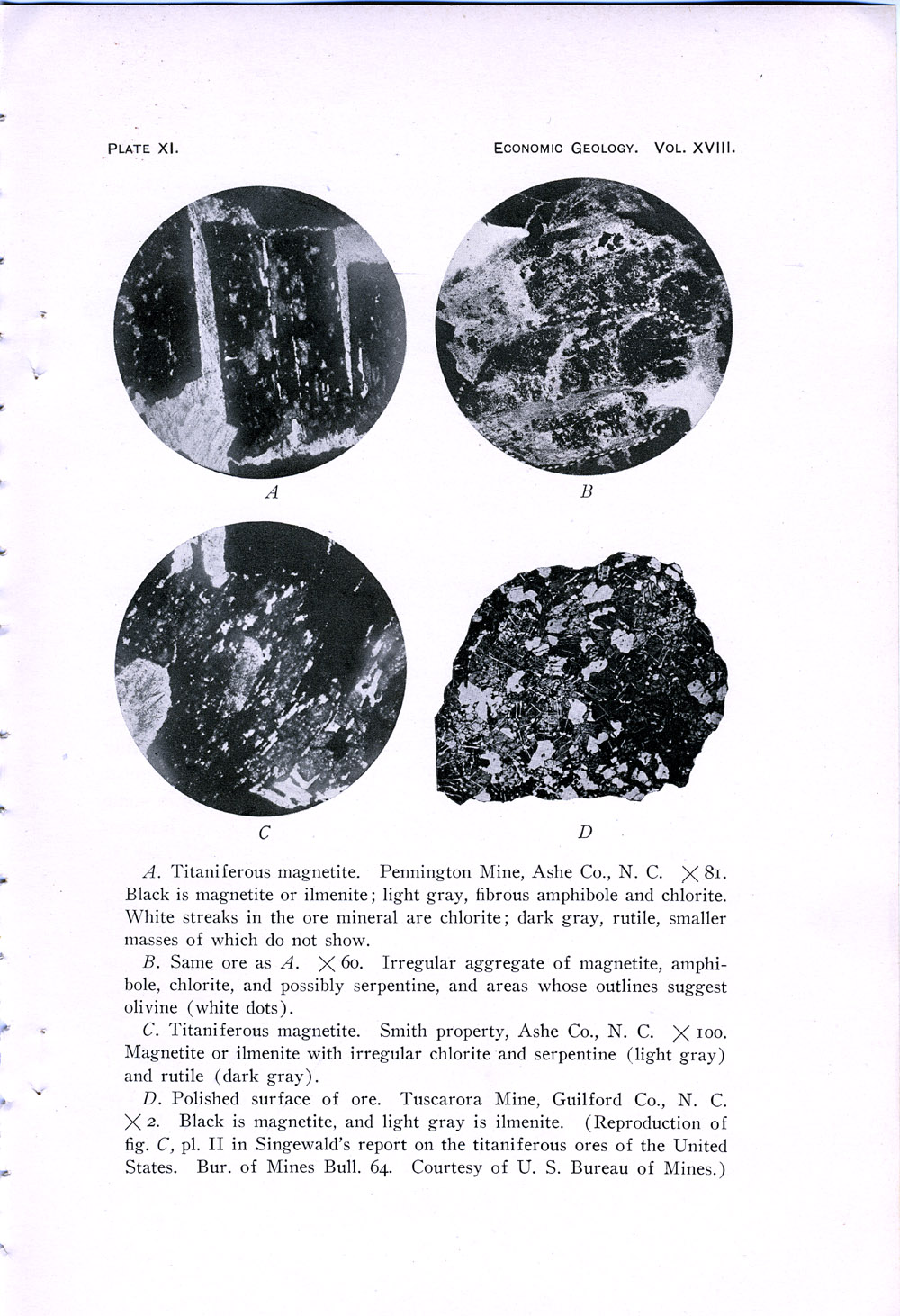
rutile has been found in abundance. It is not in minute needles, nor
in definite grains uniformly distributed through magnetite or
ilmenite, but is for the most part in broad yellowish-brown
translucent masses which in some cases are wider than the opaque
magnetite or ilmenite between them. (Plate XI, A. C.) In the
Tuscarora ore, however, it appears to exist in part as crystals
imbedded in magnetite.
8Warren, C. H., "The
Ilmenite Rocks near St. Urbain, Quebec; a New Occurrence of Rutile
and Sapphirine," Amer. Jour. Sci., 4th ser., vol. 33, pp.
263— 277, 1912. |
 |
||||||||||||||||||||||||||||||||||||||||||||||||||||||||||||||||||||||||||||||||||||||||
| page 385 | occu385.jpg | RUTILE IN NORTH
CAROLINA AND TENNESSEE. 385
there is now left only a narrow layer of the opaque mineral
between neighboring layers of the brownish rutile. That the opaque
mineral is magnetite rather than ilmenite is indicated by the strong
magnetism of the ore. Of course, it is possible that the material of
the ore grains was once an intergrowth of magnetite and ilmenite and
that the present interlayering of magnetite and rutile is the result
of some sort of metamorphism of the ilmenite.11
11
Compare Warren's comments on the intergrowths of ilmenite and
hematite in the St. Urbain ilmenites: Amer. Jour. Sci., 4th ser.,
vol. 33, pp. 266-7, 1912. 26 |
 |
||||||||||||||||||||||||||||||||||||||||||||||||||||||||||||||||||||||||||||||||||||||||
| page 386 | occu386.jpg | 386
W. S. BAYLEY.
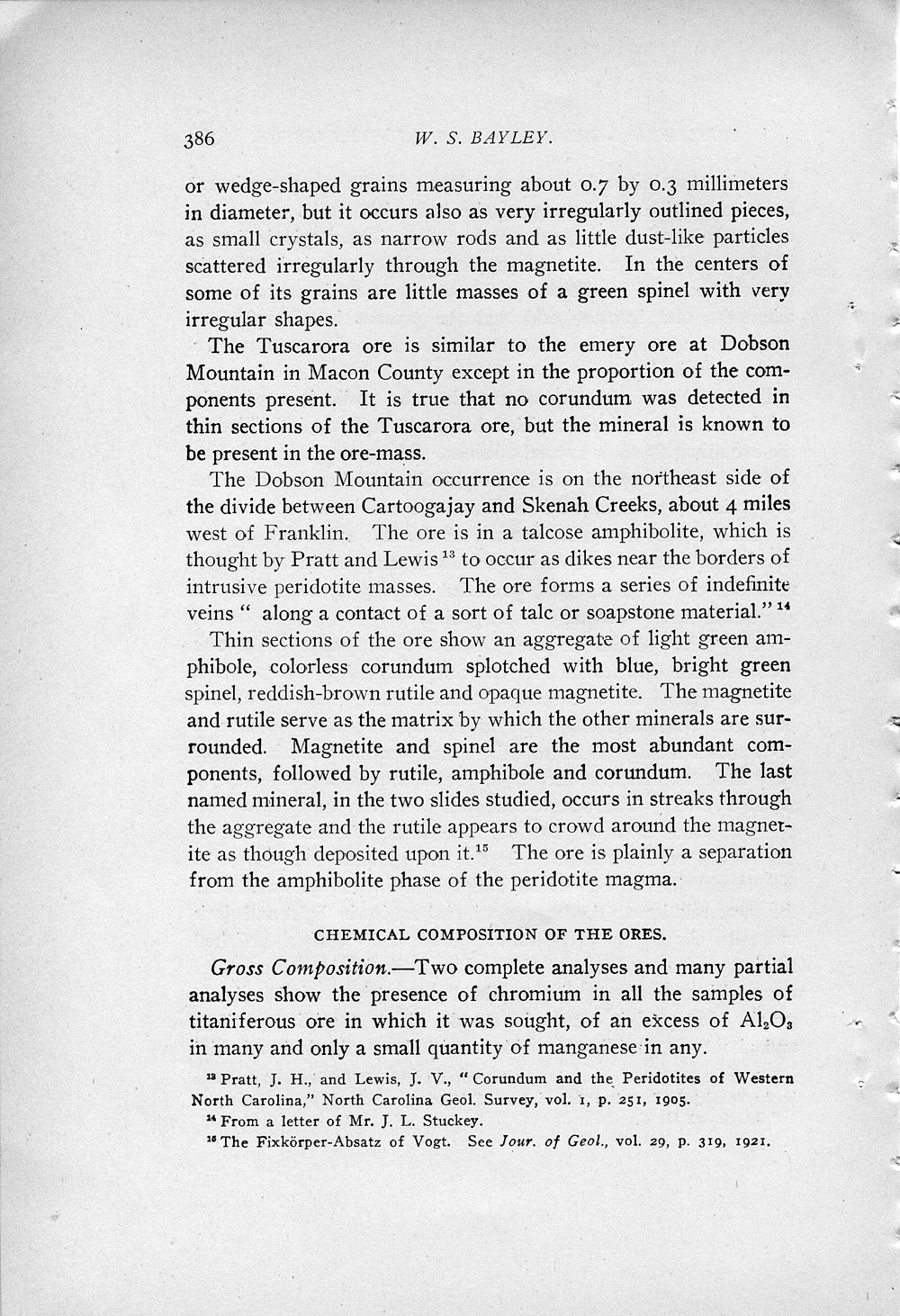
or wedge-shaped grains measuring about 0.7 by 0.3 millimeters in
diameter, but it occurs also as very irregularly outlined pieces, as
small crystals, as narrow rods and as little dust-like particles
scattered irregularly through the magnetite. In the centers of some
of its grains are little masses of a green spinel with very
irregular shapes. CHEMICAL COMPOSITION OF THE ORES. Gross Composition.—Two complete analyses and many partial
analyses show the presence of chromium in all the samples of
titaniferous ore in which it was sought, of an excess of A12O3
in many and only a small quantity of manganese in any. |
 |
||||||||||||||||||||||||||||||||||||||||||||||||||||||||||||||||||||||||||||||||||||||||
| page 387 | occu387.jpg |
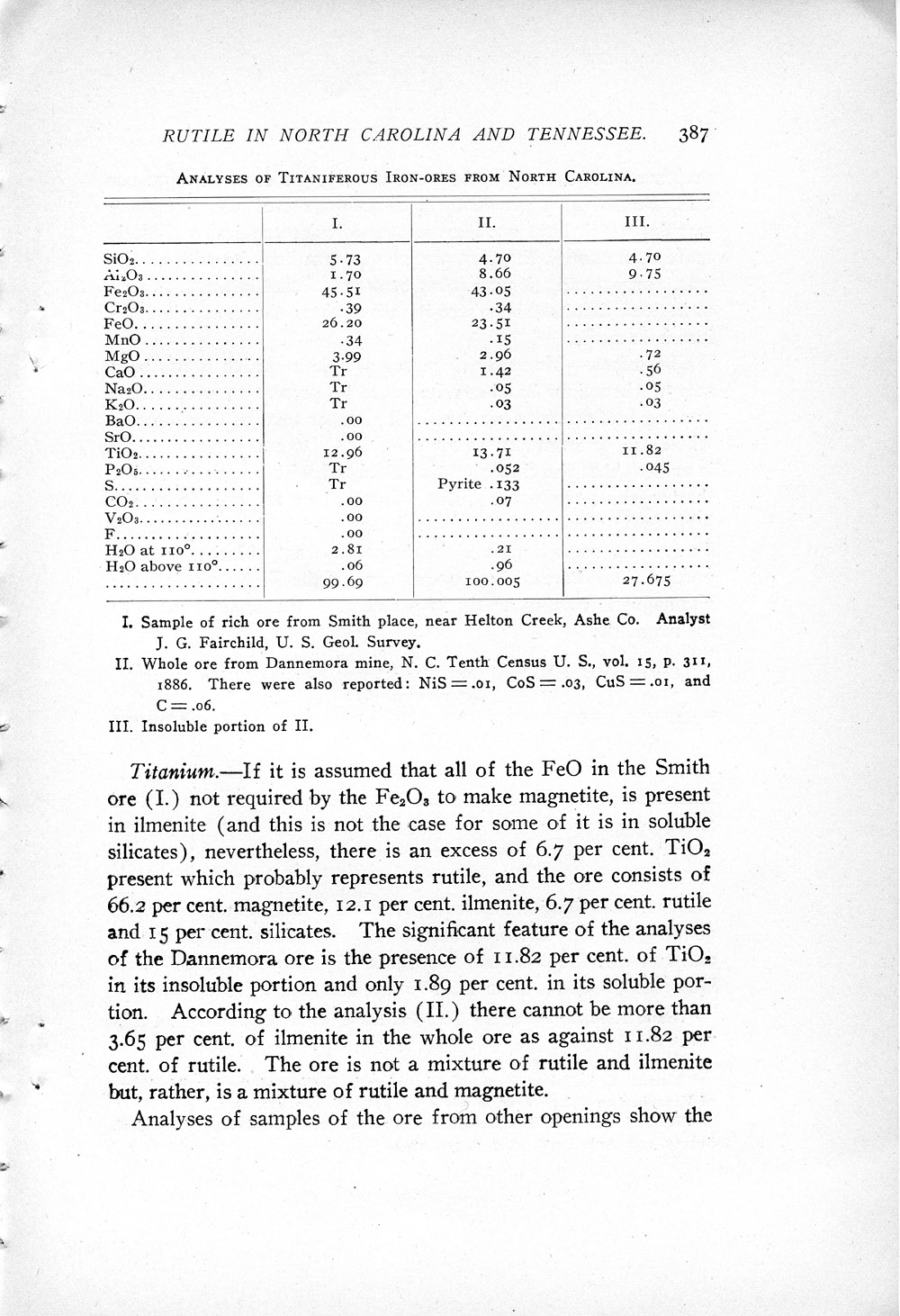
RUTILE IN NORTH CAROLINA AND TENNESSEE. 387 ANALYSES OF TITANIFEROUS IRON-ORES FROM NORTH CAROLINA.
I. Sample of rich
ore from Smith place, near Helton Creek, Ashe Co. Analyst II. Whole ore from
Dannemora mine, N. C. Tenth Census U. S., vol. 15, p. 311, 1886.
There were III. Insoluble portion of II.
Titanium.—If it is assumed that all of the FeO in the Smith ore ( I.) not required by the Fe2O3 to make magnetite, is present in ilmenite (and this is not the case for some of it is in soluble silicates), nevertheless, there is an excess of 6.7 per cent. TiO2 present which probably represents rutile, and the ore consists of 66.2 per cent. magnetite, 12.1 per cent. ilmenite, 6.7 per cent. rutile and 15 per cent. silicates. The significant feature of the analyses of the Dannemora ore is the presence of 11.82 per cent. of TiO2 in its insoluble portion and only 1.89 per cent. in its soluble portion. According to the analysis (II.) there cannot be more than 3.65 per cent. of ilmenite in the whole ore as against 11.82 per cent. of rutile. The ore is not a mixture of rutile and ilmenite but, rather, is a mixture of rutile and magnetite. Analyses of samples of the ore from other openings show the |
 |
||||||||||||||||||||||||||||||||||||||||||||||||||||||||||||||||||||||||||||||||||||||||
| page 388 | occu388.jpg |
388 W. S. BAYLEY. presence of TiO2 varying between about 4 per cent. Ti
to 96 per cent. Fe and 47.5 per cent. Ti to 52.5 per cent. Fe. In
some samples which have not been examined microscopically, there is
more than enough titanium present to form ilmenite with all the
iron, consequently, it may fairly be assumed that in these, as well
as in those that have been seen in thin sections, the excess of
titanium is in rutile.
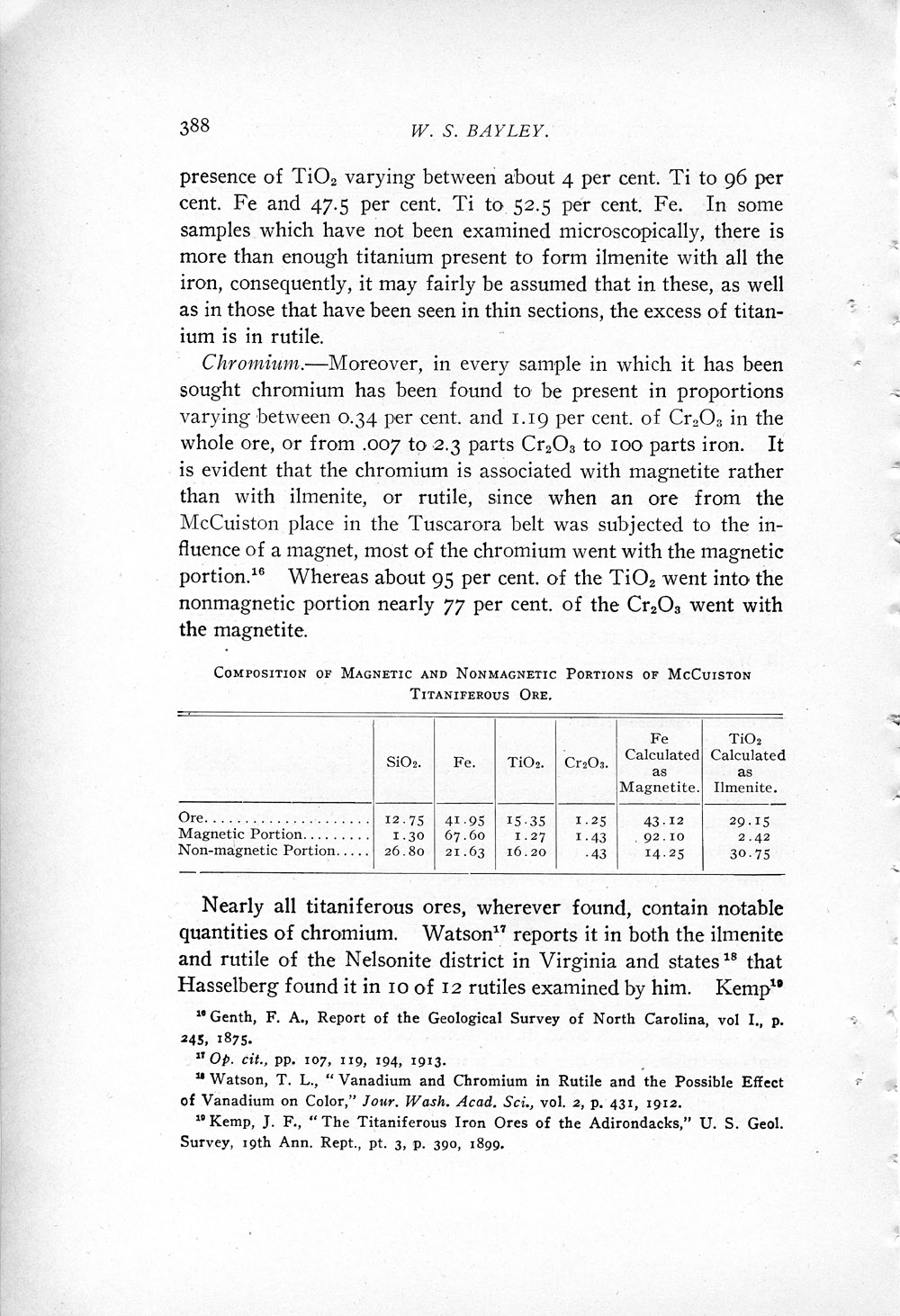
COMPOSITION OF MAGNETIC AND NONMAGNETIC PORTIONS OF
McCUISTON TlTANIFEROUS ORE.
Nearly all titaniferous ores, wherever found, contain notable quantities of chromium. Watson17 reports it in both the ilmenite and rutile of the Nelsonite district in Virginia and states18 that Hasselberg found it in 10 of 12 rutiles examined by him. Kemp19 16 Genth, F. A., Report of the Geological Survey of North Carolina, vol I., p. 245, 1875. 17 Op. cit., pp. 107, 119, 194, 1913. 18 Watson, T. L., " Vanadium and Chromium in Rutile and the Possible Effect of Vanadium on Color," Jour. Wash. Acad. Sci., vol. 2, p. 431, 1912. 19 Kemp, J. F., "The Titaniferous Iron Ores of the Adirondacks," U. S. Geol. Survey, 19th Ann. Rept., pt. 3, p. 390, 1899. |
 |
||||||||||||||||||||||||||||||||||||||||||||||||||||||||||||||||||||||||||||||||||||||||
| page 389 | occu389.jpg |
RUTILE IN NORTH CAROLINA AND TENNESSEE.
389
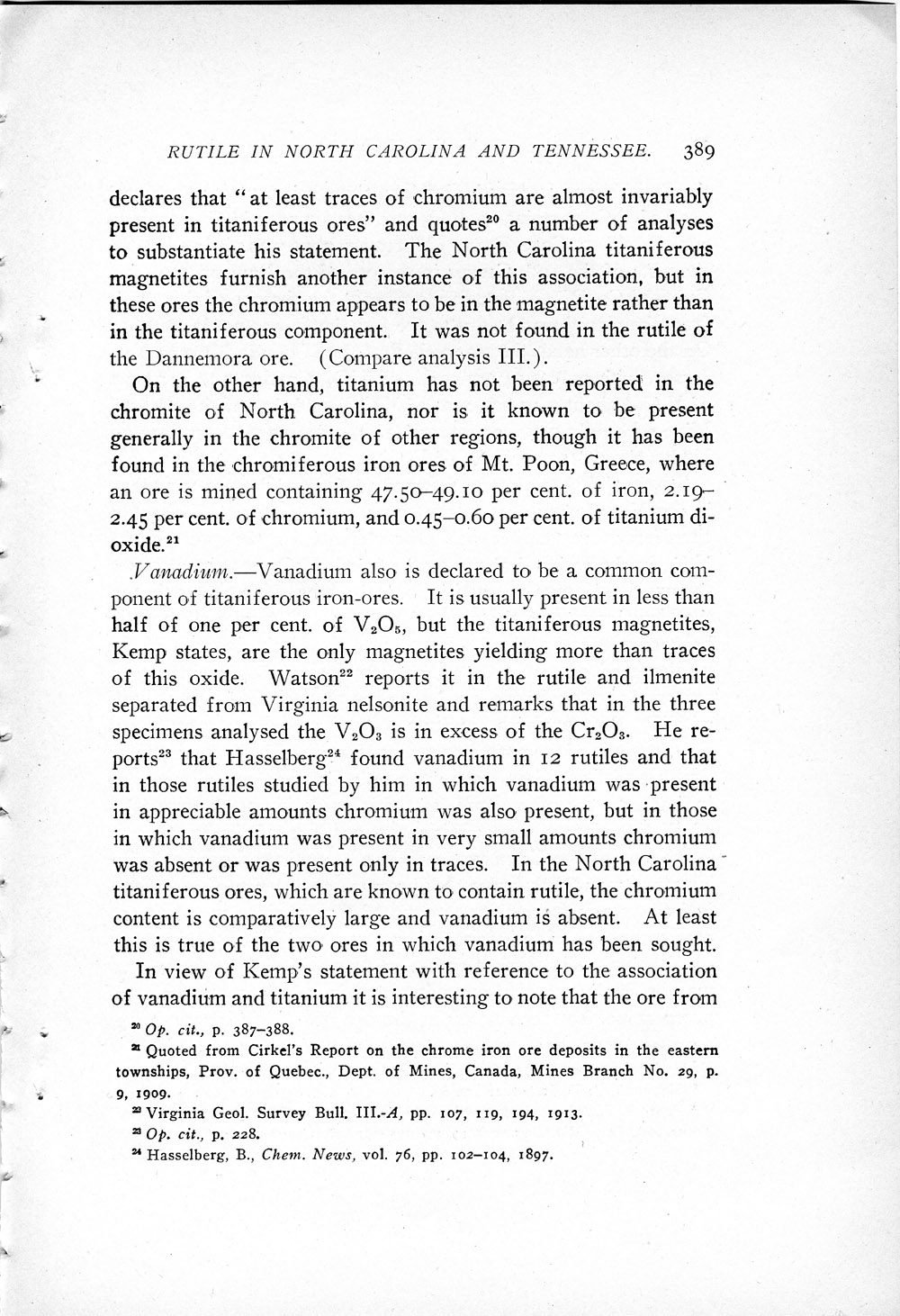
declares that " at least traces of chromium are almost invariably
present in titaniferous ores" and quotes20 a number of
analyses to substantiate his statement. The North Carolina
titaniferous magnetites furnish another instance of this
association, but in these ores the chromium appears to be in the
magnetite rather than in the titaniferous component. It was not
found in the rutile of the Dannemora ore. (Compare analysis III.) 20 Op. cit., p. 387-388. 21 Quoted from Cirkel's Report on the chrome iron ore deposits in the eastern townships, Prov. of Quebec., Dept. of Mines, Canada, Mines Branch No. 29, p. 9, 1909. 22 Virginia Geol. Survey Bull. III.-A, pp. 107, 119, 194, 1913. 23 Op. cit., p. 228. 24 Hasselberg, B., Chem. News, vol. 76, pp. 102-104, 1897. |
 |
||||||||||||||||||||||||||||||||||||||||||||||||||||||||||||||||||||||||||||||||||||||||
| page 390 | occu390.jpg |
390 W. S. BAYLEY. the Smith place, in North Carolina, though it contains 12.96 per
cent. of TiO2 contains no V2O5 and
there is none in the titaniferous ore of Lost Cove, Tenn. Moreover,
none was reported by the chemists of the l0th Census in the ore of
the Dannemora Mine, Guilford Co., N. C., though in this case the
absence of this oxide from the record may be due to the fact that it
was not looked for. On the other hand, the magnetite25
of the Hibernia Mine in New Jersey, with only 0.54 per cent. of TiO2
contains 0.14 per cent. of V2O3 (about 0.17
per cent. of V2O5), and that of the Richard
Mine with only 0.30 per cent. of TiO2 contains 0.11 per
cent. of V2O3 (about 0.13 per cent. of V2O5).
25 Bayley, W.
S., " Iron Mines and Mining in New Jersey," Geol. Survey of N. J.
Final Report Series of the State Geologist, vol. 7, pp. 112—113,
1910. |
 |
||||||||||||||||||||||||||||||||||||||||||||||||||||||||||||||||||||||||||||||||||||||||
| page 391 | occu391.jpg |
RUTILE IN NORTH
CAROLINA AND TENNESSEE. 391
and both spinel and corundum in the titaniferous emery of Dobson Mountain. Moreover, corundum is known to occur in many of the titaniferous ore-bodies at various points on the Piedmont Plateau in North Carolina. The analysis of the insoluble residue of the Dannemora ore indicates its presence in this ore. OCCURRENCE AND ORIGIN OF THE ORES.28 All the titaniferous ores in North Carolina and Eastern Tennessee that have been studied occur as vein-like bodies associated with peridotites, olivine gabbros or talcose and serpentinous schists. In this respect they are very different from the non-titaniferous magnetites in the same district, which are always associated with pegmatite. At Senia P. O., which is at the mouth of Roaring Creek in Avery County, N C, the ore is in a series of small veins in websterite. At the Smith place, in Ashe County, the ore particles are in a weakly polarizing material in elliptical areas outlined by magnetite dust (Pl.XI B). This material under high powers is found to be composed of a light green, fibrous, chloride mass containing minute spicules of a brightly doubly refracting mineral and particles of magnetite or tiny grains of rutile. If the streaks of magnetite dust that surround the elliptical areas mark the boundaries of some mineral that has disappeared, it is probable that this mineral was olivine, as the boundaries are like those of cross-sections of olivine. Other sections reveal a mass of fibrous minerals among which may be recognized actinolite, epidote and chlorite and a large quantity of a very finely fibrous material that is probably serpentine, forming a felt in which the other fibrous components and the ore grains are imbedded. In some places are curved lines of magnetite particles surrounding portions of the felt in a way that may mark the outlines of what were originally olivine crystals. The titaniferous ores of other deposits in Ashe Co. are of the same general character as at the Smith place. They consist of ore particles in a fibrous aggregate that may have been derived from olivinitic rocks. At the Tus- 28 For a more detailed discussion of the origin of the titaniferous ores see: U. S. Geol. Survey Bull. 735-G, pp. 260—261, 1922. |
 |
||||||||||||||||||||||||||||||||||||||||||||||||||||||||||||||||||||||||||||||||||||||||
| page 392 | occu392.jpg | 392
W. S. BAYLEY.
carora Mine the rock immediately associated with the ore is an
olivine gabbro. UNIVERSITY OF ILLINOIS, 29 Pratt, J. H., and Lewis, J. V.,
North Carolina Geol. Survey, vol. i, pp. 369-384, 1905. |
 |
||||||||||||||||||||||||||||||||||||||||||||||||||||||||||||||||||||||||||||||||||||||||
| plate XI | occuplatex1.jpg |
 |
|