

|
Suggestions for Burning Fuel
Economically and Smokelessly |
|
|
|
| Title | Suggestions for Burning Fuel Economically and Smokelessly in Small Domestic Furnaces and Boilers, City of Asheville, NC. |
| Identifier | http://toto.lib.unca.edu/findingaids/books/booklets/suggestions_burning_fuel/default_suggestions_burning_fuel.htm |
| Creator | City of Asheville, NC |
| Subject Keyword | Asheville, NC ; gas ; furnaces ; boilers ; heating ; pollution ; fuels ; economy ; |
| Subject LCSH | Asheville (N.C.) Buncombe County (N.C.) Appalachian Region, Southern -- Cities |
| Date original | 1891 |
| Date digital | 2007-03-13 |
| Publisher | Franklin, N.C. : Franklin Press Print, 1891 |
| Contributor |
|
| Type | Source type: text |
| Format | [digital] image/jpeg/text ; [booklet] 15 pages ; 22 cm. ; printed in two columns |
| Source | uncatalogued |
| Language | English |
| Relation | Is part of: Frank Cox Collection |
| Coverage temporal | 1891 |
| Coverage spatial | Asheville, NC |
| Rights | Any display, publication or public use
must credit D. H. Ramsey Library, Special Collections, University of
North Carolina at Asheville. Copyright retained by the authors of certain items in the collection, or their descendants, as stipulated by United States copyright law. |
| Donor | n/a |
| Description | A booklet promoting the use of gas burning furnaces. Produced by the city of Asheville. |
| Acquisition | n.d. |
| Citation | Suggestions for Burning Fuel Economically and Smokelessly in Small Domestic Furnaces and Boilers, City of Asheville, NC, D. H. Ramsey Library, Special Collections, University of North Carolina at Asheville 28804 |
| Processed by | Special Collections staff, 2007 |
| Last update | 2007-03-13 |
| Page | Image | Description | Thumbnail |
| page 1 | sugg001 |
Suggestions For "Burning Fuel Economically and Smokelessly in Small Domestic Furnaces and Boilers ClTY OF ASHEVILLE North Carolina |
 |
| page 2 | sugg002 |
SUGGESTIONS
FOR BURNING FUEL ECONOMICALLY
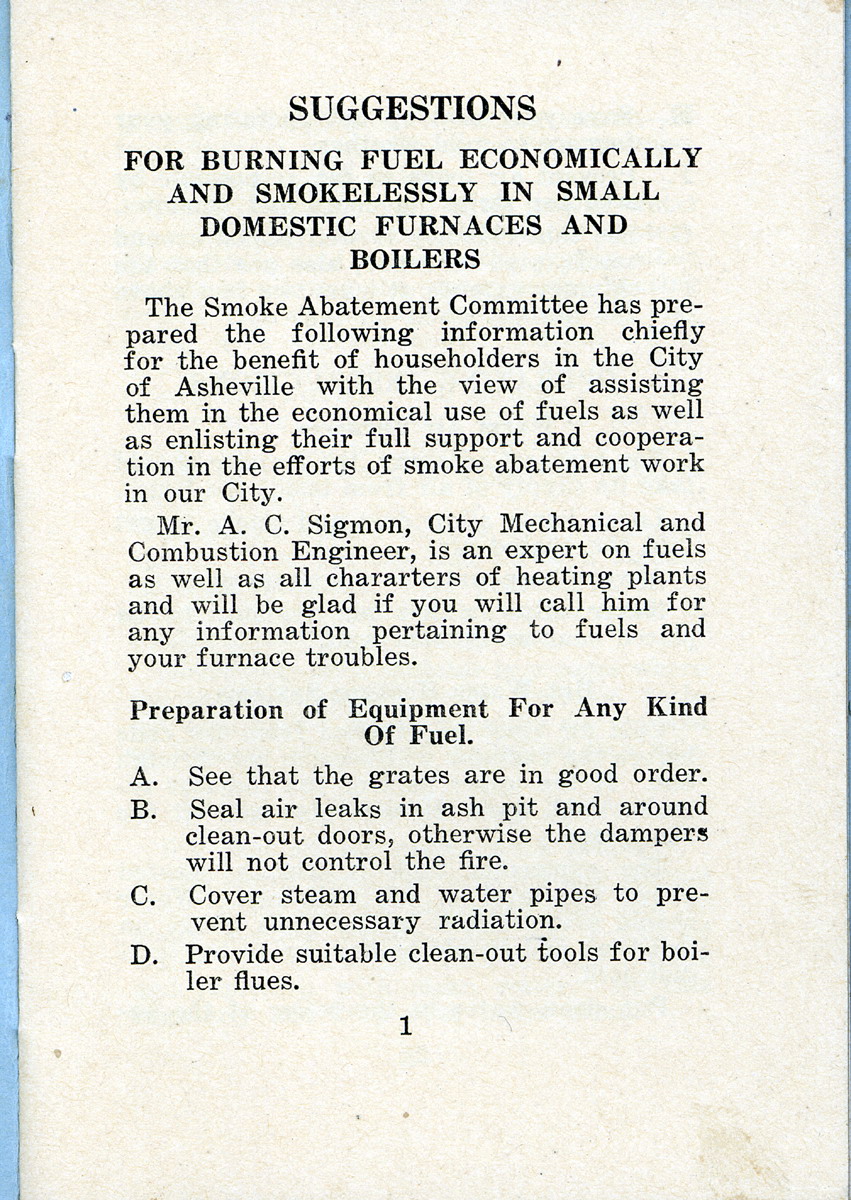
DOMESTIC FURNACES AND The Smoke Abatement Committee has prepared the following information chiefly for the benefit of householders in the City of Asheville with the view of assisting them in the economical use of fuels as well as enlisting their full support and cooperation in the efforts of smoke abatement work in our City. Mr. A. C. Sigmon, City Mechanical and Combustion Engineer, is an expert on fuels as well as all chararters of heating plants and will be glad if you will call him for any information pertaining to fuels and your furnace troubles. Preparation of Equipment For Any Kind Of Fuel. A. See that the grates are in good order. B. Seal air leaks in ash pit and around clean out doors, otherwise the dampers will not control the fire. C. Cover steam and water pipes to prevent unnecessary radiation. D. Provide suitable clean-out fools for boiler flues. |
 |
| page 3 | sugg003 |
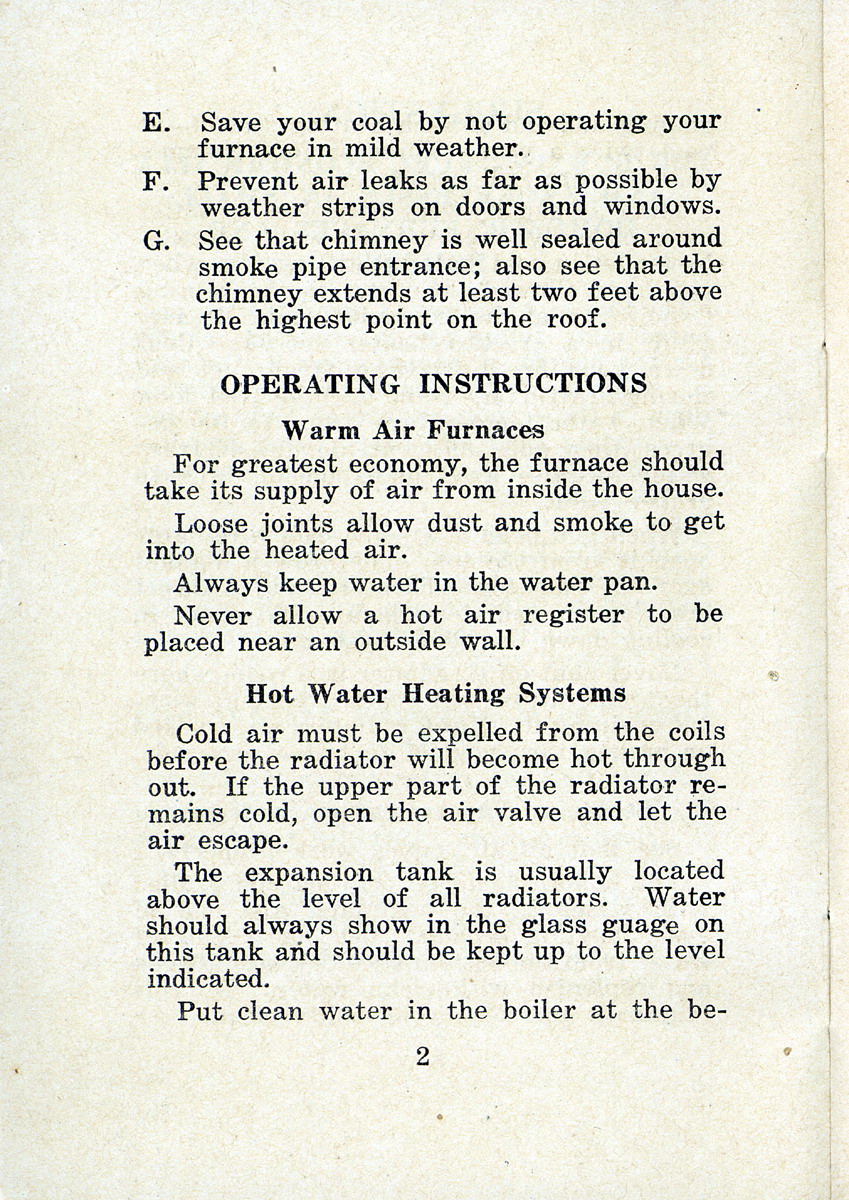
E. Save your coal by not operating your furnace in mild weather. F. Prevent air leaks as far as possible by weather strips on doors and windows. G. See that chimney is well sealed around smoke pipe entrance; also see that the chimney extends at least two feet above the highest point on the roof. OPERATING INSTRUCTIONS Warm Air Furnaces
For greatest economy, the furnace should take its supply of air from inside the house. Loose joints allow dust and smoke to get into the heated air. Always keep water in the water pan. Never allow a hot air register to be placed near an outside wall. Hot Water Heating Systems Cold air must be expelled from the coils before the radiator will become hot through out. If the upper part of the radiator remains cold, open the air valve and let the air escape. The expansion tank is usually located above the level of all radiators. Water should always show in the glass guage on this tank arid should be kept up to the level indicated. Put clean water in the boiler at the be- |
 |
| page 4 | sugg004 |
ginning and end of each heating season—at least twice a year. Three or four changes of water are still better. There is usually very little loss of water in a properly operated hot-water system. Never let in cold water to the system when you have allowed the water in the heating to boil over at the expansion tank. It may result in a cracked heater section. Cool down your fire by adding fresh fuel and closing draft damper and opening feed door. When water temperature drops to 100 degrees, then add sufficient amount of fresh water to raise level in expansion tank to proper point. When you open a window over a radiator open it from the top, and throw a blanket over the radiator. This prevents a direct draft on the radiator which would result in cooling down the whole system. Never shut off a radiator in a room where the temperature will reach freezing, without draining it. Many radiators are cracked or broken thru neglect to follow this rule.
See that all air valves work properly. The boiler should be emptied and refilled with water at the beginning and end of every heating season. Let out a pail of water from the bottom once or twice a week and replenish with clean water. Do this regularly and keep your boiler clean |
 |
| page 5 | sugg005 |
Whenever you fix the fire, note the glass water gauge. Turn the exhaust cocks above and below gauge occasionally to make certain there is a free passage from boiler to gauge. Keep the gauge half full of water. Half the space is needed for steam. If the water is not kept to the half-way level, injury may result to the boiler. When you open a window over a radiator open it from the top, and throw a blanket over the radiator. This prevents a direct draft on the radiator which would result in cooling down the whole system. Never shut off a radiator in a room where the temperature will reach freezing, without draining it. Many radiators are cracked or broken thru neglect to follow this rule. What Fuel To Burn It is here recommended by the Smoke Abatement Committee that— With poor draft conditions—coke be used about the size of a walnut. With good draft conditions—Pocahontas or New River coal be used; or in other words a fuel having less than twenty per cent volatile matter (smoke) in it. These recommendations are made as we have found through experience that the domestic furnace or boiler is not designed to burn the smoke contained in the high |
 |
| page 6 | sugg006 |
volatile soft coal and by the use of this soft coal in such furnaces and boilers there is an absolute waste of money to say nothing of the damage to household furnishings and the neighborhood at large. SEMI-BITUMINOUS (SMOKELESS) COALS A. The semi-bituminous coals, embracing the "smokeless" Pocahontes, New River and George Creek coals of Virginia and Maryland, are probably the best adapted of any coal for use in hot air furnaces or boilers. If properly fired and draft properly regulated, these coals can be burned without smoke and will deposit very little soot in the furnace or chimney. These "smokeless" coals are available at practically all coal dealers. They are higher in heat value than hard coal and as a general rule can be bought considerably cheaper. Because of the higher heat value, if sold at two-thirds the price of hard coal, the purchaser actually gets almost twice the amount of heat for his money. With proper care in operating his furnace, he can realize this entire amount of savings, but even with careless handling considerable savings will result. Also, because of the available heat in this type of coal, the purchaser can afford to pay at least one fourth more for Pocahontas, New River or George Creek coals than for soft coal. The mine run grade of the semi-bitumi- |
 |
| page 7 | sugg007 |
nous coals can be used without any difficulty in the ordinary hot air furnace or boiler because of the fact that when the slack is thrown on the fire, it will in a very few minutes coke together and form one large lump. This, you will see, is a good feature for the reason that the slack will not sift through the grates and be lost to the ash pit. 'Ordinary soft coal is composed almost one-third of tarry substance. Hence, it is a smoky coal. Semi-bituminous coal (Po-cahontus, New River, etc.) have less than one-half this amount of tar and are less than one-half as smoky. B. How to Start A Fire With Pacahontus, New River, Or George Greek Coals. 1. Clean grate and ash pit thoroughly. 2. Close check draft in smoke pipe and open draft door for fuel draft. 3. Cover grate with paper and kindling. 4. Light fire and add small lumps of coal to a depth of about six inches. C. Adding A Fresh Charge Of Pocahontus, New River, Etc. 1. Shake grates lightly until red coals fall thru. |
 |
| page 8 | sugg008 |
2. Punch several holes thru top of fire bed. 3. Add sufficient coal to make depth of fuel on grates between eight and twelve inches. 4. Keep all holes covered in fire bed. D. Preparing The Fire For The Night With Pocahontus, New River And Georges Creek Coals. 1. Cover grates to a depth of about twelve inches. 2. Cover fire bed with a thin layer fine ash. 3. Close draft damper and open check damper. E. Care Of The Fire In The Morning. 1. Close check damper, open draft damper. 2. Shake grates slightly until red coals fall thru. 3. Punch several holes thru top of fire bed. 4. Add sufficient coal to make a depth of fuel on grates between eight and twelve inches. 5. Keep all holes covered in the fire bed. |
 |
| page 9 | sugg009 |
Coke A. Coke is the residue which is left when the gas, volatiles, tars, and smoke making ingredients of soft coal are removed at the gas works, or coke oven. The only reason coke is not more widely used, is because it is not known, people have not tried it; for, having tried it, they would never return to the use of soft coal. In Asheville, in particular, coke can be obtained at the same or cheaper price than any good grade of lump coal. The factors of elimination of smoke, dust, soot, etc. when using coke, are of such great importance to the average housewife, that once having used coke, seldom, if ever, is a return made to the use of soft coal. About seven and one-half tons of coke will deliver as much heat into the house as ten tons of soft coal. B. How To Start A Fire With Coke 1. Open all dampers for draft and close check dampers. 2. Use paper and kindling to start fire. 3. When kindling is well ignited, cover with a layer of coke about six inches thick. 4. After coke is burning nicely, add sufficient coke to make thickness of fire bed fourteen to eighteen inches. 5. Check draft and allow coke to burn slowly |
 |
| page 10 | sugg010 |
C. Adding Fresh Charge Of Coke. 1. Do not disturb dampers. 2. In very severe weather the grate should be shaken a little before each firing, leaving a thin layer of ash on top of grates. 3. Add sufficient coke to keep level of fire bed between fourteen and eighteen inches. D. Banking The Fire At Night With Coke 1. Fill fire bed with coke, covering with a layer of fine coke and packing down firmly. 2. Close ash pit door and open check damper in smoke pipe. 3. If ash pit does not fit tightly, in order to keep fire over night, open the damper in the firing door slightly. E. Care Of The Fire In The Morning 1. Level the fire with a poker, stir-ing it so as to shake some ashes down into the ash pit. 2. Add a six inch layer of coke, open damper in ash pit, close check damper in smoke pipe and also close damper in firing door. 3. After coke is well ignited a heavy firing can be put in to last the greater part of the day. |
 |
| page 11 | sugg011 |
4. If there is an excessive amount of ash or clinker on the grates the grates can be shaken and and the clinker removed thru the fire door before putting in the heavy firing. DOMESTIC FUEL CONSUMPTION A recent survey shows that the residential sections use more than half of the fuel consumed in Asheville per year and it is therefore very necessary that the residential sections eliminate their smoke thru the use of low volatile coals and coke. Let us work together to make this a greater, cleaner, healthier, and more beautiful Asheville. A. H. MALONE, Chairman,
SMOKE ABATEMENT COMMITTEE |